
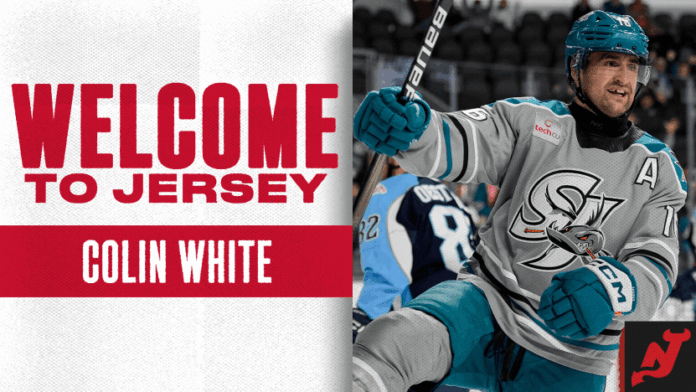

Colin White has already tasted the Stanley Cup Final. Now he’s chasing a roster spot in New Jersey on a two-way contract, and honestly, that tells you almost everything you need to know about where his career sits right now, and where the Devils think it could still go.
New Jersey signed the 29-year-old forward to a one-year, two-way deal worth $900,000 at the NHL level and $400,000 in the AHL, another move stamped with the dual signatures of general manager Sunny Mehta and assistant GM Braden Birch, who doubles as the Utica Comets’ GM. That pairing keeps showing up on these announcements, and it’s not an accident. It signals a front office that’s treating its AHL pipeline as genuinely connected tissue to the NHL roster rather than a separate operation running on its own track.
White’s résumé is the kind that makes scouts lean forward and casual fans squint at the box score before understanding why. He spent the last two seasons in the San Jose organization, and last year specifically, he tore up the AHL with the San Jose Barracuda, putting up 48 points on 21 goals and 27 assists across 46 regular season games. Every one of those numbers, goals, assists, total points, represented a career high for a single AHL season. Rank him against his own teammates and he finished second on the entire Barracuda roster in scoring. That’s not a fringe minor leaguer padding stats against weak competition. That’s a legitimate offensive threat who, for whatever reason, hasn’t found a permanent NHL home to match that production.
Here’s where the story gets more complicated, and more interesting. San Jose originally signed White in January of 2025, and he got exactly three NHL games with the club that season. Three. Meanwhile he was posting 25 points in 48 AHL games that same year, including a career-best three shorthanded goals, second on the team in that specific category. When a player’s underlying AHL numbers keep climbing while his NHL opportunities stay this scarce, something in the equation isn’t matching up, whether that’s organizational depth ahead of him, system fit, or simple bad timing. I don’t pretend to know exactly which explanation applies here, and I’d be lying if I said the answer was obvious from box scores alone.
What isn’t in question is the NHL pedigree White’s actually built over a genuinely long career. He’s appeared in 323 career NHL regular season games, dating back to his debut with Ottawa on April 3, 2017, against Detroit. Ottawa drafted him 21st overall back in 2015, and he stuck around the organization through the 2021-22 season before a stint in Florida the following year, where he actually got real playoff minutes, 21 postseason games during the Panthers’ run all the way to the 2022-23 Stanley Cup Final. That’s meaningful. Playing significant minutes on a Cup Final roster isn’t a participation trophy, it’s proof a player can hold up when games matter most. After Florida, White split time between Pittsburgh and Montreal in 2023-24 before landing in San Jose. His best individual NHL season came early, back in 2018-19 with Ottawa, when he posted 14 goals and 27 assists for 41 points, numbers that still represent his career ceiling at the highest level.
Go back further and the pattern of real, sustained achievement only gets clearer. Born in Hanover, Massachusetts, White spent two seasons in the USA Hockey National Team Development Program before landing at Boston College, where he racked up 76 points across 72 games and finished top three in team scoring in both his seasons there. He won Hockey East Rookie of the Year in 2016 and made the conference’s Second All-Star Team that same season. His international résumé is arguably even more impressive. He represented the United States at three separate U-18 and U-20 World Junior Championships, and at the 2014-15 U-18 tournament, he scored the actual game-winning goal in the Gold Medal round against Finland. He added a Bronze at the 2015-16 WJC, another Gold at the 2016-17 WJC, and later a Bronze at the 2017-18 World Championship. That’s a player who’s won at every single level he’s ever competed at, except, so far, at the very top of the NHL on a consistent basis.
That’s precisely the kind of profile worth taking a low-risk flyer on, and I’d argue this signing is exactly the right kind of bet for where the Devils currently sit. A two-way, one-year deal at under a million dollars carries almost no downside. If White’s AHL scoring translates even partially into a bottom-six NHL role, New Jersey gets a proven, well-traveled forward on a bargain contract. If it doesn’t work out, the team’s out a modest AHL salary and nothing more. Compare that risk profile to what other clubs are paying for depth forwards on the open market right now, and this move looks like disciplined asset management rather than a desperate reach.
It’s also worth zooming out, because White’s signing didn’t happen in isolation. New Jersey’s had an active offseason across the board. On the outside additions side, the Devils brought in forward Anthony Mantha on a two-year deal worth $9.5 million, added forward Riley Tufte on a one-year, $850,000 contract, signed defenseman Vladislav Kolyachonok to a similar one-year, $850,000 deal, and brought in goaltender David Rittich on a one-year, $1 million contract. White’s the most recent name added to that external list. Internally, the club has been busy locking down its own core and depth pieces too, re-signing forward Arseny Gritsyuk to a three-year deal at a $3.25 million average, extending captain-caliber center Nico Hischier for five years at $11.7 million annually, bringing back goaltender Nico Daws on a two-year, $1.1 million deal, and re-signing a handful of depth forwards including Marc McLaughlin, Xavier Parent, Amadeus Lombardi, and Ben Steeves, along with goaltender Jakub Malek. Add defenseman Topias Vilen’s recent restricted free agent re-signing to that pile, and it’s clear the front office spent this summer building out organizational depth methodically rather than chasing a single splashy move.
Not every offseason story ends with a jersey number, though, and it’s worth acknowledging the players New Jersey chose to let walk. Defenseman Calen Addison, goaltender Tyler Brennan, forward Dylan Wendt, and forward Paul Cotter, who signed with Vancouver, weren’t qualified as restricted free agents. On the unrestricted side, defenseman Dennis Cholowski landed with the Rangers, forward Brian Halonen signed in Boston, forward Zack MacEwen went to Toronto, defenseman Colton White signed with Columbus, and forward Ryan Schmelzer returned to Utica on an AHL deal for a sixth season there. A couple of names, forward Jonathan Gruden and forward Nathan Légaré, who signed overseas with Traktor Chelyabinsk in the KHL, round out the group heading elsewhere entirely.
Put the whole picture together and you get a franchise treating its NHL roster and AHL pipeline as one connected project rather than two separate departments. Colin White is a low-cost, potentially high-reward addition to that pipeline, a player with legitimate Stanley Cup Final experience and a scoring touch that’s never fully translated at the NHL level despite years of trying. Whether Utica or New Jersey ends up being the place that finally unlocks it remains to be seen. But for a nine-hundred-thousand-dollar bet, the Devils have very little to lose and a genuinely interesting reclamation story to gain.
















