

What began as a small bump on a young boy’s toe during a family vacation has evolved into one of the most inspiring and emotionally powerful pediatric cancer stories unfolding anywhere in New Jersey today. At just 10 years old, Summit native Chase Singer has already endured surgeries, hospital stays, amputations, scans, rehabilitation, uncertainty, and the emotional weight of battling one of the rarest forms of cancer doctors encounter in children. Yet instead of allowing the experience to define him through fear, Chase and his family have transformed that battle into something much larger: a statewide message about resilience, rare cancer awareness, pediatric research funding, and the extraordinary human impact of community-driven healthcare advocacy.
Today, Chase Singer is not simply a fifth grader recovering from cancer treatment. He has become a symbol of determination, courage, and emotional strength while helping raise more than $100,000 for rare cancer research through Memorial Sloan Kettering’s nationally recognized Cycle for Survival initiative. In the process, the Summit family has emerged as one of the most compelling examples of how personal crisis can evolve into public purpose, especially within New Jersey’s deeply interconnected healthcare and philanthropic communities.
For the Singer family, everything changed in 2024.
At the time, Chase was the definition of an active, energetic child deeply immersed in sports, particularly soccer and lacrosse. Like many kids growing up in suburban New Jersey, his life revolved around practices, teammates, games, school, family activities, and the nonstop energy that comes with childhood athletics. Nothing initially appeared alarming when Chase discovered what seemed like a small abnormality on his foot while the family was on vacation.
His parents, Sarah and Jason Singer, understandably assumed it might be something minor. Maybe a bug bite. Maybe swelling. Maybe an irritation caused by running or sports activity. But when the issue failed to improve, the family sought additional medical evaluation, a decision that would quickly send them into an entirely different reality.
The situation escalated rapidly.
After being referred to Memorial Sloan Kettering Cancer Center, doctors discovered that what initially appeared minor was actually a solid tumor. Eventually, physicians diagnosed Chase with clear cell sarcoma, an exceptionally rare and aggressive form of soft tissue cancer that typically affects tendons and connective tissue. The disease is extraordinarily uncommon in children, with only a few hundred documented cases reportedly diagnosed over the past decade.
For any family, hearing the word cancer attached to a child instantly changes life forever.
But what made Chase’s diagnosis even more emotionally difficult was the reality that clear cell sarcoma currently lacks consistently effective standard treatments like chemotherapy, radiation, or immunotherapy. Instead, doctors determined that surgery represented the best and most immediate option available.
That decision ultimately led to one of the most difficult chapters of Chase’s life.
He underwent the amputation of one of his toes, followed by tissue graft procedures, additional surgeries, rehabilitation, and an extended recovery process that fundamentally altered nearly every aspect of daily life for the family. For a child who had previously been competing athletically and living at full speed, the transition into hospital rooms, medical equipment, crutches, wheelchairs, walkers, and constant testing became emotionally and physically overwhelming.
Yet remarkably, the family says Chase never lost the personality that defines him.
Even throughout repeated scans, blood work, MRIs, PET scans, CT imaging, surgeries, and lengthy hospital visits, Chase reportedly maintained the humor, spirit, and emotional resilience that continue inspiring everyone around him. Sarah Singer has repeatedly emphasized that despite the brutal realities of cancer treatment, her son never allowed the disease to take away the core of who he is: a funny, sports-obsessed, energetic kid who still approaches life with optimism and personality intact.
That emotional resilience became especially important during the recovery process itself.
It reportedly took nearly six months before Chase was able to fully walk and run again following the surgeries and rehabilitation. The experience forced the family into an exhausting cycle of medical appointments, testing, recovery setbacks, emotional uncertainty, and the constant anxiety that accompanies rare cancer monitoring. Every few months still involves extensive scans and medical evaluations designed to watch for recurrence.
For many pediatric cancer families, that ongoing uncertainty becomes one of the most emotionally difficult aspects of survivorship itself.
Cancer does not simply disappear emotionally once surgeries end. The waiting remains. The scans remain. The fear remains. Families learn to live between appointments, hoping for clear results while simultaneously attempting to preserve normalcy for their children.
What appears to have helped anchor the Singer family throughout that process was the extraordinary level of emotional connection built with Chase’s medical team at Memorial Sloan Kettering.
Sarah Singer has spoken extensively about the impact pediatric oncologist Dr. Julia Glade Bender and orthopedic surgeon and surgical oncologist Dr. Daniel Prince have had not only medically, but emotionally, on the entire family. Their relationship with Chase reportedly extends far beyond standard clinical care. The doctors connected with him personally, communicating in ways a child could emotionally process while still preserving his confidence and sense of self throughout treatment.
That emotional bond matters enormously within pediatric medicine.
Children do not experience illness the same way adults do. Pediatric care requires not only technical expertise, but emotional intelligence capable of helping children navigate fear, confusion, pain, and uncertainty without stripping away childhood itself. By all accounts, Chase’s medical team succeeded in creating that balance.
And ultimately, that care inspired the family to fight back in another way.
During one of Chase’s hospital visits, the family noticed information connected to Cycle for Survival, Memorial Sloan Kettering’s nationally recognized rare cancer fundraising initiative partnered with Equinox. What started as curiosity quickly became mission-driven involvement after Chase reportedly decided he wanted to participate in order to help support his doctors and advance cancer research for families facing diseases like his own.
That decision transformed into something extraordinary.
Cycle for Survival has become one of the largest rare cancer fundraising movements in the country since its launch in 2007, generating more than $450 million for rare cancer research and clinical trials at Memorial Sloan Kettering. The initiative specifically targets rare cancers, which collectively account for roughly half of all cancer diagnoses yet historically receive significantly less research funding than more common forms of the disease.
The 2026 campaign alone generated approximately $38 million while involving more than 30,000 participants and roughly 155,000 donors nationwide. Importantly, organizers emphasize that 100 percent of every donation directly supports rare cancer research and clinical trial development.
For the Singer family, joining Cycle for Survival became deeply personal.
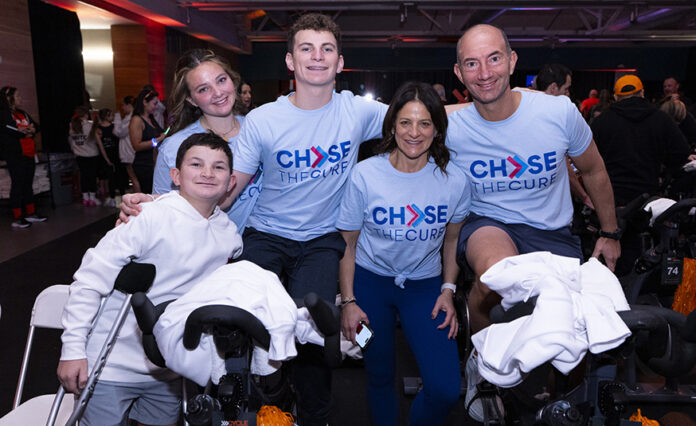
Under the team name “Chase the Cure,” the family participated in the Summit Equinox event in New Jersey this past March, joining more than 1,000 riders participating across over 100 bikes in support of rare cancer research. What followed quickly became one of the event’s standout fundraising stories.
Chase himself raised more than $100,000.
For a 10-year-old child still actively undergoing monitoring and recovery from rare cancer treatment, the accomplishment resonated far beyond fundraising numbers alone. It became a symbol of agency, hope, and emotional empowerment. Rather than remaining solely defined by illness, Chase positioned himself directly inside the fight for future medical advancement.
That emotional transformation appears central to the family’s entire perspective now.
The Singers frequently speak not only about surviving cancer, but about creating meaning from the experience itself. They openly acknowledge how underfunded pediatric and rare cancer research remains nationally, particularly for diseases as uncommon as clear cell sarcoma. For them, supporting research represents a direct investment into future possibilities that could dramatically improve quality of life for children like Chase.
Whether through improved diagnostic testing, blood-based detection methods, targeted immunotherapy, or less invasive treatments, the family views research funding as essential to changing outcomes for future patients.
Importantly, Chase himself appears deeply aware of that mission.
Rather than withdrawing emotionally after his diagnosis, he reportedly emerged from the experience with even greater determination and purpose. His mother says the experience taught him how to become “a fighter” and “be brave,” lessons that now shape not only how he approaches recovery, but how he views his future entirely.
In fact, Chase now says he hopes to become a doctor himself someday, specifically an oncologist at Memorial Sloan Kettering.
That aspiration alone speaks volumes about the impact compassionate pediatric care can have on young patients.
Even now, while still undergoing regular testing and scans every few months, Chase reportedly continues approaching life with remarkable optimism and perspective. His family says the experience fundamentally changed how they value everyday moments, teaching them not to take ordinary life for granted.
And perhaps that emotional perspective is ultimately what makes this story resonate so deeply throughout New Jersey’s healthcare, philanthropic, and community landscape.
At its core, this is not simply a story about illness. It is a story about resilience. About advocacy. About how one child’s fight against an unimaginably rare disease evolved into a movement helping fund hope for thousands of other families facing similar uncertainty.
In Summit and far beyond, Chase Singer has already accomplished something extraordinary.
He has turned fear into purpose, pain into advocacy, and personal struggle into outsized public impact.
And at only 10 years old, his story is just beginning.
















