

A major industrial site that has long stood at the center of environmental debates, public safety concerns, and economic opportunity in Camden is now facing one of the most significant challenges in its history.
Following a massive two-alarm fire that sent thick smoke across portions of the city and reignited years of community frustration, Camden officials have officially suspended the junkyard license for the EMR facility located near Front Street and Atlantic Avenue. The action forces the scrapyard to halt operations while local, county, and state officials evaluate what comes next for a site that has become one of the most closely watched industrial properties in New Jersey.
The decision represents far more than a response to a single fire.
Instead, it highlights a growing conflict that has unfolded for years between environmental advocates, neighborhood residents, public officials, workers, and industry representatives. At the center of the debate is a difficult question that communities across America increasingly face: how do cities balance environmental protection, public health, industrial activity, economic development, and employment opportunities when all of those interests collide in one location?
For Camden, that question has become impossible to ignore.
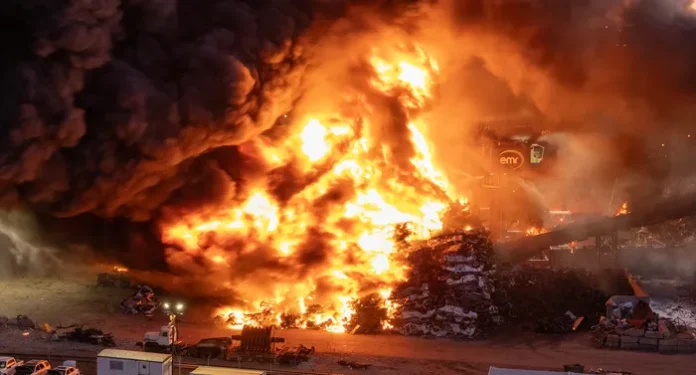
The most recent incident occurred on May 29, when a significant fire broke out at the metal recycling facility, generating large plumes of smoke visible throughout the region. Residents in nearby neighborhoods once again found themselves watching emergency crews battle flames while concerns about air quality and public safety quickly resurfaced.
Although firefighters successfully contained the blaze, the event triggered immediate scrutiny because it was not an isolated occurrence.
According to city officials, the facility has experienced at least fourteen fires between February 2020 and March 2026, creating a pattern that many residents and elected leaders argue can no longer be dismissed as occasional industrial accidents.
The frequency of these incidents has become one of the primary concerns driving calls for stronger oversight and regulatory intervention.
For many residents living near the facility, particularly within Camden’s Waterfront South neighborhood, the latest fire represented another chapter in a long-running struggle over environmental conditions and quality of life.
Community groups have spent years advocating for additional protections, arguing that repeated industrial incidents place an unfair burden on neighborhoods already surrounded by significant industrial infrastructure. Environmental organizations have similarly pushed for stronger enforcement measures, citing concerns about emissions, recurring fires, and the cumulative impact of industrial activity on nearby communities.
Those concerns have increasingly drawn the attention of state officials.
Earlier this year, the New Jersey Attorney General’s Office initiated legal action aimed at addressing operational and environmental issues associated with the facility. That lawsuit elevated what had largely been a local issue into a statewide discussion about industrial accountability, environmental justice, and regulatory authority.
The recent fire has only intensified those conversations.
Perhaps one of the most troubling aspects of the latest incident involves reports regarding fire suppression infrastructure.
The facility had reportedly invested millions of dollars into upgraded fire prevention and suppression systems designed specifically to reduce the risk of future incidents. According to officials reviewing the event, those systems did not perform as expected during the May fire, raising additional questions about safety measures, operational procedures, and long-term risk management.
For regulators and public officials, that development has become a critical part of the ongoing evaluation process.
Yet the situation is far more complicated than a simple regulatory dispute.
Behind the headlines, lawsuits, and policy debates are hundreds of workers whose livelihoods depend on the facility’s continued operation.
In the days following the city’s decision, more than one hundred employees gathered and marched to Camden City Hall, urging officials to consider the economic consequences of a prolonged shutdown.
Many of those workers emphasized that the facility provides opportunities that can be difficult to find elsewhere.
For a significant portion of the workforce, employment at the scrapyard has represented more than a paycheck. It has provided a pathway toward stability, workforce development, and second chances for individuals rebuilding their lives after incarceration or other personal challenges.
That reality has added a deeply human dimension to an already complex situation.
The debate surrounding EMR is not simply about environmental policy or industrial regulation. It is also about employment, economic mobility, workforce inclusion, and the role that industrial employers continue to play within urban communities.
For Camden officials, balancing those competing priorities has proven exceptionally difficult.
City leaders have acknowledged the seriousness of resident concerns while simultaneously recognizing the importance of preserving employment opportunities whenever possible. County and state officials have similarly found themselves navigating competing demands from environmental advocates, community organizations, labor interests, and business stakeholders.
The result has been a policy challenge with no easy solution.
Adding further complexity is the question of regulatory authority itself.
Officials have repeatedly noted that local governments often possess limited tools when addressing large industrial facilities operating under broader state and federal regulatory frameworks. While cities can issue licenses, impose conditions, and pursue enforcement actions within certain boundaries, many significant environmental and operational decisions ultimately depend upon state agencies, courts, and regulatory bodies.
That reality has become increasingly evident throughout the ongoing discussions surrounding EMR.
The current license suspension is temporary, lasting thirty days while city officials conduct further evaluation. A reassessment is expected in July, when leaders will review conditions, compliance measures, legal developments, and operational concerns before determining next steps.
What happens during that review period could have lasting implications not only for the facility itself but for industrial regulation throughout New Jersey.
The outcome may influence how governments address recurring industrial incidents, how environmental compliance is enforced, and how communities balance economic needs against public safety concerns.
The case also reflects broader trends occurring throughout the state and across the nation.
As communities continue reevaluating relationships between industrial development and residential quality of life, debates over environmental justice have become increasingly prominent. Questions about where industrial facilities are located, who bears the burden of environmental impacts, and how governments respond to recurring incidents are becoming central policy issues in many urban areas.
Camden’s situation has emerged as one of the most visible examples of those broader discussions.
For residents living near the facility, the focus remains straightforward. Many want assurances that repeated fires and environmental concerns will be addressed effectively and permanently. For workers, the priority centers on protecting jobs and preserving economic opportunities. For public officials, the challenge lies in finding solutions that address both realities simultaneously.
As investigations continue and legal proceedings move forward, the future of the EMR facility remains uncertain.
What is clear, however, is that the latest fire has transformed a long-running local issue into a defining moment for environmental policy, industrial regulation, and economic development discussions throughout New Jersey.
The coming weeks will likely determine whether the facility returns to operation under new conditions, faces additional restrictions, or becomes the subject of even more significant regulatory action. Whatever path emerges, the decisions made this summer will resonate far beyond a single scrapyard.
They will influence how New Jersey confronts some of the most difficult questions facing modern communities: how to protect public health, preserve jobs, encourage responsible industry, and ensure that economic growth and environmental stewardship move forward together rather than in opposition.
For Camden, that conversation is no longer a future challenge.
It is happening now.
















