
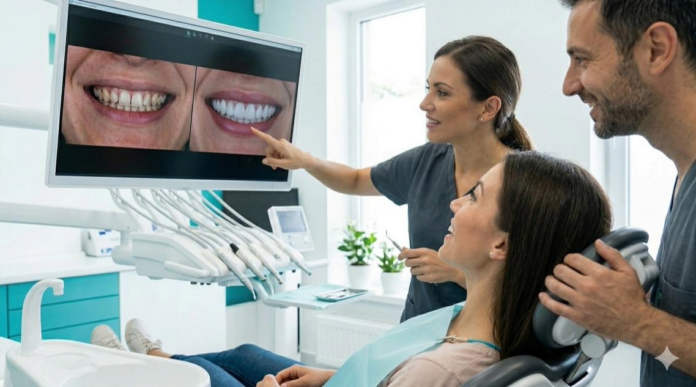

Bergenfield Dental, a comprehensive family and cosmetic dental practice located at 29 West Church Street in Bergenfield, has integrated a genuinely comprehensive suite of digital dental technology into its everyday patient care, replacing several of dentistry’s more uncomfortable traditional methods with modern, precision driven alternatives. Led by Dr. Ehab Shahid, the practice has built its approach around three core goals, sharper clinical precision, genuinely improved patient comfort, and a noticeably less intimidating overall dental experience for patients who might otherwise dread a routine visit.
At the center of that technological shift sits 3D cone beam imaging, commonly referred to as CBCT, a system capable of capturing highly accurate three dimensional scans of a patient’s jaw and surrounding bone structure. That level of detailed imaging gives Dr. Shahid and his team a considerably more precise diagnostic picture than traditional two dimensional X-rays alone could ever provide, supporting more accurate treatment decisions from the very first evaluation. That same imaging data feeds directly into the practice’s digital treatment planning process, which uses advanced computer software to map out complex procedures in careful detail before any actual treatment begins. This kind of digital planning proves especially valuable for computer guided dental implant placements, where precise positioning matters enormously for long term success, allowing the practice to plan an implant’s exact placement virtually before ever picking up a surgical instrument.
Perhaps the single most welcome upgrade for patients involves how the practice now captures impressions of the teeth themselves. Rather than relying on the traditional trays of thick, uncomfortable putty most patients have come to dread, Bergenfield Dental uses intraoral scanners to build an exact virtual model of a patient’s teeth, eliminating that familiar gag inducing experience entirely while producing a considerably more accurate digital impression in the process. Digital X-rays round out the practice’s core imaging technology, replacing conventional film with electronic sensors that transmit images instantly to a monitor for immediate review. Beyond the obvious convenience of instant results, this shift to digital X-rays carries a genuinely significant health benefit as well, reducing patient radiation exposure by an estimated 80 to 90 percent compared to traditional film based X-rays.
Beyond its investment in imaging and planning technology, Bergenfield Dental has placed real emphasis on patient comfort more broadly, pairing its digital advancements with specialized IV conscious sedation services. That sedation option is specifically designed for patients who struggle with severe dental anxiety or genuine dental phobia, giving them a realistic path toward completing comprehensive oral surgeries or full smile rehabilitations without the overwhelming stress that might otherwise keep them from seeking necessary care at all. For patients who have avoided the dentist for years due to fear alone, that kind of sedation option can make the difference between continuing to put off care and finally addressing longstanding dental issues in a genuinely comfortable, controlled setting.
Taken together, Bergenfield Dental’s combination of 3D cone beam imaging, digital treatment planning, intraoral digital impressions, low radiation digital X-rays, and specialized sedation options reflects a genuinely comprehensive modernization of the traditional dental office experience. For patients throughout Bergenfield and the surrounding community, that investment translates directly into more precise diagnoses, more predictable treatment outcomes, and a considerably more comfortable overall experience, whether they’re coming in for a routine cleaning or a more involved procedure like implant placement. Under Dr. Shahid’s leadership, the practice has positioned itself as a genuine example of what modern, technology forward dental care can look like when a practice commits fully to replacing outdated methods rather than layering new technology on top of an unchanged patient experience.
















