
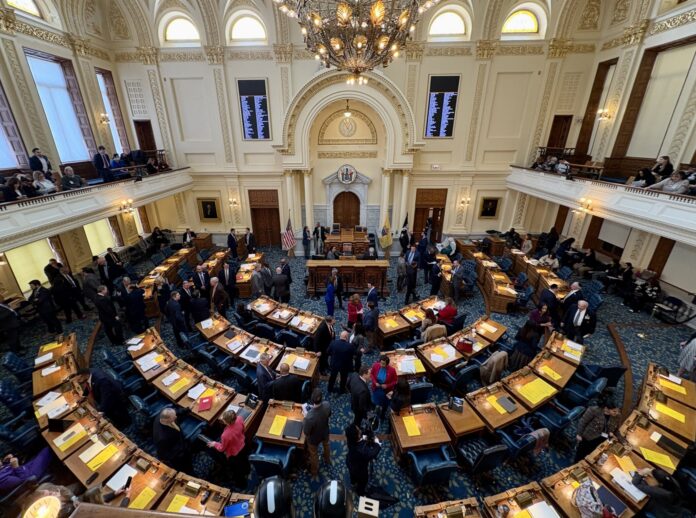

Assemblyman Gerry Scharfenberger says the state comptroller’s calm delivery of a nine figure Medicaid recovery number proves Trenton has stopped taking taxpayer waste seriously. The comptroller’s own testimony, and years of similar figures before it, tell a more complicated story about what that number actually represents.
A $223 Million Medicaid Number Means Very Different Things Depending on Who You Ask in Trenton
A routine line in a state budget hearing has turned into a pointed political flashpoint in Trenton. During Assembly Budget Committee testimony this spring, Acting State Comptroller Shirley Emehelu told lawmakers her office’s Medicaid Fraud Division was on track to recover or facilitate the recovery of more than 223 million dollars in improper Medicaid payments for the current fiscal year, a figure she offered in the same measured, procedural tone typically reserved for routine agency updates. Assemblyman Gerry Scharfenberger, a Monmouth County Republican, has spent the weeks since arguing that tone was precisely the problem.
In a public statement responding to the hearing, Scharfenberger said the amount itself was less shocking to him than the casual, almost routine way it was delivered, comparing it to treating the loss of a quarter billion taxpayer dollars as just another day at the office. He has argued that this kind of matter of fact reporting on fraud and waste is exactly why taxpayers feel ignored by state government, and has called for immediate accountability, clawbacks of improperly spent funds, and structural reforms rather than what he characterizes as calm acknowledgments of institutional failure.
What the Comptroller Actually Said, in Context
The 223 million dollar figure is real and comes directly from Emehelu’s own written and spoken testimony to the Assembly Budget Committee. It is worth being precise about what that number represents, since the comptroller’s office and Scharfenberger’s characterization of it diverge in an important way. In her testimony, Emehelu described the figure as money her division was on track to recover or facilitate the recovery of, language that covers a broad category of improper Medicaid payments identified through audits, billing reviews, and investigations, not exclusively criminal fraud in the sense of deliberate theft. Some portion of recovered Medicaid funds each year reflects outright fraud, but historically a significant share has come from more mundane billing errors, such as Medicaid paying for care that should have been billed to a beneficiary’s other insurance, or continuing to cover someone who had since moved out of state.
That distinction matters for how the number should be read, though it does not make the underlying figure any less real as a measure of money that should not have left the state’s Medicaid budget in the first place. The 223 million dollar figure also is not a one time anomaly. The comptroller’s office recovered roughly 132.5 million dollars in fiscal year 2025, up from about 119.2 million in fiscal year 2024 and 114.5 million in fiscal year 2023, according to the office’s own public reporting, and has recovered or facilitated the recovery of more than 1 billion dollars in Medicaid funds over the past decade, with roughly 70 percent of that total recovered since 2022. Read against that trend line, this year’s higher figure could reflect either a genuine increase in improper payments or, just as plausibly, a more aggressive and effective recovery effort catching more of what was already there, a distinction the comptroller’s office has not definitively resolved in its public testimony.
A Broader Political Fight Over Medicaid Oversight
The exchange in Trenton is also unfolding against a larger national argument over Medicaid fraud enforcement. Earlier this year, New Jersey’s attorney general joined counterparts from several other Democratic led states in publicly defending their oversight records after facing criticism from the Trump administration and federal officials, who have argued that Democratic controlled states are not doing enough to root out Medicaid fraud as justification for cutting federal funding to the program. New Jersey officials countered that argument by pointing to the same recovery figures now at the center of Scharfenberger’s criticism, framing a rising recovery total as evidence of strengthened enforcement rather than worsening fraud.
Scharfenberger’s own broader argument extends beyond a single hearing. In a companion op-ed, he pointed to the federal 2026 National Health Care Fraud Takedown, a Department of Justice initiative that has charged 455 defendants, including 90 licensed medical professionals, in connection with more than 6.5 billion dollars in false claims nationally, calling it evidence that healthcare fraud represents a much larger and more organized problem than any single state hearing can capture. He has also cited considerably larger fraud figures reported in states like Minnesota and California as evidence that the national scale of the problem dwarfs even New Jersey’s own numbers.
Two Read of the Same Set of Numbers
What remains genuinely disputed is not whether the money was recovered, both sides agree it was, but what that recovery says about the state of the program itself. Scharfenberger’s position treats a rising recovery number as proof that fraud and waste are accelerating and that Trenton’s political leadership has grown complacent about it. The comptroller’s office and the state’s Democratic leadership have generally framed the same rising figures as evidence their oversight systems are working better than ever, catching more improper payments than in past years precisely because enforcement has intensified rather than because the underlying problem has grown worse. Both readings are consistent with the same set of published numbers, which is precisely why a routine budget testimony line has turned into a live political argument rather than a settled fact either side can simply point to and move on from.
















