

New
Golden Goat Brings Los Angeles-Inspired Asian Comfort Food to Park Ridge as New Jersey’s Restaurant Scene Continues Expanding Beyond Convention. Northern New Jersey’s restaurant culture has entered a period where diners are no longer simply chasing trends. Increasingly, they are looking for places with identity, specificity, and point of view. They want restaurants that feel personal rather than manufactured. They want menus shaped by actual culinary perspective instead of algorithmic branding. They want food that reflects memory, migration, family influence, regional crossover, and creative risk rather than another interchangeable fast-casual formula built around social media aesthetics.
That shift is precisely what makes the arrival of Golden Goat in Park Ridge feel notable within New Jersey’s evolving dining landscape.
Set to officially celebrate its grand opening on June 17, 2026, Golden Goat arrives at 133 Park Avenue carrying with it a distinctly different kind of energy from many of the restaurant openings currently flooding suburban commercial corridors. Founded by chefs Robert and Jess Scully, the concept first developed in Los Angeles before making its move eastward to Bergen County, bringing with it a culinary identity rooted not in rigid categorization, but in a broader interpretation of Asian comfort food shaped by street culture, family influence, handcrafted preparation, and deeply personal flavor construction.
At a time when restaurant branding often relies heavily on buzzwords and visual gimmicks, Golden Goat appears more interested in substance.
That becomes clear almost immediately through the menu itself.
The restaurant’s culinary focus centers on handmade dumplings, wok-fired noodle dishes, rotating Eastern-inspired comfort foods, café pastries, specialty teas, and highly personalized weekly offerings that extend well beyond predictable takeout staples. Rather than attempting to flatten multiple Asian culinary traditions into one generic menu structure, Golden Goat embraces movement between influences, allowing dishes to feel exploratory without becoming unfocused.
The result is a restaurant concept that feels contemporary without appearing engineered purely for trend cycles.
That distinction matters more than ever in New Jersey’s increasingly competitive restaurant ecosystem.
Across Bergen County and much of North Jersey, diners have become remarkably sophisticated. The region’s proximity to New York City, combined with the state’s extraordinary cultural diversity, has created an audience increasingly familiar with regional Asian cuisines, specialized techniques, international street-food formats, and cross-cultural culinary experimentation. Restaurants can no longer rely on novelty alone. They have to deliver clarity of execution and authenticity of perspective.
Golden Goat seems fully aware of that reality.
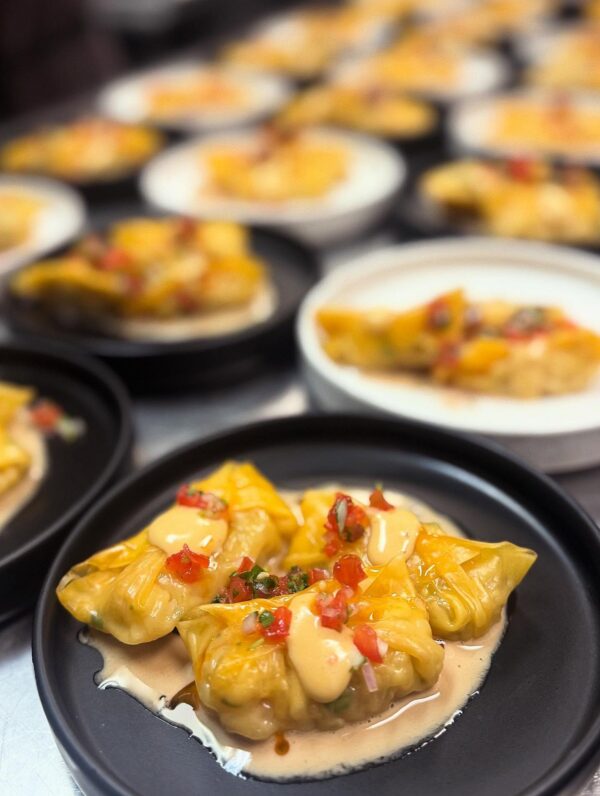
The handmade dumplings serve as one of the restaurant’s defining anchors, reflecting a level of labor-intensive preparation increasingly valued by diners seeking food that feels intentionally crafted rather than mass-produced. In many modern restaurant environments, handmade preparation has itself become a differentiator. Consumers recognize the difference between food assembled for efficiency and food built around texture, timing, balance, and technique.
That same philosophy extends into the wok-fired dishes, where heat, seasoning, smoke, and timing become central to the flavor profile. Proper wok cooking remains one of the most difficult techniques to replicate authentically within scaled fast-casual environments because it requires both technical precision and speed. When done correctly, it creates a distinct depth and aromatic complexity impossible to imitate through simplified preparation systems.
Golden Goat appears intent on preserving that integrity.
The rotating specials further reinforce the restaurant’s broader culinary ambitions. Dishes such as Soto Betawi — the Indonesian beef soup built around rich coconut milk, layered spices, and slow-developed depth — suggest a kitchen interested in exploring broader Southeast Asian influences rather than confining itself to familiar commercial standards. That willingness to rotate lesser-known regional specialties into the menu structure gives the restaurant flexibility while also inviting diners into culinary experiences they may not encounter elsewhere in suburban North Jersey.
Importantly, the concept does not isolate itself solely around savory dishes.
The café side of Golden Goat adds another layer entirely to the experience. House-made pastries, including Jasmine Tea Cream cupcakes and Black Sesame desserts, help position the restaurant within a broader all-day café culture that has increasingly reshaped modern dining behavior. Across both urban and suburban markets, restaurants capable of functioning across multiple dayparts — coffee, pastries, lunch, dinner, takeaway, casual meetups — often create stronger long-term community integration than businesses operating strictly around traditional meal structures.
Golden Goat’s approach seems built around that flexibility.
The Park Ridge location itself reflects a similarly modern understanding of consumer behavior. While the restaurant includes limited indoor seating with high-top window bar seating, the primary operational emphasis appears focused on streamlined convenience without sacrificing culinary quality. Outdoor picnic seating planned for warmer months further reinforces the casual, neighborhood-oriented atmosphere the owners appear to be cultivating.
That hybrid structure — part café, part street-food kitchen, part neighborhood takeaway destination — increasingly reflects where successful independent restaurants are heading nationally.
Consumers today move fluidly between dine-in, takeaway, remote work cafés, quick-service meals, and social dining experiences. Restaurants capable of adapting to those overlapping patterns often build stronger long-term customer relationships because they become integrated into everyday life rather than existing solely as occasional destinations.
Golden Goat’s Los Angeles roots also feel significant within the broader context of New Jersey dining culture.
Los Angeles has spent the past two decades reshaping American food conversations through immigrant-driven street-food innovation, genre-blending culinary experimentation, and a more fluid understanding of regional authenticity. Many of the country’s most influential modern restaurant concepts emerged from LA’s willingness to embrace culinary crossover without diluting cultural specificity. Bringing that sensibility into suburban Bergen County creates an interesting dynamic, particularly within a New Jersey dining scene already undergoing substantial expansion and diversification.
That broader evolution is becoming increasingly visible throughout the state.
Through Explore New Jersey’s continuing restaurant coverage, it has become clear that New Jersey’s food culture is no longer defined solely by legacy diners, Italian restaurants, or shore-town institutions — although those remain deeply important to the state’s identity. Increasingly, the state’s restaurant landscape is being shaped by chef-driven independents, globally influenced neighborhood concepts, immigrant-owned specialty kitchens, artisan bakeries, experimental breweries, modern café culture, and smaller culinary operators willing to build highly focused concepts around craft and originality.
Golden Goat enters the market squarely within that newer generation.
The restaurant also arrives during a moment when Asian comfort food itself is receiving greater recognition within mainstream American dining culture. For years, many Asian cuisines were simplified commercially into limited categories designed primarily around convenience and familiarity. But consumers have become increasingly interested in regional nuance, house-made preparation, street-food authenticity, fermentation techniques, specialty noodles, layered broths, and cross-cultural influences that reflect actual lived culinary traditions.
Restaurants capable of presenting those elements thoughtfully now occupy one of the fastest-growing segments within the independent restaurant industry.
Golden Goat appears positioned to capitalize on exactly that shift.
At the same time, the restaurant’s relatively intimate scale may ultimately become one of its greatest strengths. Smaller concepts often maintain tighter culinary control, stronger owner visibility, more flexible menus, and deeper neighborhood connection than aggressively scaled restaurant groups. Diners increasingly respond to spaces that feel personal and rooted rather than corporate and standardized.
That feeling may ultimately define Golden Goat more than any single menu item.
Because what Robert and Jess Scully appear to be building in Park Ridge is not simply another takeout operation or trend-focused opening. They are building a restaurant centered around craft, flavor memory, and cultural movement — one that reflects both the evolution of modern Asian comfort food and the broader transformation currently reshaping New Jersey’s restaurant scene itself.
And in a state whose culinary identity continues expanding far beyond old assumptions, Golden Goat may arrive at exactly the right moment.












Your source for everything happening in the Garden State. Enjoy live music year-round, skiing, hiking, beaches, rivers, and mountains. Explore New Jersey’s wine scene by visiting top wineries and vineyards offering award-winning wines. Check out reviews and photos of the best places to sip and sample. Love beer? Discover New Jersey’s breweries — currently home to 123 licensed breweries — and explore the highest-rated beers brewed in the state.
© 2026 Explore New Jersey, a Sunset Entertainment & Media Company | 1928 The Woods II - Cherry Hill, New Jersey 08003. All Rights Reserved.