

True West
Princeton Summer Theater Closes Its Season With Sam Shepard’s “True West,” American Theater’s Definitive Study of Sibling Warfare
July 23 @ 7:30 PM – July 25 @ 11:30 PM
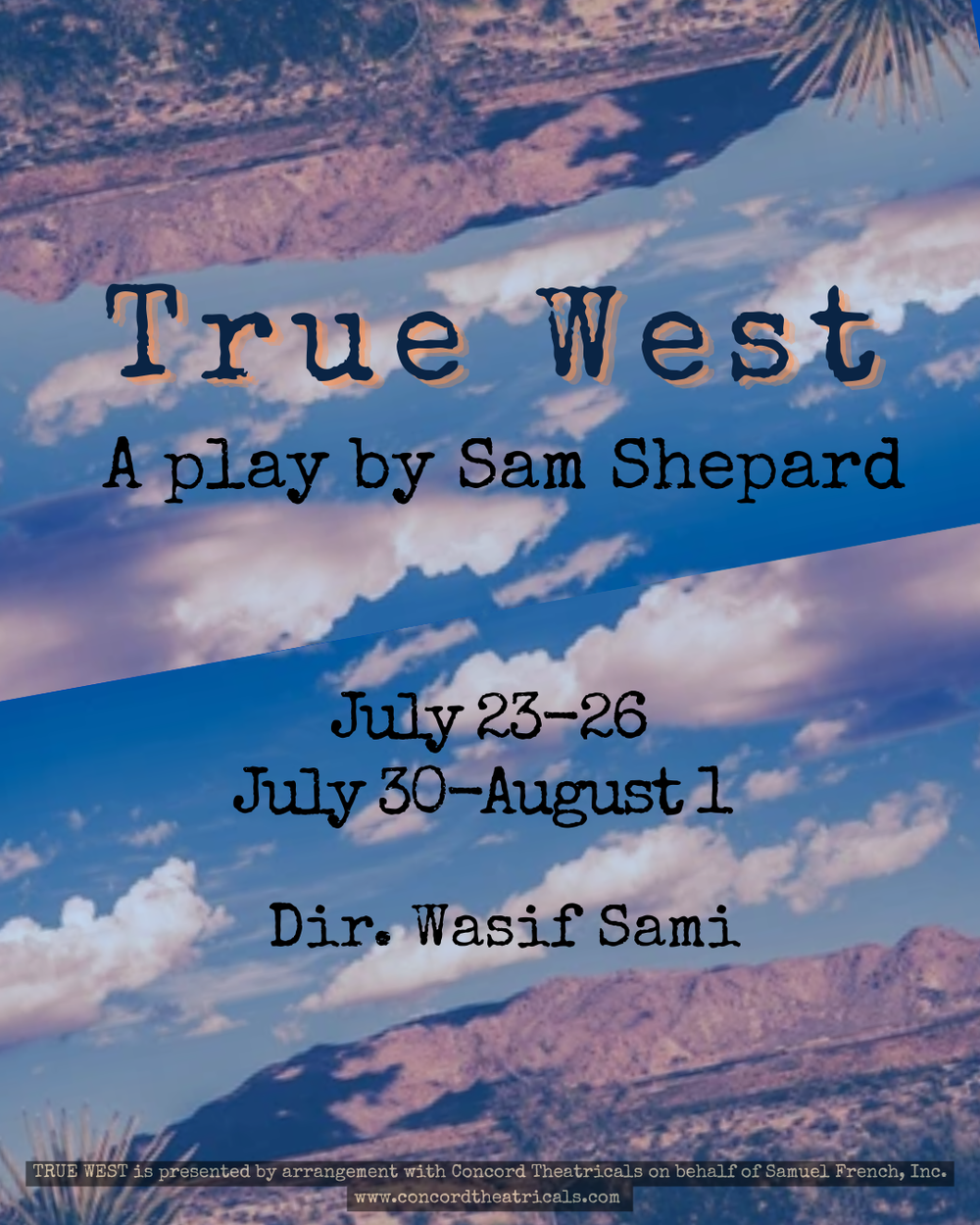
There is a reason Sam Shepard’s True West has never lost its grip on American theater since its 1980 premiere at San Francisco’s Magic Theatre, and it is not nostalgia for the desert imagery or the era of California suburban sprawl in which the play is set. It is that the central conflict at the heart of the play — two brothers who despise each other precisely because each one recognizes, in the other, the version of himself he was never permitted to become — has lost none of its psychological accuracy in the four and a half decades since Shepard wrote it. Princeton Summer Theater closes its 56th season with True West, directed by Wasif Sami, running July 23 through August 1 at the Hamilton Murray Theater on the Princeton University campus, in a production that brings one of the most demanding two-actor showcases in the modern American repertoire to a company with a track record of taking on exactly this caliber of material.
The production runs Thursday through Saturday evenings at 7:30 p.m. on July 23-25, July 30, and July 31, with an additional Saturday performance, and Sunday matinees at 2:00 p.m. on July 25, July 26, and August 1. The schedule closes Princeton Summer Theater’s main-stage season, following the company’s June production of Neil Simon’s Barefoot in the Park and its July run of Patrick Barlow’s The 39 Steps — a season that Artistic Director Lucy Shea has described as moving deliberately from romantic comedy through farcical mystery into the psychologically volatile family drama that True West represents, a structure designed to showcase the full range of registers a serious summer theater company can command across eight weeks of programming.
What True West Actually Does to an Audience
Sam Shepard’s play unfolds entirely within the kitchen and breakfast alcove of a well-kept Southern California suburban home roughly forty miles east of Los Angeles, where Austin — a buttoned-down, Ivy League-educated screenwriter house-sitting for his mother while she vacations in Alaska — is working by candlelight on a romantic screenplay he hopes to sell to a Hollywood producer. His estranged older brother Lee, a desert drifter and petty thief who has spent recent years scraping by on burglary and odd survival, arrives unannounced after a five-year absence, and the collision between the two men’s radically different relationships to ambition, authenticity, and the inherited wreckage of their alcoholic, desert-dwelling father becomes the engine that drives the play toward its now-legendary final confrontation.
What makes True West more than a well-constructed sibling drama is the mechanism Shepard builds into its structure: across the play’s nine scenes, Austin and Lee do not simply argue past each other — they begin, gradually and then catastrophically, to exchange identities. When Hollywood producer Saul Kimmer arrives to discuss Austin’s screenplay, Lee inserts himself into the meeting and pitches his own absurd, violent vision of a “true” Western — a chase across the desert that he insists carries the authenticity Austin’s polished, sentimental script lacks specifically because Lee has actually lived the rootless, dangerous life Austin has only imagined from the safety of suburban comfort. When Kimmer inexplicably abandons Austin’s project in favor of Lee’s outline and demands that Austin, the only brother who can actually type, write the screenplay Lee cannot construct on his own, the play’s central reversal begins in earnest. Austin descends into drunken chaos, stealing toasters from the surrounding neighborhood in a single increasingly deranged night. Lee, meanwhile, develops an unexpected and humiliating dedication to the writing craft he has always claimed to despise, hunched over a typewriter he barely knows how to operate.
By the time their mother returns home early from Alaska — bewildered by the destruction of her kitchen, more concerned about her dead houseplants and an expected visit from Pablo Picasso than the war zone her sons have made of her home — Austin and Lee have each become a grotesque inversion of where they started. The play’s final image, with the brothers facing off in fighting stances as the lights fade and a coyote howls somewhere outside, refuses the audience any resolution. Shepard does not allow either brother victory, redemption, or even clarity. He leaves them exactly where the American mythology of the West and the American mythology of suburban respectability both eventually leave everyone who believes too completely in either one: trapped, violent, and unable to distinguish anymore which version of themselves was ever real.
A Pulitzer Finalist That Belongs to a Body of Work
True West was a finalist for the 1983 Pulitzer Prize for Drama and is widely regarded by critics and scholars as Shepard’s signature achievement — frequently grouped alongside Curse of the Starving Class and Buried Child as part of what theater historians describe as Shepard’s “family trilogy,” three plays written across the late 1970s and early 1980s that systematically dismantle the mythology of the American nuclear family and the American frontier simultaneously. Shepard, who had already established himself as the resident playwright at San Francisco’s Magic Theatre by the time he wrote True West, was explicit about his intentions for the piece: he wanted to write a play about what he called “double nature,” the devastating ways in which a single person — or, in this case, a single family — can be split into apparently irreconcilable halves that are nonetheless inseparable from each other.
The play’s original 1980 Magic Theatre production starred Peter Coyote as Austin and Jim Haynie as Lee, under the direction of Robert Woodruff. When the production transferred off-Broadway to Joseph Papp’s Public Theater later that year, Tommy Lee Jones and Peter Boyle took over the lead roles. But it was the 1982 Steppenwolf Theatre Company production in Chicago — starring two then-largely-unknown actors named Gary Sinise, who also directed, and John Malkovich — that cemented the play’s reputation and launched both actors toward the sustained careers that would eventually make them among the most respected dramatic performers of their generation. That production transferred to off-Broadway’s Cherry Lane Theatre in 1982 with Shepard’s explicit approval, and the Sinise-Malkovich dynamic remains, for many theater historians and critics, the definitive interpretation of the Austin-Lee relationship against which subsequent productions are measured.
The role of Lee in particular has become one of the great actor’s showcases in the modern American repertoire, having attracted performers including Bruce Willis, who starred in a 2002 Showtime film adaptation alongside Chad Smith, and a roster of stage actors across regional and Broadway revivals that includes some of the most respected names in contemporary American performance. The dual demands of the two lead roles — Austin’s arc from buttoned-down propriety into drunken chaos, Lee’s parallel and inverse arc from menacing volatility into anxious, hunched concentration — require performers capable of sustaining genuine psychological transformation across a single uninterrupted theatrical evening, without the scene breaks or costume changes that might otherwise help an audience track the shift. It is, by the consistent assessment of directors and critics who have staged it, one of the most technically and emotionally demanding two-actor structures in the American dramatic canon.
The Director Behind Princeton Summer Theater’s Closing Production
True West is directed by Wasif Sami, a member of Princeton’s Class of 2025 and a New York-based director whose recent work has included Princeton productions exploring experimental and high-concept theatrical formats. Sami’s directorial sensibility, developed within the same Princeton theater ecosystem that has produced this season’s other creative leadership, brings a generation of theater-makers trained specifically within the demanding, collaborative environment that Princeton Summer Theater and the university’s Lewis Center for the Arts have cultivated.
Directing True West presents a specific challenge that differs meaningfully from the technical demands of a production like The 39 Steps, which Princeton Summer Theater staged earlier this same season. Where Barlow’s farce depends on relentless external pacing and visible theatrical mechanics, Shepard’s play depends almost entirely on the internal psychological journey of two actors across a single static location, with the dramatic tension generated by what is happening beneath the surface of seemingly mundane domestic interactions rather than by physical spectacle. A director taking on True West must calibrate the production’s pacing to allow the play’s slow-building dread and dark comedy to accumulate naturally, trusting two actors and Shepard’s spare, repetitive dialogue to carry an audience toward a climax that the script’s structure makes inevitable but that an underprepared production can easily rush past or undersell.
Why This Production Matters Within Princeton Summer Theater’s Mission
Princeton Summer Theater has operated continuously since 1968 as an institution explicitly dedicated to training emerging theatrical professionals — offering current Princeton students and recent graduates from Princeton and other institutions the opportunity to develop expertise across every discipline of theatrical production. The company’s choice to close its 56th season with True West reflects a programming philosophy that has defined the organization across more than five decades: exposing young performers and directors to material of genuine canonical weight and difficulty, rather than selecting safer or more commercially predictable closing productions.
True West demands two actors capable of sustaining a ninety-minute psychological and physical transformation in front of a live audience, in an intimate venue where every flicker of hesitation or inauthenticity registers clearly. It is the kind of role that has historically separated promising young performers from those who go on to build sustained professional careers — precisely the developmental stakes that have defined Princeton Summer Theater’s mission since a group of Princeton students founded the company in 1968 specifically to extend their theatrical education into the summer months. The organization’s alumni roster, which includes Tony Award winner Bebe Neuwirth and television and Broadway writer Winnie Holzman, reflects what becomes possible when young theater artists are given the opportunity to work on material this demanding under genuine production pressure rather than in a purely academic classroom setting.
Attending the Production
True West performances take place at the Hamilton Murray Theater, also known as Theatre Intime, inside Murray-Dodge Hall on the Princeton University campus — the same intimate, air-conditioned indoor venue that has hosted Princeton Summer Theater’s full 2026 season. The venue’s scale is particularly well suited to this material: a play built around the slow accumulation of psychological tension within a single domestic space benefits enormously from a theater small enough that an audience can register every shift in an actor’s physical bearing, every pause before a line, every moment where Austin’s composure begins visibly to crack or Lee’s menace gives way to something more vulnerable.
Evening tickets for the 7:30 p.m. performances and matinee tickets for the 2:00 p.m. performances are available for purchase online through Princeton Summer Theater’s ticketing partner. With the production closing the company’s 2026 main-stage season, it represents the final opportunity this summer to see Princeton Summer Theater’s particular combination of serious dramatic ambition and the technical polish that more than fifty years of institutional development have produced — applied to a play that remains, more than four decades after its premiere, one of the most psychologically precise and theatrically demanding studies of American family identity ever written for the stage.











