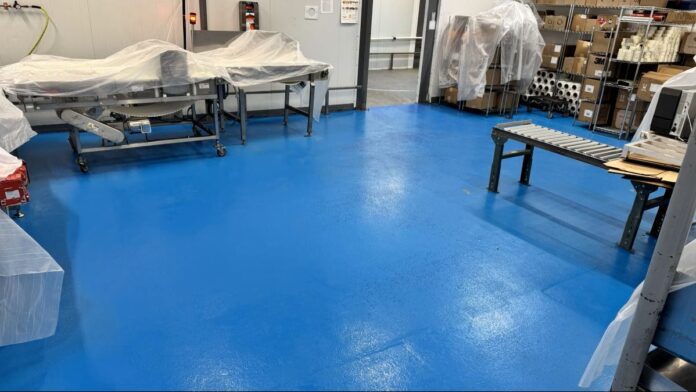

The modern industrial facility bears little resemblance to the manufacturing plants and processing centers of previous generations. Today’s food production facilities, pharmaceutical operations, distribution centers, biotechnology laboratories, clean rooms, warehouses, and advanced manufacturing environments operate under increasingly rigorous standards governing safety, sanitation, durability, compliance, and operational efficiency. As New Jersey continues strengthening its position as a national leader in food production, life sciences, logistics, healthcare, and advanced manufacturing, infrastructure investments occurring beneath workers’ feet are becoming just as important as the technologies driving production lines.
That reality is helping fuel growing interest in advanced industrial flooring systems, and one New Jersey-area contractor is responding to the demand with the rollout of new SQF-certified resinous flooring solutions designed specifically for high-performance commercial and industrial environments throughout New Jersey, New York, and Pennsylvania.
High Performance Systems, a premier industrial and commercial flooring contractor serving the Northeast region, has announced the expansion of its advanced resinous flooring offerings, targeting industries where sanitation, durability, regulatory compliance, and long-term operational performance are mission-critical requirements.
The move comes at a time when New Jersey’s industrial and manufacturing sectors continue experiencing significant investment and expansion. From food processing facilities in South Jersey and pharmaceutical campuses in Central Jersey to logistics hubs along the Turnpike corridor and biotechnology operations throughout the state, companies are increasingly seeking infrastructure solutions capable of supporting modern production demands while helping meet evolving regulatory requirements.
For many facilities, flooring is no longer viewed as a basic construction component. Instead, it has become an integral part of operational strategy.
In industries where cleanliness, contamination prevention, moisture resistance, chemical exposure, temperature fluctuations, and heavy equipment traffic are daily realities, flooring systems must function as active contributors to workplace safety and productivity. Traditional concrete surfaces often struggle under these conditions, leading facility operators to invest in specialized resinous systems engineered to withstand demanding environments while supporting compliance objectives.
The introduction of SQF-certified flooring systems addresses one of the most important priorities facing food manufacturers today.
Safe Quality Food certification has become a widely recognized benchmark throughout the food industry, emphasizing rigorous standards for food safety management, risk mitigation, sanitation, and operational integrity. Facilities seeking certification or maintaining compliance increasingly evaluate every aspect of their physical infrastructure, including flooring, walls, drains, processing areas, and production environments.
In these settings, flooring must do more than simply support equipment and foot traffic. It must resist bacterial growth, withstand aggressive cleaning procedures, tolerate chemical exposure, prevent moisture intrusion, and maintain structural integrity despite constant operational demands.
Resinous flooring systems have emerged as one of the industry’s preferred solutions because of their ability to create seamless, non-porous surfaces that eliminate many of the vulnerabilities associated with traditional flooring materials. Unlike surfaces containing joints, seams, cracks, or grout lines, resinous systems provide continuous protection that simplifies cleaning and minimizes potential contamination risks.
For food manufacturers operating in New Jersey, these advantages are becoming increasingly valuable.
The Garden State maintains a significant presence within the national food production and distribution economy. Food processing facilities, beverage manufacturers, commercial bakeries, refrigerated distribution centers, seafood processors, specialty food producers, and agricultural businesses collectively contribute billions of dollars to the state’s economy. Maintaining competitive operations within these sectors requires ongoing investment in infrastructure capable of supporting modern food safety standards and consumer expectations.
The same considerations apply across several other industries experiencing rapid growth throughout New Jersey.
The state’s pharmaceutical and biotechnology sectors continue attracting substantial investment, driven by New Jersey’s longstanding reputation as one of the nation’s premier life sciences hubs. Research laboratories, pharmaceutical manufacturing facilities, clean-room environments, and healthcare operations often require flooring systems capable of supporting strict cleanliness protocols while resisting exposure to chemicals, heavy equipment, and constant activity.
Distribution and logistics facilities represent another major growth sector influencing construction trends throughout the region. New Jersey’s strategic location between major metropolitan markets has fueled continued expansion of warehouses, fulfillment centers, transportation hubs, and supply-chain infrastructure. These facilities require flooring capable of enduring forklift traffic, pallet movement, automated systems, and round-the-clock operations without compromising safety or performance.
High Performance Systems’ expanded offering reflects broader trends occurring throughout industrial construction and facility management.
Owners, developers, architects, engineers, and contractors are increasingly emphasizing lifecycle value rather than simply evaluating upfront construction costs. Durable materials that reduce maintenance requirements, minimize downtime, improve safety, and support compliance initiatives often generate substantial long-term savings despite higher initial investment.
Resinous flooring systems fit squarely within that philosophy.
Modern formulations can withstand extreme temperatures, chemical exposure, impact stress, abrasion, moisture intrusion, and heavy operational loads while maintaining aesthetic consistency and performance characteristics over extended periods. Many facilities view these systems as essential infrastructure investments that contribute directly to operational reliability.
The growing emphasis on workplace safety also plays an important role in adoption decisions.
Industrial environments face increasing scrutiny regarding employee safety, risk management, and accident prevention. Flooring systems can contribute significantly to these efforts through slip-resistant surfaces, improved visibility, chemical resistance, and enhanced durability. In facilities where spills, moisture, oils, cleaning solutions, or processing materials are routinely present, specialized flooring becomes an important component of broader workplace safety strategies.
Across New Jersey, the construction industry continues adapting to changing client expectations and technological advancements. Infrastructure projects increasingly incorporate materials and systems designed to improve sustainability, operational efficiency, and long-term resilience. Flooring technologies are no exception.
Many advanced resinous systems now offer environmental benefits alongside performance improvements. Reduced maintenance requirements, longer service lives, and enhanced durability contribute to sustainability objectives while helping organizations reduce lifecycle costs and operational disruptions.
For developers and facility operators, these advantages become particularly attractive when considering the competitive realities of modern business operations. Downtime can be extraordinarily expensive. Production interruptions, maintenance closures, compliance failures, or facility disruptions often generate costs far exceeding the initial investment required to install high-performance infrastructure.
As a result, industrial flooring has evolved from a relatively overlooked construction element into a strategic investment category.
The expansion of SQF-certified resinous flooring solutions throughout New Jersey, New York, and Pennsylvania reflects that transformation. It also underscores the continuing growth of industries that depend upon reliable, compliant, and technologically advanced facilities to remain competitive.
For New Jersey specifically, the development highlights broader economic trends shaping the state’s future. Manufacturing, food production, healthcare, biotechnology, logistics, warehousing, and advanced industrial operations continue serving as critical pillars of the state’s economy. Supporting those industries requires infrastructure investments at every level—from transportation networks and utilities to the highly specialized materials found within individual facilities.
As companies continue modernizing operations and preparing for future growth, demand for high-performance construction solutions is expected to remain strong. Flooring may not always receive the attention given to automation systems, robotics, artificial intelligence, or production equipment, but industry professionals increasingly recognize its importance as a foundational component of operational success.
In today’s industrial landscape, performance begins from the ground up. As New Jersey continues building the next generation of manufacturing, food production, healthcare, and logistics facilities, innovations in construction materials and infrastructure systems will play an increasingly important role in shaping how those industries operate, compete, and grow.
The expansion of advanced SQF-certified resinous flooring solutions represents one more example of how specialized construction technologies are helping meet the evolving demands of modern industry—ensuring that the facilities driving the region’s economy are equipped to support the challenges and opportunities of the decades ahead.