
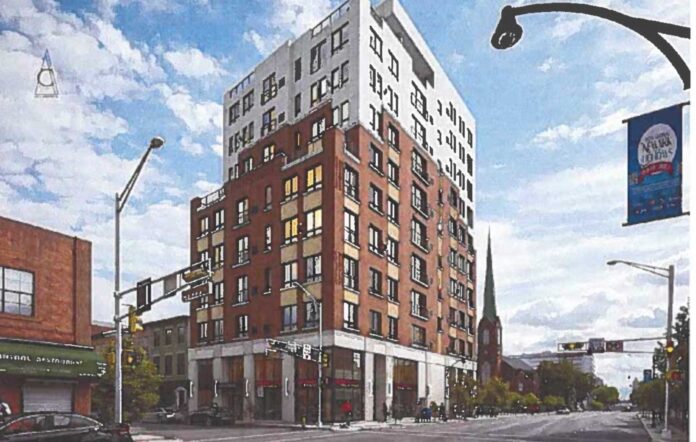

In a city where nearly every block carries layers of political history, social struggle, architectural ambition, and cultural memory, few proposed developments in Newark have ever represented more than Kawaida Towers. More than five decades after the original proposal became one of the most controversial and emotionally charged housing battles in New Jersey history, the project has once again reemerged in downtown Newark, reviving conversations that extend far beyond architecture, zoning, or development economics. The renewed proposal for Kawaida Towers at 17 Halsey Street is not simply another affordable housing project entering the city pipeline. It is the reawakening of a deeply symbolic idea tied directly to Newark’s post-riot identity, racial history, housing inequality, political transformation, and ongoing struggle over who gets to shape the future of one of America’s most historically important urban centers.

The latest version of Kawaida Towers recently resurfaced during a Newark Landmarks Commission meeting, where updated plans for the proposed development were formally introduced as part of the approval process required within the city’s historic district. The presentation followed a significant step forward from Newark’s City Council, which approved an $8 million grant for Kawaida Towers JV Partners, LLC, the joint venture development group now pushing the project toward reality after years of delays, uncertainty, and stalled momentum.
For Newark Mayor Ras Baraka, however, this development proposal represents something profoundly personal in addition to being political. The project is deeply connected to the legacy of his father, Amiri Baraka, the internationally influential poet, activist, playwright, and founder of the Temple of Kawaida movement from which the original housing concept derived its name. The term “Kawaida,” rooted in Swahili philosophy and pan-African thought, symbolized cultural self-determination, empowerment, and Black urban autonomy during one of the most volatile periods in Newark’s modern history.
To understand why the reemergence of Kawaida Towers matters so deeply today, it is necessary to revisit the historical moment that first gave birth to the project itself. The original Kawaida Towers proposal emerged during the aftermath of the 1967 Newark riots, one of the defining urban uprisings in American history. Newark at that time was experiencing enormous racial tension, white flight, economic collapse, aggressive urban renewal policies, and deep mistrust between Black residents and political power structures. Housing conditions throughout the city had deteriorated severely, and affordable housing shortages were becoming increasingly catastrophic for working-class residents.
The original Kawaida Towers project was envisioned as a bold all-affordable residential development planned for 129 Lincoln Avenue in Newark’s North Ward. The proposal called for a 16-story tower containing approximately 210 residential units, intended not merely as housing but as a statement of Black-led urban development and community control during an era when minority communities were routinely excluded from planning decisions that dramatically reshaped their neighborhoods.
The symbolism surrounding the tower immediately elevated it beyond ordinary real estate development. Supporters viewed it as a visionary response to Newark’s housing crisis and an expression of Black political and cultural empowerment. Critics, however, saw something very different. Opposition quickly intensified throughout the neighborhood, fueled by racial tensions, fear surrounding public housing towers, anxieties over crime, and growing public resistance to dense high-rise residential developments throughout urban America during the 1970s.
At the center of the controversy was a rapidly changing Newark struggling to define itself after the riots. The city was simultaneously confronting suburban flight, economic instability, deteriorating infrastructure, institutional distrust, and enormous demographic transformation. Housing debates became inseparable from racial politics, class tensions, and questions about who possessed the right to influence Newark’s future.
Despite legal victories supporting the project, the public backlash surrounding Kawaida Towers became overwhelming. Community protests escalated. Political resistance intensified. Demonstrations drew support from neighborhood organizations, local politicians, activists, and even elements within law enforcement circles. Opposition figures included major public personalities such as Stephen Adubato, State Assemblymen Anthony Imperiale and Frank Megaro, along with various neighborhood groups deeply skeptical of large-scale affordable housing developments.
The irony of the original project’s collapse remains striking even today. Supporters of Kawaida Towers actually won many of the legal battles surrounding the proposal. In 1973, Superior Court Judge Irwin Kimmelman ruled in favor of the organization behind the development, arguing that courts could not act as social engineers speculating on hypothetical community consequences. Newark Mayor Kenneth Gibson publicly urged residents to support the project and move beyond the bitterness consuming the city’s political climate.
Yet even with judicial backing and mayoral support, the development never recovered from the sustained social resistance surrounding it. The project’s foundation had already been poured at a cost exceeding $1 million, but the tower itself was never constructed. By 1976, what had once been envisioned as a transformative housing development was quietly abandoned, with the foundation eventually filled back in and buried beneath dirt. The New York Times famously described the ending as a “quiet burial,” but in many ways the political and emotional debates surrounding Kawaida Towers never truly disappeared from Newark’s collective memory.
Now, nearly fifty years later, the project’s revival arrives during another profoundly important moment in Newark’s evolution. The latest version of Kawaida Towers reflects both continuity and transformation. The new proposal for 17 Halsey Street is smaller than the original vision, standing at 10 stories instead of the symbolic 16-story height previously discussed during earlier revival efforts in 2021. That reduction reflects changing economic realities, financing pressures, construction costs, and the difficult mathematics now facing affordable housing development throughout New Jersey and the broader Northeast.
Still, even at a reduced scale, the project carries enormous symbolic weight. The reappearance of Kawaida Towers comes as affordable housing once again dominates political and economic conversations across New Jersey. Rising rents, housing shortages, gentrification pressures, displacement concerns, and deteriorating affordability continue reshaping urban communities throughout the state. Newark itself has experienced a dramatic development renaissance over the last decade, attracting luxury apartment construction, corporate investment, higher-income residents, and significant downtown redevelopment activity. At the same time, many longtime residents continue struggling with affordability, aging housing stock, maintenance failures, and fears about being economically pushed out of neighborhoods they helped sustain through Newark’s hardest decades.
That tension sits directly beneath the renewed Kawaida conversation. The project now exists at the intersection of history, symbolism, economics, race, and urban identity in ways few developments ever do.
The latest public discussions surrounding the proposal reveal that even supporters remain highly aware of the sensitivity surrounding the project’s legacy. During Landmarks Commission discussions, commissioner Linda Caldwell-Epps suggested incorporating artwork or historical memorialization into the completed building itself so that the complicated history of Kawaida Towers would not be erased or forgotten.
That suggestion reflects an increasingly important reality within urban redevelopment conversations nationwide. Cities are no longer debating only what gets built. They are debating how history gets remembered through development itself. In Newark, where memory and identity remain inseparable from place, the story of Kawaida Towers cannot simply be reduced to another affordable housing ribbon-cutting ceremony.
Developers themselves appear aware of that challenge. Shanell Dunns, one of the project investors, acknowledged publicly that conversations surrounding Kawaida Towers still generate deeply mixed emotions within parts of the community. That caution is understandable. For some Newark residents, Kawaida Towers represents visionary Black empowerment and housing justice delayed for decades. For others, it recalls divisive political conflicts, failed urban planning experiments, and unresolved anxieties surrounding high-density affordable housing developments.
What makes the current moment particularly fascinating is how dramatically Newark itself has changed since the original proposal collapsed in the 1970s. Modern downtown Newark now stands in the middle of a major economic and cultural transformation fueled by tech investment, higher education expansion, arts development, transportation accessibility, and major residential construction. Entire sections of the city once defined by abandonment and disinvestment are now experiencing billions in redevelopment activity.
At the same time, however, many of the deeper issues underlying the original Kawaida Towers controversy remain unresolved. Questions about housing equity, racial division, economic access, political trust, and neighborhood identity continue shaping Newark’s future. Even today, tenant complaints surrounding conditions at privately owned affordable housing complexes throughout the city reveal the enormous pressure facing Newark’s lower-income residents.
That reality gives the renewed Kawaida Towers proposal unusual emotional power. The project now represents more than an apartment building. It has become a reflection of Newark’s unfinished civic conversation about who development ultimately serves and whether modern urban growth can coexist with affordability, cultural memory, and social equity.
The reemergence of Kawaida Towers also highlights Mayor Ras Baraka’s broader political philosophy regarding Newark’s future. Throughout his tenure, Baraka has consistently emphasized development models that attempt balancing investment with inclusivity rather than allowing market-rate construction alone to dictate the city’s trajectory. Reviving a project tied directly to his father’s legacy reinforces that larger political narrative while simultaneously reconnecting Newark’s modern redevelopment era to its deeper historical struggles.
In many ways, the return of Kawaida Towers forces Newark to confront its own history honestly. The project serves as both memorial and mirror. It reflects the city’s painful racial divisions, unrealized ambitions, political conflicts, and decades-long battle over housing justice. Yet it also reflects Newark’s resilience, persistence, and refusal to abandon difficult conversations simply because they remain uncomfortable.
Whether the latest version of Kawaida Towers ultimately succeeds where the original failed remains uncertain. Development economics, community reception, financing pressures, and political realities will all shape the project’s future in the months ahead. What is already undeniable, however, is that Kawaida Towers once again occupies a unique place inside Newark’s public imagination.
Half a century after its original collapse, the project’s revival reminds New Jersey that some developments are about far more than real estate. They become symbols of who cities were, who they are becoming, and what kind of future they ultimately choose to build.
















