
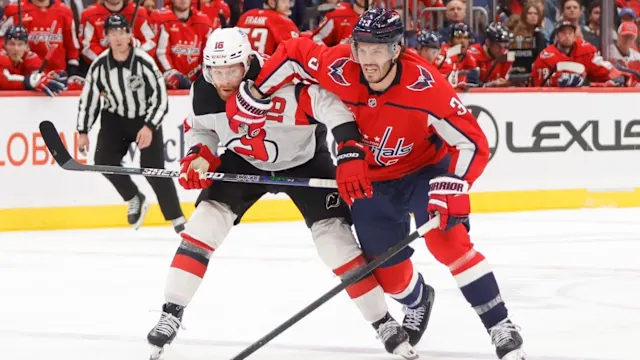

The New Jersey Devils arrived in Washington, D.C. facing long odds, but left Capital One Arena confronting a far more definitive reality. In a tightly contested 2–1 loss to the Washington Capitals on March 20, 2026, the Devils delivered effort without execution—a combination that has defined too many nights this season and now places them on the brink of playoff elimination.
With the Eastern Conference wildcard race accelerating toward a near 100-point pace, the margin for error had already disappeared. This loss doesn’t just sting in the standings—it underscores systemic issues that have persisted across the Devils’ campaign: slow starts, inconsistent offensive pressure, and an overreliance on goaltending to mask structural breakdowns.
The result may not officially end the season mathematically, but functionally, it places the Devils in a position where anything short of a near-perfect finish would be required to keep postseason hopes alive.
From the opening puck drop, the game revealed a familiar pattern. The first period unfolded cautiously, but Washington struck first on a defensive breakdown that left Ryan Leonard with time and space to beat Jake Allen high glove side. It marked yet another instance in which New Jersey surrendered the opening goal—a recurring trend that has undermined their ability to control games and dictate pace.
Despite a handful of isolated offensive flashes—most notably a missed opportunity on a developing odd-man rush involving Jack Hughes and Jesper Bratt—the Devils struggled to generate sustained pressure. Washington dictated the tempo, outchancing New Jersey significantly and controlling high-danger opportunities. By the end of the period, the Devils were fortunate to trail by just one.
The second period reinforced the imbalance. The Capitals tightened their structure through the neutral zone, effectively stifling the Devils’ transition game and forcing them into low-percentage entries. New Jersey’s inability to carry speed through center ice has been a critical weakness, and Washington exploited it with precision.
Jake Allen emerged as the defining figure of the period, delivering a sequence of high-level saves that kept the Devils within striking distance. From point-blank denials on Alexander Ovechkin to multiple stops on Anthony Beauvillier, Allen provided the kind of goaltending performance that typically shifts momentum. Instead, it merely preserved the deficit.
Special teams offered a potential turning point. The Devils were granted two power-play opportunities, including a sequence late in the period where Dougie Hamilton came inches from equalizing, ringing a shot off the crossbar. Yet the inability to convert in those moments further emphasized a season-long inconsistency in capitalizing on critical chances.
Entering the third period down 1–0, the Devils finally found another gear. The pace increased, the forecheck intensified, and for a stretch, New Jersey tilted the ice in their favor. Advanced metrics reflected the shift, with the Devils controlling expected goals share and outshooting Washington during key segments.
But hockey games are not won on momentum alone. Despite multiple net-front scrambles and sustained offensive zone time, the Devils were unable to solve Capitals goaltender Logan Thompson, who remained composed under pressure. Washington’s defensive structure tightened around the crease, effectively neutralizing second-chance opportunities.
With time winding down, the Devils pulled Allen in favor of the extra attacker, a calculated risk that ultimately backfired. Washington capitalized with an empty-net goal from Aliaksei Protas, extending the lead to 2–0 and delivering what appeared to be the decisive blow.
To their credit, the Devils responded immediately. On a subsequent six-on-five sequence, Jack Hughes found Jesper Bratt with a cross-ice feed, and Bratt finished with precision, lifting the puck over a sliding defender and past Thompson. It was a moment of skill and urgency—but it came too late to alter the outcome.
This loss encapsulates the Devils’ season in microcosm. There is talent. There are stretches of dominance. There are elite individual performances, particularly in goal. But there is also a persistent inability to align those elements into a complete, consistent effort across sixty minutes.
For New Jersey, the implications extend beyond a single game. The gap between potential and execution has become the defining storyline, and as the standings tighten, that gap has proven too large to overcome.
Within the broader context of New Jersey’s sports and entertainment landscape, moments like these resonate deeply. As covered across the Explore New Jersey Entertainment section, the connection between teams and communities remains a powerful force, with fan engagement tied not just to wins and losses, but to identity, resilience, and shared experience. The Devils, even in defeat, continue to occupy a central role in that narrative.
Looking ahead, the focus inevitably shifts from playoff positioning to evaluation and recalibration. The remaining games will serve as a proving ground—not for postseason qualification, but for establishing the foundation of what comes next. Young talent will be scrutinized, systems will be assessed, and leadership will be tested.
The margin for error is gone. What remains is an opportunity to redefine the trajectory.
In Washington, the Devils showed fight. They showed flashes of the team they are capable of being. But in a league where consistency is currency, flashes are not enough.
















