

New Jersey’s music pipeline has long been synonymous with authenticity, grit, and unmistakable storytelling—and now, a new voice is stepping into that lineage on one of the biggest stages in the world. Jake Thistle, a rising artist with deep ties to the Shore’s creative heartbeat, has officially advanced to the Top 20 of American Idol 2026, delivering performances that are not only earning national recognition but also reinforcing New Jersey’s enduring influence on American music.
For a state that has produced some of the most iconic voices in modern music history, Thistle’s emergence is more than a moment—it’s a continuation of a legacy. And as his journey unfolds on primetime television, it’s becoming increasingly clear that his artistry is shaped by the same cultural DNA that has defined New Jersey’s music scene for generations.
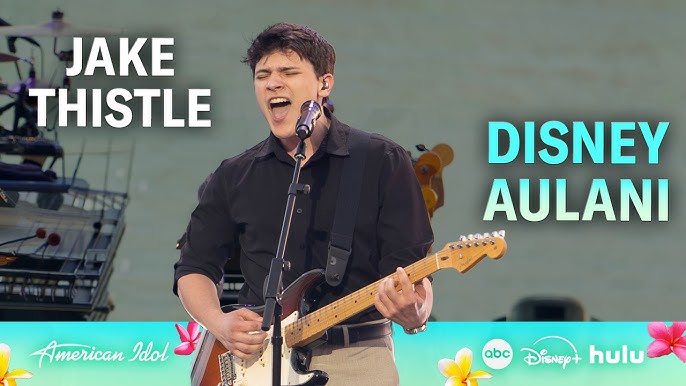
Thistle’s latest breakthrough came during the Hawaii Top 20 round, where he delivered a high-energy rendition of “The Power of Love” by Huey Lewis & The News.
It was a performance that balanced technical control with raw enthusiasm—an approach that resonated immediately with the judges and audience alike. Rather than simply covering a classic track, Thistle injected it with personality, movement, and a sense of urgency that made the performance feel current and alive.
The response from the judging panel underscored just how impactful that moment was. Carrie Underwood highlighted his stage presence, noting a performance style reminiscent of Brad Paisley’s dynamic energy. Lionel Richie leaned into the emotional authenticity of the moment, emphasizing that Thistle’s willingness to fully commit—vocally and physically—was what made the performance memorable. Luke Bryan, known for recognizing crossover appeal, has also consistently pointed to Thistle’s ability to bridge genres and connect with a wide audience.
That versatility is one of Thistle’s defining strengths. Earlier in the competition, during the Ohana Round, he secured his place in the Top 20 with an original song titled “Sleep On Me.” The performance showcased a different side of his artistry—introspective, narrative-driven, and rooted in songwriting rather than spectacle. It was here that the comparisons began to crystallize. Carrie Underwood described his style as a blend of a young Bruce Springsteen and Bob Dylan, while Luke Bryan drew parallels to Paul Simon.
Those comparisons are not made lightly, particularly in the context of New Jersey’s music identity. Artists like Bruce Springsteen have long defined the state’s sound through storytelling, emotional depth, and a connection to place. For Thistle to be mentioned in that same breath speaks not only to his potential, but to the authenticity he brings to his performances.
What sets him apart is how naturally those influences translate into a modern context. He’s not imitating a past era—he’s channeling its spirit while building something that feels distinctly his own. His guitar work, stage movement, and vocal delivery all contribute to a performance style that feels both grounded and forward-looking.
That balance was further refined with guidance from guest mentor Brad Paisley, who encouraged Thistle to elevate the visual and emotional intensity of his guitar playing. The advice was strategic: in a televised competition where every moment counts, performance is as much about what the audience sees as what they hear. Thistle’s ability to integrate that feedback in real time demonstrates a level of adaptability that is critical at this stage of the competition.
As he moves forward, Thistle now faces the most pivotal phase of the American Idol journey—the public vote. With the Top 20 competing for a place in the Top 14, audience engagement becomes the deciding factor. While voting windows are tightly structured, the broader impact of each performance extends far beyond a single episode. Visibility, momentum, and connection all play a role in determining who continues and who exits.
For New Jersey, this moment represents more than just support for a hometown artist. It’s an opportunity to spotlight the state’s music ecosystem on a national platform. From Asbury Park’s storied venues to its thriving independent scene, New Jersey continues to produce artists who carry forward its tradition of authenticity and innovation. Thistle’s rise is a reflection of that environment—a reminder that the state remains a vital force in shaping the future of music.
Across the broader landscape, New Jersey’s music culture is experiencing a renewed wave of attention. Live performances, emerging artists, and genre-blending experimentation are redefining what it means to be part of the state’s creative community. Platforms like American Idol serve as amplifiers, bringing local talent into the national conversation and reinforcing the depth of artistry that exists within the region.
For audiences following Thistle’s journey, the appeal lies in both his talent and his trajectory. He’s not arriving as a fully formed, polished product—he’s evolving in real time, taking feedback, refining his approach, and expanding his range with each performance. That evolution is compelling, and it mirrors the very process that has defined so many successful artists before him.
As the competition continues, all eyes will remain on how he navigates the next stages—song selection, performance strategy, and audience connection will all play critical roles. But regardless of the outcome, one thing is already clear: Jake Thistle has established himself as a serious contender and a legitimate emerging voice within New Jersey’s music scene.
In a state where music is more than entertainment—it’s identity, history, and cultural currency—his rise feels both timely and significant. And as he steps onto each new stage, he carries with him not just his own ambitions, but the sound and spirit of New Jersey itself.
















