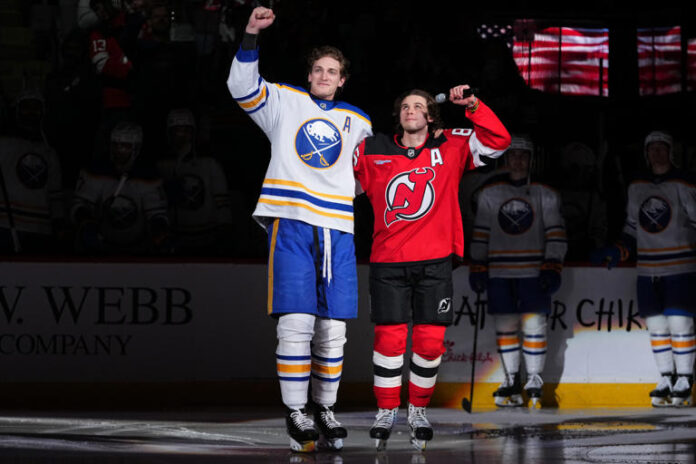

The New Jersey Devils dropped a tightly contested 2–1 decision to the Buffalo Sabres on February 25, 2026, at the Prudential Center, a night that blended pride, momentum swings, and razor-thin margins in the Metropolitan Division race.
Buffalo (33–19) capitalized on key second- and third-period moments, while New Jersey (28–28) mounted a late push that ultimately fell just short. Yet the evening was about more than the final score. It was about resilience, response, and a franchise cornerstone honored in front of a charged home crowd.
For fans across the Garden State tracking every shift, every point, and every playoff implication, this was a game that underscored how narrow the gap can be between victory and setback in the NHL.
A Tribute to Jack Hughes Sets the Tone
Before the puck dropped, the Prudential Center crowd rose in celebration of Jack Hughes, who recently scored the gold-medal-winning goal for Team USA at the Winter Olympics.
The pregame ceremony delivered one of the season’s most electric atmospheres. Hughes’ Olympic achievement elevated not only his personal legacy but the visibility of the Devils organization on the international stage. The ovation reflected pride that extended beyond Newark — it reverberated across New Jersey.
Moments like this matter. They reinforce that the Devils are not just competitive within the NHL; they are producing global-impact talent.
The challenge that followed was transitioning from ceremony to execution against a Sabres team that arrived focused and opportunistic.
Scoring Breakdown: Details That Defined the Night
Buffalo opened the scoring in the second period when Tage Thompson found space and converted, shifting momentum toward the visitors. The Devils responded with pressure but were unable to equalize before intermission.
In the third period, Peyton Krebs extended the Sabres’ lead to 2–0, forcing New Jersey into chase mode.
The Devils’ response came late.
With 2:30 remaining in regulation, Timo Meier cut the deficit to one, finishing a sequence assisted by Hughes. The building erupted. The assist served as a poetic continuation of the pregame tribute — Hughes influencing the game when the Devils needed him most.
New Jersey pushed aggressively in the final minutes, generating zone time and net-front presence, but Buffalo goaltender Ukko-Pekka Luukkonen stood firm, turning aside 27 of 28 shots.
On the opposite end, Jake Allen delivered a steady 28-save performance that kept the Devils within striking distance throughout the night.
Goaltending Stability in a One-Goal Game
In matchups decided by a single goal, goaltending becomes magnified.
Allen’s 28 saves reflected composure under layered Buffalo pressure. He managed rebounds effectively and prevented the score from expanding beyond reach during critical stretches in the second period.
Luukkonen, meanwhile, demonstrated positional discipline and calm under late-game stress. His ability to withstand the Devils’ final surge sealed the outcome.
For New Jersey, the takeaway is not concern in net. It is finishing.
Offensive Execution: Inches from a Different Narrative
The Devils generated opportunities, particularly during extended third-period shifts. Shot volume was competitive, and offensive-zone entries were structured. Yet high-danger conversions were limited.
In games against playoff-caliber opponents, the difference often lies in:
Net-front traffic
Secondary rebound positioning
Quick puck release
Power-play precision
New Jersey’s lone breakthrough came when Meier capitalized late, but the earlier inability to break through on momentum-building shifts defined the scoreboard.
At 2–1, the margin was minimal.
The performance, however, revealed a team capable of competing — and one that must refine finishing details to translate pressure into points.
Metropolitan Division Implications
At 28–28, every point carries weight.
The Metropolitan Division remains one of the NHL’s most competitive landscapes. Buffalo’s 33–19 mark underscores the caliber of opponent the Devils faced. These are not games decided by dominance; they are decided by execution windows.
New Jersey’s push for positioning requires rapid response after setbacks. The parity across the Eastern Conference means that momentum swings can shift standings quickly.
The Devils’ challenge now becomes immediate recalibration as they prepare for the next contest on the schedule.
Emotional Energy vs. Tactical Precision
The emotional high of honoring Hughes created a charged environment. Translating that energy into early scoring is always the objective, yet Buffalo’s defensive structure limited transition lanes and forced the Devils into perimeter sequences for stretches.
Hockey’s mental side is unforgiving. The ability to pivot from celebration to structured aggression separates contenders from competitors.
New Jersey displayed resilience late. The earlier breakthrough simply did not materialize.
Timo Meier’s Late Strike: A Signal of Push
Meier’s goal was more than a late tally; it was a signal that the Devils’ compete level remained intact.
Assisted by Hughes, the goal compressed the ice and reignited urgency. The final minutes saw sustained zone time and desperation puck retrieval, hallmarks of a team unwilling to concede.
Those closing sequences are building blocks. In an 82-game campaign, teams often learn more from one-goal losses than comfortable wins.
The Prudential Center Factor
The home crowd remained engaged throughout the contest. The tribute, the late goal, the final push — each moment reinforced the Devils’ deep connection with their fanbase.
The Prudential Center continues to serve as one of the NHL’s most dynamic environments when stakes intensify. As the Devils move deeper into the season, home-ice energy will remain a strategic advantage.
For fans following comprehensive Devils coverage, this game exemplifies how competitive margins shape the narrative of a season.
Immediate Focus: Response Mode
Elite teams measure themselves by response.
The Devils have demonstrated throughout the season that narrow losses do not linger long in the locker room. Video review will focus on:
Zone entry efficiency
High-danger shot generation
Power-play conversion rate
Defensive lane sealing
When adjustments are precise rather than sweeping, bounce-back performances often follow.
The Broader Picture
This 2–1 result does not define the Devils’ trajectory. It highlights the competitive reality of the Eastern Conference.
The Olympic tribute elevated the franchise’s global stature. Meier’s late goal reaffirmed offensive capability. Allen’s performance ensured stability in net.
Now, the task is converting lessons into points.
For New Jersey, the formula remains intact: pace through the neutral zone, layered forechecking, defensive cohesion, and timely scoring.
The margin between victory and defeat on February 25 was one goal.
In a league where inches matter, that difference is both a reminder and a motivator.
Explore New Jersey will continue delivering in-depth Devils analysis as the season unfolds, tracking every pivotal moment in the pursuit of postseason positioning.
The New Jersey Devils head into Pittsburgh with urgency, clarity, and a sharpened edge.
After a tightly contested 2–1 setback against the Buffalo Sabres on Wednesday, the Devils now turn their focus to a Pittsburgh Penguins squad emerging from the Olympic break and looking to rediscover rhythm. For New Jersey, this is not merely a bounce-back opportunity. It is a divisional pressure point in the Metropolitan race — and a moment to reassert structure, tempo, and identity.
As we continue our in-depth coverage of the New Jersey Devils throughout the season, this matchup carries implications well beyond two points in the standings. It is about response, resilience, and recalibration.
Resetting After Buffalo: Process Over Panic
Wednesday’s loss to Buffalo was not a systemic breakdown. It was a razor-thin margin game defined by execution details: net-front battles, transition timing, and special teams windows that narrowed quickly.
New Jersey generated quality looks but could not fully capitalize. Defensive coverage remained disciplined, and goaltending kept the contest within reach deep into the third period. In a season where parity defines the NHL, games like this often hinge on a single deflection, a missed clearance, or a power-play conversion.
For the Devils, the tape reveals correctable issues — not structural flaws.
The emphasis heading into Pittsburgh is tightening offensive zone puck management, increasing shot volume from the slot, and converting second-chance opportunities. Expect adjustments in forecheck pressure and a renewed push to establish possession early.
Pittsburgh’s Post-Olympic Variable
The Penguins enter this contest with their own storyline: shaking off post-Olympics rust. Breaks can recalibrate veterans and reset nagging injuries, but they also disrupt timing, line chemistry, and in-game rhythm.
That creates volatility.
Pittsburgh’s veteran core has historically thrived in momentum swings, but reestablishing competitive pace after extended downtime can be unpredictable. For the Devils, this is a strategic opening.
The mandate: dictate tempo immediately.
By controlling puck possession early and forcing defensive zone turnovers, New Jersey can test Pittsburgh’s game readiness before the Penguins fully settle into structure.
Metropolitan Division Pressure
Every divisional game amplifies importance in February hockey.
The Metropolitan Division remains one of the NHL’s most competitive landscapes. Point swings between contenders can shift seeding, playoff matchups, and home-ice advantage scenarios. For the Devils, games against Pittsburgh are not isolated calendar entries — they are leverage moments.
The Devils’ identity this season has centered on speed through the neutral zone, aggressive puck retrieval, and dynamic transition scoring. When that system is synchronized, New Jersey forces opponents into defensive scrambling and extended shifts.
In Buffalo, execution lagged by inches.
In Pittsburgh, inches must become advantages.
Key Tactical Adjustments to Watch
Neutral Zone Control
New Jersey thrives when its defense initiates clean breakouts and the forwards attack with layered support. Expect a renewed emphasis on quick outlets and middle-lane drive to stretch Pittsburgh’s coverage.
Special Teams Discipline
Close games demand efficient power play deployment and penalty kill precision. The Devils’ ability to convert early man-advantage opportunities could dictate emotional momentum inside the arena.
Goaltending Stability
In tight 2–1 contests, goaltending remains the stabilizer. If the Devils receive steady performance between the pipes, confidence spreads up the bench. Early saves translate into aggressive offensive posture.
Physical Engagement
Pittsburgh traditionally leans into physical forechecking at home. New Jersey’s response must be assertive but controlled — winning board battles without sacrificing defensive positioning.
Offensive Catalysts
The Devils’ scoring depth remains one of their strongest assets. When lines roll consistently and secondary scorers contribute, New Jersey becomes exceptionally difficult to contain.
The formula in Pittsburgh will hinge on:
Driving traffic to the crease
Creating layered screens
Rebounding shot attempts
Forcing high-danger scrambles
A 2–1 loss underscores the reality that one additional conversion changes the narrative entirely. Offensive assertiveness from the opening shift will be critical.
Defensive Composure in a Road Environment
Road games test communication and composure. Crowd energy, last-change disadvantages, and travel variables compound pressure.
New Jersey’s defensive corps must maintain tight gap control and eliminate east-west passing lanes that Pittsburgh exploits when fully synchronized.
Limiting odd-man rushes will be paramount.
When the Devils defend cohesively, they transition quickly. That transition fuels their offensive identity.
Psychological Edge: Response Defines Contenders
Every competitive season reveals defining characteristics.
Championship-caliber teams respond immediately after narrow losses. They correct details without overhauling systems. They absorb frustration and channel it into pace.
The Devils have shown throughout the season that adversity does not linger long. The expectation heading into Pittsburgh is a focused, high-tempo opening period that reestablishes identity.
A strong first ten minutes could reset the narrative.
Fan Momentum and Garden State Expectations
Back in New Jersey, fan engagement remains intense. Devils supporters have elevated the atmosphere at the Prudential Center all season, and that energy carries onto the road through visible fan travel and social momentum.
The appetite for postseason positioning is real.
Every divisional matchup is tracked, dissected, and debated across the state. The expectation is not merely competitive hockey — it is sustained contention.
Explore New Jersey continues to monitor each pivotal stretch in the Devils’ season, providing comprehensive coverage as momentum swings unfold.
Why This Game Matters Beyond Two Points
In an 82-game schedule, certain games feel heavier.
A bounce-back victory in Pittsburgh accomplishes multiple objectives:
Restores offensive confidence
Reinforces defensive trust
Applies pressure within the Metropolitan standings
Neutralizes narrative drift after Buffalo
Reasserts road competitiveness
It is not just about recovery. It is about recalibration.
The Road Ahead
As the Devils navigate this critical stretch, consistency becomes currency. Divisional wins compound significance late in the season.
Pittsburgh presents both challenge and opportunity — a veteran opponent recalibrating after Olympic pause against a Devils team seeking immediate response.
If New Jersey executes at its identity standard — pace, structure, pressure — the outcome shifts decisively.
For the Devils, the mandate is clear: bounce back, reclaim momentum, and reinforce Metropolitan positioning.
And in Pittsburgh, the opportunity to do exactly that awaits.