
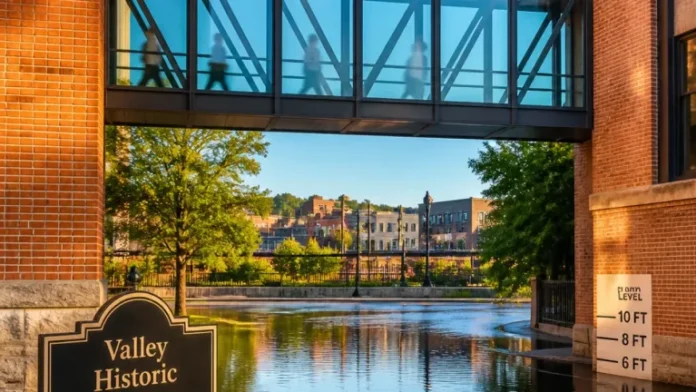

Once a symbol of midcentury urban planning gone wrong, the elevated pedestrian bridge is making a genuine comeback across New Jersey, this time as a practical fix for flood zones, scarce liquor licenses, and other logistical headaches developers can’t solve any other way.
New Jersey’s New Skybridges Aren’t About Skipping the Street. They’re About Surviving It.
Skybridges are having a real moment in New Jersey architecture again, and this time the reasoning behind them looks almost nothing like the version that made them controversial the first time around. Once largely confined to big cities like Newark and Minneapolis, elevated pedestrian bridges are now showing up in proposals for a historic district in Orange, a small downtown in Somerville, and a growing commercial corridor in New Brunswick, driven less by midcentury urban planning theory than by genuinely practical problems developers cannot solve any other way.
A Bridge Built Because the Ground Floor Floods
In Orange’s Valley Historic District, neighboring developments are proposing skybridges specifically to work around the New Jersey Department of Environmental Protection’s strict flood zone regulations. At the Nassau Commons site, the building’s own entrance can see as much as three feet of standing floodwater during a major storm. For developer Vida Capital, that created a genuine life safety problem, ensuring residents could actually get out of the building above the floodplain during an emergency, one a standard ground level exit simply could not solve. Their answer was a skybridge connecting the building directly to its neighbor, giving residents a safe evacuation route that stays entirely above the flood line.
From the Vasari Corridor to the Robert Moses Era
Skybridges themselves are hardly a new invention. The oldest known example still standing is Florence’s 16th century Vasari Corridor, built specifically to let Medici nobility move between palaces without ever having to walk among ordinary citizens below. That same underlying impression, elevated walkways built to separate one class of people from another, followed the format for centuries, and resurfaced directly in American cities during the Robert Moses era of urban planning, when new construction techniques made skybridges considerably easier to build and a new vision of downtowns as workplaces for suburban commuters made them culturally fashionable.
Newark got its first skybridge in 1972, connecting Penn Station directly to the newly built Gateway complex. At the ribbon cutting, Gateway developer Norman Kranzdorf was direct about how much that single bridge had shaped his own decision to build in the city at all, saying the city’s promise to construct the pedestrian connection had contributed strongly to the project moving forward in the first place.
A Structure That Became a Symbol of Something Else Entirely
That original Newark skybridge did not age well in the public imagination. Longtime Star-Ledger historian Charles Cummings, writing in his column Knowing Newark, described the bridge as a physical manifestation of suburban commuters’ fears of the city following the 1967 riots, a structure that let workers, in his words, stay in their glass towers and never mingle with the people below. Cummings drew a direct line between that impulse and the same elitism embedded in the Vasari Corridor centuries earlier, arguing Newark’s skybridge let a largely suburban workforce avoid contact with everyday Newarkers just as effectively as Florence’s nobility had avoided contact with its own commoners.
The New Skybridges Solve Problems, Not Optics
What separates today’s wave of proposals from that earlier, more contentious history is purpose. Rather than functioning as a way to avoid a city’s streets, the current generation of New Jersey skybridges is being built almost entirely to solve specific, unglamorous logistical problems that would otherwise stall a project outright.
Orange: Escaping a Floodplain
Vida Capital’s Nassau Commons skybridge exists purely to give residents a safe evacuation route above a floodplain that regularly submerges the building’s ground floor entrance.
Somerville: Sharing a Scarce Liquor License
Edgewood Properties’ Edge on Main skybridge, spanning Davenport Street and approved by Somerville’s Planning Board in 2021, physically connects two buildings specifically so a single liquor license can legally serve restaurants in both.
New Brunswick: Connecting a Growing Downtown
As the city’s commercial core continues expanding, skybridge proposals are being used to link adjacent developments directly, part of a broader pattern of pedestrian infrastructure keeping pace with new construction.
The Somerville case in particular turns an old zoning headache into a genuinely creative workaround. New Jersey liquor licenses are notoriously scarce and expensive, tightly capped by population based formulas that leave many towns with only a small handful available at any given time. By physically linking two buildings with a skybridge, Edgewood Properties found a way to let a single license effectively serve restaurant space in both structures at once. Devin Healey, a Somerville resident and founder of Engage Social Media Solution, put the logic plainly, calling the move a pretty genius one for a town where liquor licenses are in such short supply that finding an extra one is rarely a realistic option.
Taken together, these projects mark a genuine shift in what a skybridge is actually for in New Jersey. The structures that once symbolized a city’s fear of its own streets are now, at least in Orange, Somerville, and New Brunswick, functioning as the specific engineering fix that makes an otherwise impossible project buildable at all, whether the obstacle is a floodplain state regulators will not budge on or a liquor license the market simply does not have enough of to go around.
















