
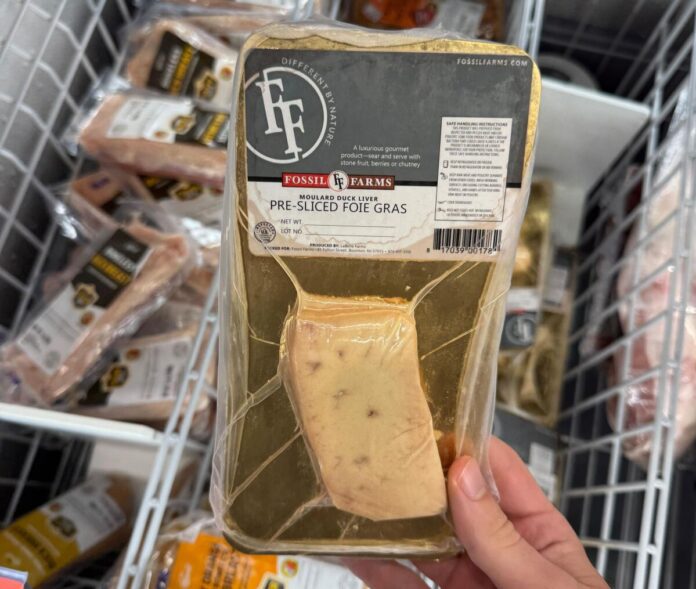

The fattened duck and goose liver delicacy remains legal to buy and serve in the Garden State, even as a pair of bills in Trenton, a tangled legal fight in New York City, and a growing list of international bans put its future on increasingly uncertain footing.
Foie Gras Is Still Legal in New Jersey, But Lawmakers Are Trying to Change That
Foie gras remains fully legal to buy, sell, and eat in New Jersey today, whether at a white tablecloth restaurant or a specialty food shop. That could change. State lawmakers have introduced companion bills, S2648 in the Senate and A2317 in the Assembly, that would prohibit the force feeding of ducks, geese, and other poultry for the production of foie gras within New Jersey, and would separately restrict the sale of any foie gras product unless it comes from a jurisdiction that already bans the practice. Both bills remain in committee as of this year, meaning the delicacy’s legal status in the state has not yet changed, but the political momentum behind restricting it has clearly been building.
The dish itself, French for fat liver, refers to the enlarged liver of a duck or goose, prized in haute cuisine for a rich, buttery texture that has made it a fixture on tasting menus from Paris to New York. Celebrity chefs including Gordon Ramsay have featured it prominently on upscale menus for years, and it remains a genuine luxury item rather than an everyday product, priced and portioned accordingly. What has made it increasingly controversial is not the flavor but the production method traditionally used to achieve it, a process called gavage, in which a tube is inserted into a bird’s throat to force feed it far beyond what it would eat naturally, rapidly enlarging its liver in the weeks before slaughter.
What New Jersey’s Bill Would Actually Do
The New Jersey legislation, if passed, would take a two pronged approach. It would ban the force feeding of birds specifically for the purpose of enlarging their liver beyond a normal size, while carving out an exception for force feeding done to improve a bird’s health rather than fatten it for slaughter. Separately, the bill would prohibit the distribution, sale, or offering for sale of foie gras or any foie gras containing product anywhere in the state, unless that product originated in a jurisdiction that already bans the underlying force feeding practice. Enforcement would fall to the state Secretary of Agriculture, with violators facing a written warning for a first offense and a 100 dollar fine for each offense after that.
It is worth noting that New Jersey has no foie gras farms of its own, so a ban on the production side would have little direct effect on any in state agricultural operation. The sales restriction is where the bill would actually bite, and it would directly affect distributors like D’Artagnan, a major national supplier of fresh foie gras and duck products that is based in Newark. Versions of this legislation have circulated in Trenton for close to two decades without becoming law, reflecting just how difficult it has historically been to move a ban through the full legislative process even when individual lawmakers have repeatedly reintroduced it.
A Patchwork of Bans, and One Very Tangled Legal Fight
New Jersey’s debate is unfolding against a backdrop of growing restrictions elsewhere. California has maintained a statewide ban on the sale and production of force fed foie gras for years, surviving its own extended legal challenges along the way. Washington, D.C. voters are currently weighing a ballot initiative that would impose a citywide sales ban. Internationally, more than twenty countries, including the United Kingdom, Germany, and Israel, have banned either the production or import of force fed foie gras products, reflecting a broader global shift in how the practice is viewed.
New York City’s experience offers the clearest illustration of just how difficult these bans are to actually enforce, even once they pass. The City Council approved a sales ban back in 2019, but the law immediately became tangled in litigation after New York’s state Department of Agriculture and Markets intervened, arguing the city was overstepping its authority by effectively regulating farms located well outside city limits. A trial court initially sided with the foie gras producers in 2024, ruling the ban violated state laws protecting agricultural practices. That changed this past March, when an appellate court reversed course and found the city had acted within its legal authority to regulate what gets sold inside its own borders. Even with that appellate win, however, the ban still has not gone into effect, since a separate lawsuit filed directly by the two upstate New York farms that produce most of the country’s foie gras has kept an injunction in place blocking enforcement until the litigation reaches a final, unappealable resolution. In other words, the city has won the legal argument so far, but restaurants there can still legally serve foie gras today while the fight continues.
The Case Against It, and the Pushback
Animal welfare organizations have built their opposition around several distinct arguments rather than relying purely on an appeal to conscience. Groups including PETA have argued that the force feeding process deliberately induces hepatic steatosis, a fatty liver disease, and that selling a product created through the intentional induction of disease in an animal raises food safety and agricultural standards questions beyond the ethics of the practice itself. Separately, the Animal Legal Defense Fund has pursued litigation targeting producers over marketing language like humane choice, arguing such labeling misleads consumers about standard industry practices. Advocacy groups have also pushed for accountability further up the supply chain, arguing that distributors and high end restaurants share responsibility when they source from producers who fail to meet their own stated welfare claims or attempt to route around regional bans entirely.
Producers and their allies in the farming and restaurant industry see the same set of facts very differently. Their central legal argument, the one that has actually succeeded in New York courts so far, rests on right to farm protections, the idea that state agricultural law exists specifically to shield established farming practices from being effectively outlawed by local or municipal governments that have no jurisdiction over where the farms themselves operate. Industry representatives have also argued that foie gras production represents a small, specialized, and already heavily regulated corner of agriculture, and that singling it out for a sales ban, while continuing to permit other forms of intensive animal agriculture, reflects cultural distaste for a specific luxury product more than a consistent, evenly applied animal welfare standard. Whether New Jersey’s own bills can clear that same legal and political terrain, after roughly twenty years of similar proposals failing to reach a governor’s desk, remains very much an open question as S2648 and A2317 continue working their way through committee in Trenton.
















