
New Jersey’s real estate landscape is moving on several fronts at once this month, from a significant leadership change at a growing affordable housing firm in Jersey City, to a statewide residential market defined by relentless bidding wars and surging Shore prices, to a freshly approved luxury apartment community taking shape in downtown Dover.
Restrepo & Associates Promotes James Barnett to Vice President
James Barnett has been promoted to vice president of Restrepo & Associates, stepping into a considerably larger leadership role at the affordable housing and community development firm four years after helping launch the company in the first place. In his new position, Barnett will oversee the firm’s expanding pipeline of mixed income and affordable housing initiatives across New Jersey, including a growing slate of mixed income homeownership projects taking shape in both Jersey City and South Jersey.
For founder John E. Restrepo, the promotion marks both a leadership transition and the natural next chapter of a professional relationship that has existed since the company’s founding. Restrepo has described Barnett as having been with him since the organization’s inception, and views him as representing the future of affordable housing and community development work in the state.
Among the projects Barnett will now help guide is 62 Sackett Street in Jersey City, where the firm recently secured $15 million in financing for a planned 40 unit condominium development. That mixed income project is designed to serve households earning roughly between $75,000 and $150,000 annually, placing it squarely within the income range many middle class families in Jersey City have found increasingly difficult to serve through traditional market rate housing. The firm is also advancing a second, even larger project at 311 Ocean Avenue in Jersey City’s Greenville neighborhood, where Restrepo & Associates has secured a 17,000 square foot site and plans to develop more than 50 mixed income and affordable condominium units.
Together, these two Jersey City projects reflect the firm’s broader philosophy, centered on creating genuine homeownership opportunities rather than simply expanding the rental housing stock, particularly within communities experiencing rapid development pressure and rising housing costs. Barnett has been direct about why he believes homeownership specifically needs to play a larger role in solving the state’s housing crisis, arguing that true progress comes from empowering families through homeownership so they can share directly in local economic growth rather than watching that growth benefit developers alone.
That philosophy is already visible in the firm’s completed Linden Street Homes project in Salem County, where Restrepo & Associates transformed ten abandoned properties on a distressed block into newly constructed, affordably priced homes. According to the company, those completed homes attracted buyers from across the state while returning long vacant properties to genuinely productive use. Barnett views the project as a template other municipalities, particularly across South Jersey, could replicate using their own vacant land and abandoned housing stock to attract new residents, create real homeownership opportunities, and strengthen local economies in the process.
Beyond its own development projects, Restrepo & Associates also partners with nonprofits, housing authorities, and for profit organizations pursuing affordable housing work throughout New Jersey. Barnett, working alongside a two person project management team, recently helped secure a $1.8 million award for the East Orange Housing Authority and a separate $2 million award for New Brunswick Tomorrow, funding that will support affordable housing initiatives both organizations are pursuing independently. Restrepo himself brings more than 25 years of affordable housing and community development experience to the firm, including earlier work with the Garden State Episcopal Community Development Corporation in Jersey City.
As Barnett assumes greater day to day responsibility over the company’s operations and project pipeline, Restrepo will step back into the role of Board chair, focusing his own attention on strategic growth and investment decisions going forward. Restrepo has expressed full confidence in Barnett’s ability to lead the company with both compassion and innovation as it enters this next chapter. With active projects now underway in both North and South Jersey, the leadership transition places Barnett squarely at the center of the firm’s broader effort to expand mixed income housing and homeownership opportunities across the entire state.
New Jersey’s Statewide Housing Market Remains a Bidding War Frenzy
Zooming out to the broader statewide market, New Jersey’s residential real estate scene is currently defined by an intense bidding war frenzy across its suburbs, a genuine price surge along the Jersey Shore, and aggressive new state legislation aimed at converting vacant commercial office space into desperately needed housing. Despite mortgage rates hovering in the 6 percent range, New Jersey remains one of the fastest selling housing markets anywhere in the country, a genuinely remarkable dynamic given how much higher borrowing costs have climbed compared to just a few years ago.
Commuter heavy towns across Essex and Union counties are experiencing genuinely extreme buyer competition as available inventory has effectively evaporated. Properties in towns like Maplewood and South Orange are routinely closing anywhere from 27 to 33 percent over their original asking price, numbers that reflect just how few homes are actually available relative to buyer demand in these particular commuter corridors. Along the coast, affluent buyers appear to be shrugging off elevated interest rates entirely, making Monmouth and Ocean counties the epicenter of the state’s biggest price gains. Fully half of New Jersey’s top 20 zip codes for value appreciation are located in coastal Shore towns, underscoring just how much premium buyers are currently willing to pay for coastal property despite the broader financing environment.
The statewide numbers back up that intensity. New Jersey’s average home value has climbed to $584,681, up roughly 3.3 percent year over year, while the average single family home is selling remarkably quickly, with a median of just 17 to 33 days before a listing goes pending. That kind of speed, layered on top of steep bidding war premiums in specific commuter towns, reflects a market where genuine supply constraints continue overwhelming even meaningfully higher borrowing costs.
State lawmakers have moved directly to address one piece of that supply shortage through groundbreaking legislation targeting economically stagnant commercial real estate. Under the newly advanced rules, owners of vacant suburban office parks of at least 50,000 square feet, or retail strips of at least 15,000 square feet, can now bypass local municipal zoning boards entirely in order to convert their properties into mixed use residential complexes. To qualify for that streamlined, by right conversion process, a commercial property must demonstrate a vacancy rate of at least 25 percent sustained continuously for 18 months, and any resulting development must designate at least 20 percent of its new units as legally protected affordable housing. That framework gives property owners a genuinely powerful new incentive to convert struggling commercial real estate into housing, while simultaneously guaranteeing that conversions contribute directly to the state’s affordable housing stock rather than adding only market rate supply.
On the commercial side, the market for industrial outdoor storage remains genuinely tight, with national firms including Jadian IOS and Legacy Real Estate continuing to aggressively acquire acreage in strategically located transit corridors like Franklin Township in Somerset County and Linden, land increasingly valued for fleet parking and logistics operations rather than traditional warehousing. Retail redevelopment continues moving forward as well, with the transformation of the former Monmouth Mall in Eatontown now underway, anchored by a new Whole Foods location as the centerpiece of that project’s latest phase.
Capodagli Property Company Advances Its Newest Meridia Community in Dover
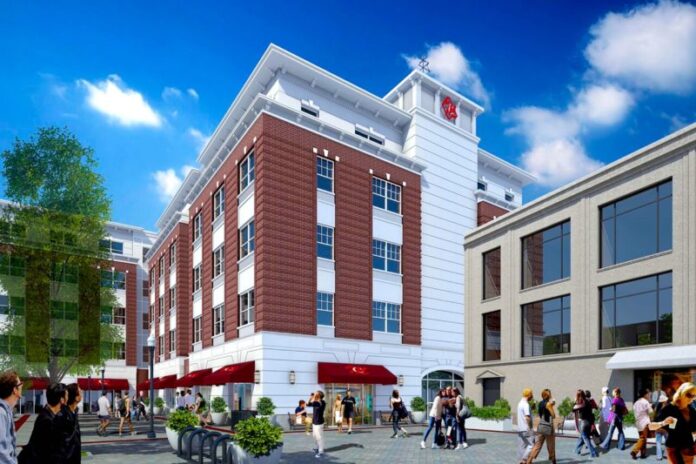
Rounding out this month’s real estate news, Capodagli Property Company has received approval to move forward with its newest Meridia Living community in downtown Dover, continuing the developer’s long running strategy of building transit oriented apartment communities across New Jersey’s downtown corridors. The new Meridia community will bring luxury apartments, ground floor retail space, and upscale resident amenities to a genuinely walkable stretch of downtown Dover, extending Capodagli’s existing footprint in the Morris County town, where the company’s earlier Meridia Transit Plaza development already sits directly alongside the Dover NJ Transit train station.
That existing Dover project offers a useful preview of what residents can likely expect from this newest addition to the Meridia portfolio, having delivered more than 200 one and two bedroom units, underground parking, ground floor retail space, and amenities including a fitness center, community rooms, and dedicated party spaces, all built around direct rail access into New York City. Capodagli has built its broader Meridia Living brand around exactly this kind of transit oriented, downtown focused development strategy, with similar communities already completed in towns including Rahway, Bound Brook, West New York, Rutherford, Hackensack, Linden, and Wallington. The company’s approach consistently emphasizes walkability, direct transit access, and a genuine sense of community built into each property, a formula that has clearly resonated enough with municipalities and residents alike to justify this latest expansion into Dover’s downtown core.
Taken together, this month’s real estate developments reflect a state moving simultaneously on multiple fronts, expanding affordable homeownership opportunities through firms like Restrepo & Associates, wrestling with a red hot, supply constrained residential market from the suburbs to the Shore, and continuing to invest in exactly the kind of transit oriented downtown housing that developers like Capodagli have built their entire business model around delivering.