
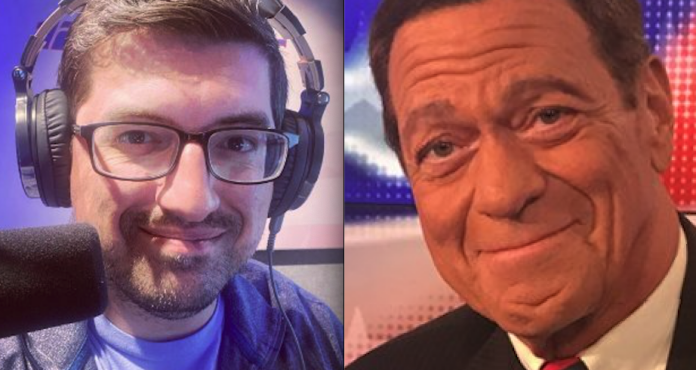

Matt Rooney sat down with Joe Piscopo on Wednesday morning for a wide-ranging conversation that covered both a recent political victory and a fresh round of criticism aimed at Governor Mikie Sherrill’s budget priorities, giving listeners a window into how two of New Jersey’s most prominent conservative media voices are framing the state’s current political moment. Rooney used the appearance to walk through his recent debate performance against State Senator Jon Bramnick, a high-profile clash over the future direction of the New Jersey Republican Party, before pivoting into a detailed breakdown of Sherrill’s spending priorities and where he believes the numbers fall short.
Any honest look at this conversation has to start with an understanding of exactly what kind of program it took place on. Neither The Joe Piscopo Show nor The Matt Rooney Show operates as a straight news broadcast, and neither host claims to be a neutral reporter delivering unbiased coverage. Both programs are built explicitly around persuasion, debate, and opinion, occupying a lane of talk radio where the goal is to argue a position convincingly rather than to present competing perspectives in equal measure. Independent media analysts generally place both shows firmly on the right side of the political spectrum, and how listeners interpret that framing tends to split sharply along existing political lines. Supporters of both hosts see them as straight-talking truth-tellers willing to call out government overreach, high taxes, and progressive policy failures that they feel other outlets soften or ignore. Critics counter that the two programs present information selectively, routinely omit counterarguments, and build narratives that consistently favor Republican positions rather than offering a genuinely balanced accounting of state affairs.
Piscopo himself has described his politics as right of center, occasionally comparing his own views to those of an old-school Democrat rather than a modern conservative, and his on-air persona leans heavily into loyalty, particularly toward his friend Donald Trump, filtered through a populist, working-class sensibility that colors how he discusses nearly every current event. Piscopo does not carry a reputation among fact-checkers for fabricating stories outright, but critics have argued that his close personal and political alliances lead him to repeat disputed talking points or gloss over facts that might complicate the narrative around candidates he personally favors.
Rooney brings a notably different style to his own commentary, one shaped heavily by his day job as a practicing attorney. His writing and on-air arguments tend to be built the way a legal brief is built, anchored in real state data, public tax records, and legislative voting histories rather than pure rhetoric. That evidentiary approach gives his commentary a different texture than a typical talk radio segment, and it is a big part of why his supporters view him as a more rigorous, fact-driven voice within conservative media. At the same time, critics note that while Rooney’s underlying facts are usually accurate and traceable to real public records, the headlines and conclusions he draws from that data are frequently delivered with sharp political spin, and his tendency to focus almost exclusively on negative stories involving Democratic officials creates what opponents describe as an unbalanced picture of the state’s actual condition. Mainstream, independent fact-checking organizations do not flag either Piscopo or Rooney as regular sources of fabricated hoaxes or outright fake news, but both men are unmistakably ideological commentators who interpret events through a distinctly conservative lens rather than attempting a multi-sided presentation of the news.
Piscopo’s own New Jersey roots run deep, and the affection is mutual enough that he earned the nickname Jersey Joe long before his induction into the New Jersey Hall of Fame. Rather than chasing a television comeback, Piscopo has built a genuinely successful second act in conservative talk radio, syndication, and live musical performance. His main daily project, The Joe Piscopo Show, airs live every weekday morning from six to ten o’clock Eastern on New York’s AM 970 The Answer, blending political commentary with morning news coverage across a full four-hour broadcast. For listeners outside the station’s broadcast footprint, every episode is chopped into a daily podcast distributed across major platforms, keeping the show accessible well beyond the New York metro area. Salem Media clearly sees long-term value in that reach, having signed Piscopo to a multi-year contract extension that keeps him behind the microphone through at least the end of 2028, recording either from the studio or from a home setup in New Jersey depending on the day.
Piscopo’s on-air identity extends well beyond politics, too. On weekends, he hosts Sundays with Sinatra on 77 WABC Music Radio, a nationally syndicated program built around his genuine, real-life friendship with Frank Sinatra, featuring deep dives into Sinatra’s catalog, behind-the-scenes stories, and live music showcases that give listeners a very different side of Piscopo than his weekday political commentary. His recent public appearances have reflected that same blend of political and entertainment worlds, including a notable moment in April 2026 when Piscopo attended the American Film Institute’s gala honoring his former Saturday Night Live castmate Eddie Murphy, speaking warmly with the press about the two men’s legendary run together on the show during the 1980s. Piscopo has continued touring nationally as well, performing live musical-comedy sets, stand-up, and big-band tribute shows that keep him connected to the entertainment career that first made him a household name.
Rooney’s own profile reflects a similarly layered career, though built around South Jersey’s legal and political institutions rather than entertainment. Beyond his media presence, Rooney hosts The Matt Rooney Show, a weekly program airing Sunday evenings from seven to ten o’clock on Philadelphia’s Talk Radio 1210 WPHT, a station with heavy reach across South Jersey and the greater Philadelphia region. Every episode is archived and widely distributed across major podcast platforms, giving the show a life well beyond its original Sunday night broadcast window. Rooney is arguably best known, though, as the founder and editor-in-chief of Save Jersey, an influential conservative political blog he launched back in 2008 that has since become a genuine daily destination for New Jersey political junkies, covering state tax issues, union politics, and Republican strategy with the kind of granular, insider detail that keeps a dedicated readership coming back.
Unlike many full-time media personalities, Rooney has continued working directly inside New Jersey’s legal and political systems rather than stepping away from them. He practices family law as a shareholder at Rooney Donohue P.C., based in Avalon, and has previously served as a municipal prosecutor and solicitor for multiple South Jersey townships. His legal standing recently expanded further when he took on the presidency of the Camden County Bar Association, adding a layer of institutional legal credibility to his already substantial media footprint. Rooney also serves as executive director for the New Jersey chapter of the America First Policy Institute, a role that places him at the intersection of grassroots conservative media and more formal policy advocacy work. That dual role as both commentator and political operator is exactly what put him on stage against Bramnick in the first place, part of an ongoing, very public argument over whether moderation or a sharper conservative identity offers New Jersey Republicans their best path back to statewide relevance, a debate Rooney has clearly not stopped fighting for, on air or off.
















