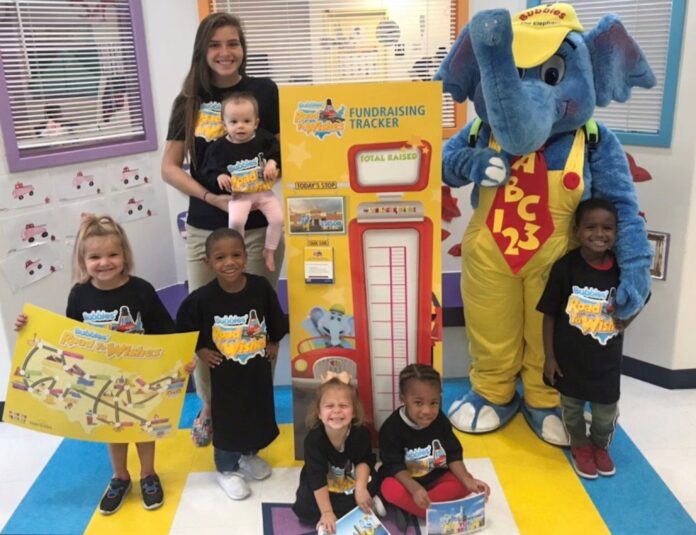

In Blackwood, four-year-olds wrote letters to children they had never met, children whose lives had been disrupted by diagnoses none of them could fully articulate but whose circumstances they understood in the way young children understand hard things — through the feeling of it, through the act of doing something about it. In Cedar Grove, a similar scene played out in a different classroom, with the same purpose and the same earnestness. Across April, the annual month-long fundraising period The Learning Experience designates for its “Let’s Grant Wishes” campaign benefiting Make-A-Wish, the preschoolers, families, and staff at TLE’s Blackwood location raised $10,100, while their counterparts in Cedar Grove raised $10,303. Together, two New Jersey campuses of a franchise with more than 80 locations across the state contributed more than $20,400 toward the wishes of children living with critical illnesses — a figure that is all the more notable for having been generated, in substantial part, by children who are themselves still years away from elementary school.
The Learning Experience is a family-founded early childhood education company that has been operating since 2002, built around what its founders describe as a mission of making a positive difference in the lives of children, their families, and the communities those families call home. The company operates more than 480 centers nationwide, with additional locations in development across the United States and United Kingdom, and its New Jersey presence — more than 80 centers spread across the state from Bergen County to Camden County — reflects a company that established its foundational growth in a state with one of the most active early childhood education markets in the country. The curriculum the company uses, called L.E.A.P. — Learning Experience Academic Program — is built around play-based learning designed to nurture children’s cognitive, social, physical, and emotional development simultaneously, using a cast of original characters that carry specific instructional purposes throughout the school year.
Among those characters, two carry the weight of the company’s philanthropic identity most directly: Grace the Greyhound and Charity Chihuahua, the mascots who guide TLE’s philanthropy curriculum throughout the year and who became the named companions of the Blackwood center’s April fundraising activities. The Let’s Grant Wishes campaign is not a single fundraising day or a guest speaker appearance — it is a month of integrated activities in which children are asked to be active participants in something genuinely consequential, through means that are calibrated to what a three- or four-year-old can meaningfully do. At the Blackwood center, guided by center leaders Tracy Hundley, Alexandra Ahl, Lee Handis, and Nicole Ritter, the children wrote encouraging letters to wish children — children enrolled in Make-A-Wish programs who are waiting for or recovering from a granted wish, children who received something handwritten and personal from a peer they will likely never meet. They participated in fundraising events that asked them to understand, at the most basic and human level, that giving something — whether time, effort, or the few dollars a child can represent at a bake sale — can change a specific other person’s experience of a difficult circumstance.
This is the ambition of the philanthropy curriculum that TLE has built into its educational framework, and it is worth understanding what makes that ambition specific rather than generic. Most early childhood programs incorporate some version of kindness and sharing into their social-emotional learning curriculum, and most of those programs operate at the level of classroom behavior — sharing toys, taking turns, using kind words. TLE’s Let’s Grant Wishes campaign is asking for something different: not that children share with a classmate they can see and interact with, but that they contribute to the wellbeing of a child they will never know, whose illness they cannot see, whose wish they may not fully comprehend, in a transaction where the connection between the act and the consequence is entirely abstract. That is a genuinely advanced developmental task, and the fact that the Blackwood and Cedar Grove centers raised more than $10,000 each in a single month suggests that the children and families who participate in the campaign find the abstract connection meaningful enough to invest in it.
Since The Learning Experience launched its partnership with Make-A-Wish in 2018, TLE centers nationwide have collectively raised more than $11.5 million for the organization. That cumulative figure, generated across April fundraising campaigns at hundreds of centers in multiple states over nearly a decade, represents the practical output of a corporate decision to build charitable giving into the educational model rather than offering it as a separate, optional activity for interested families. The Let’s Grant Wishes campaign is held during April in celebration of what Make-A-Wish recognizes as World Wish Day and now World Wish Month — a calendar alignment that the organization and TLE have used to amplify the campaign’s visibility and to connect the classroom activity explicitly to a broader national conversation about the role that wish-granting plays in the lives of children navigating critical illness.
Make-A-Wish grants wishes to children between the ages of two and a half and eighteen who have been diagnosed with a critical illness, with a mission built around the documented evidence that the experience of having a wish granted — whatever form that wish takes, from a celebrity meeting to a trip to a specific destination to a specific material object that has captured a child’s imagination — produces measurable improvements in the emotional and psychological wellbeing of children whose lives have been significantly constrained by illness and medical treatment. The research base behind Make-A-Wish’s model is more substantive than the organization’s feel-good public reputation sometimes suggests: multiple peer-reviewed studies have documented improvements in physical health indicators, treatment compliance, and emotional resilience in wish recipients, outcomes that the medical community has taken seriously enough to make wish referrals a routine part of pediatric oncology and other serious illness care in many hospital systems. The $10,100 raised in Blackwood and the $10,303 raised in Cedar Grove are not abstract philanthropic contributions to a feel-good cause. They are contributions toward specific, documented interventions that change specific children’s experiences of illness.
The Learning Experience’s broader presence in New Jersey makes both the Blackwood and Cedar Grove results visible within the context of a statewide organizational footprint large enough to create meaningful aggregate impact. With centers operating across South Jersey, Central Jersey, and North Jersey, TLE’s New Jersey campuses collectively represent one of the largest single-franchise presences in the state’s early childhood education market. In South Jersey alone, TLE centers in Cherry Hill, Marlton, Mount Laurel, Voorhees, and Medford serve families across a regional geography that encompasses several of the state’s most active suburban communities, while North Jersey campuses like Cedar Grove operate within the dense early childhood market of Essex County. The diversity of those communities — their different economic profiles, their different demographics, their different relationships to both early childhood education and charitable giving — makes the consistent theme of both the Blackwood and Cedar Grove results worth noting: across different New Jersey communities, TLE’s philanthropy curriculum is producing families willing to mobilize around a fundraising campaign that benefits children they will never know, and generating results that exceed what most adult-led charitable campaigns at similar community scale regularly achieve.
For New Jersey families considering early childhood education options, the Let’s Grant Wishes results from Blackwood and Cedar Grove add a specific dimension to the TLE value proposition that goes beyond the standard metrics of curriculum quality, safety record, and facility amenities that typically dominate enrollment decisions. The question of whether a preschool teaches children to be active participants in their own community — not in the abstract developmental sense, but in the specific, documented, dollars-raised-and-letters-written sense — is a question that matters to a growing share of parents whose own approach to community and charitable engagement shapes how they want their children to understand the world. The $20,400 raised across two New Jersey TLE campuses in April answers that question with some specificity. The classrooms at Blackwood and Cedar Grove are teaching children that their actions affect people they will never see, and the children and families in those classrooms have demonstrated that they find that teaching worth acting on.