
Rutgers University is preparing to take another decisive step in the evolution of its athletic infrastructure and financial model, as the Board of Governors is scheduled to vote on April 23, 2026, on a resolution that would rename Yurcak Field to RWJBarnabas Health Stadium. While on the surface the move represents a naming rights update, the implications run far deeper, signaling a continued alignment between higher education, healthcare leadership, and the business of collegiate athletics in New Jersey.
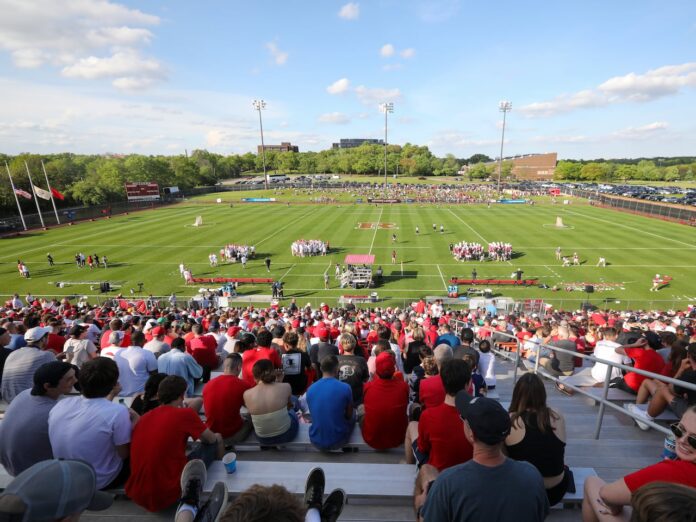
The facility at the center of this decision, Yurcak Field, has long served as a foundational venue within the Rutgers athletic ecosystem. With a capacity of approximately 5,000, it is home to the university’s men’s and women’s soccer programs as well as its lacrosse teams. Beyond its physical footprint, the venue has been an important part of Rutgers’ athletic identity for decades, hosting competition, development, and community engagement in equal measure. The proposed transition to RWJBarnabas Health Stadium represents both a modernization of that identity and a recalibration of how collegiate venues are positioned within broader institutional partnerships.
At the core of this transformation is Rutgers’ expanding relationship with RWJBarnabas Health, one of the largest and most influential healthcare systems in the state. Since 2018, the partnership has been anchored by a long-term commitment valued at $1 billion over 20 years, designed to advance medical research, healthcare innovation, and academic collaboration. The naming rights proposal for Yurcak Field is a natural extension of that relationship, reinforcing the integration between Rutgers’ academic mission and its athletic platform.
This is not the first visible manifestation of the partnership across Rutgers athletics. RWJBarnabas Health already holds naming rights to the university’s Athletic Performance Center, a critical training hub for basketball and gymnastics programs. By extending its presence to a competitive venue like Yurcak Field, the organization deepens its footprint within Rutgers’ public-facing athletic experience, connecting its brand directly with student-athletes, fans, and the broader New Jersey community.
The proposed renaming also reflects a broader strategic direction under Rutgers Athletic Director Pat Hobbs, who has aggressively pursued naming rights agreements and commercial partnerships as part of a comprehensive effort to stabilize and grow the department’s financial base. In an era where collegiate athletics are increasingly shaped by revenue generation, media exposure, and Name, Image, and Likeness dynamics, Rutgers has moved proactively to position itself within this evolving landscape.
This strategy is already visible across multiple flagship venues. SHI Stadium stands as the home of Rutgers football, carrying the naming rights of Somerset-based SHI International, while Jersey Mike’s Arena—formerly known as the RAC—serves as the centerpiece for basketball and wrestling. Each of these partnerships reflects a deliberate effort to align Rutgers athletics with major corporate stakeholders, creating a diversified revenue model that supports long-term competitiveness.
The introduction of Scarlet Knight Enterprises further reinforces this direction. Designed as a centralized entity to manage naming rights, sponsorships, and NIL opportunities, the initiative represents a structural shift toward a more sophisticated, business-oriented approach to collegiate athletics. By consolidating these functions under a unified framework, Rutgers is positioning itself to compete more effectively within the increasingly complex financial ecosystem of college sports.
At the same time, the proposed renaming raises important considerations regarding legacy and tradition. Yurcak Field was originally named in 1994 in honor of Ronald N. Yurcak, a 1965 All-American lacrosse player and a significant benefactor to the university. His contributions have been woven into the history of Rutgers athletics, and any transition involving the venue carries an inherent responsibility to preserve that legacy. University naming practices often incorporate measures to maintain recognition of original honorees within the facility, whether through dedicated spaces, commemorative installations, or continued historical acknowledgment. As Rutgers moves forward, balancing progress with respect for its past will remain a critical component of the process.
From a broader perspective, the potential transformation of Yurcak Field into RWJBarnabas Health Stadium reflects a larger trend across collegiate athletics, where institutional partnerships are becoming central to both identity and sustainability. Universities are increasingly leveraging their athletic platforms as extensions of their academic and research missions, creating ecosystems where branding, community engagement, and innovation intersect.
For Rutgers, this approach is particularly significant within the context of New Jersey’s competitive sports and academic landscape. As one of the state’s flagship public institutions, Rutgers carries the dual responsibility of representing New Jersey on the national stage while serving as a hub for local development and opportunity. Strategic partnerships like the one with RWJBarnabas Health enable the university to fulfill both roles, strengthening its infrastructure while enhancing its visibility and impact.
The timing of this proposal also aligns with a period of heightened attention on Rutgers athletics, with football, basketball, and Olympic sports programs all navigating a rapidly changing competitive environment. From high-profile scheduling decisions to ongoing investment in facilities and talent, the university is actively shaping its trajectory within the Big Ten and beyond. Coverage across Explore New Jersey’s Rutgers Scarlet Knights section continues to track these developments, highlighting the intersection of performance, strategy, and institutional growth.
As the Board of Governors prepares to cast its vote, the outcome will represent more than a naming decision. It will serve as a marker of Rutgers’ ongoing transformation—a signal of how the university is adapting to the realities of modern collegiate athletics while leveraging its partnerships to build a more resilient and forward-looking program.
In redefining Yurcak Field, Rutgers is not simply changing a name; it is reinforcing a vision. A vision where athletics, healthcare, education, and business converge to create a model that is both sustainable and ambitious. A vision that reflects the evolving identity of the Scarlet Knights and positions them firmly within the future of college sports.