
New Jersey’s influence on the national wrestling stage has long been undeniable, but the latest NCAA Wrestling Championships have brought that dominance into even sharper focus. From coaching excellence to controversial championship moments, the performances and storylines surrounding Rutgers Scarlet Knights wrestling and Princeton Tigers wrestling underscore a broader truth: New Jersey is not just participating in college wrestling’s biggest moments—it is helping define them.
At the center of the conversation is Chris Ayres, a New Jersey native whose impact on the sport has been recognized at the highest level. Ayres, widely credited with elevating Princeton’s wrestling program into a nationally competitive force, earned a major honor at the NCAA Championships—an acknowledgment that reflects years of sustained program-building, athlete development, and strategic leadership. His recognition is not simply a personal milestone; it is a reflection of the infrastructure and talent pipeline that continues to position New Jersey as a cornerstone of collegiate wrestling.
Ayres’ tenure at Princeton redefined expectations for Ivy League wrestling. Traditionally viewed as academically elite but athletically constrained, Princeton emerged under his leadership as a legitimate contender on the national stage. That transformation required more than recruiting—it demanded a cultural shift, one that emphasized discipline, technical development, and a belief that Ivy League athletes could compete with—and defeat—the best programs in the country. The results have been evident not only in team performance but in the caliber of individual wrestlers produced during his tenure.
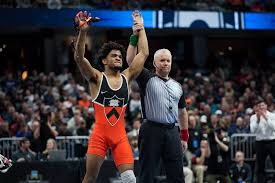
That legacy was on full display during the NCAA Championships, where Princeton’s Marc-Anthony McGowan reached the national final in a performance that captured both the promise and the volatility of elite-level competition. McGowan’s path to the championship match reflected the technical precision and competitive resilience that have become hallmarks of the program. Yet the final itself introduced a layer of controversy that has sparked debate across the wrestling community.
In a match defined by strategy as much as execution, McGowan’s loss on a stalling call drew immediate and vocal प्रतिक्रिया from the crowd. Boos echoed throughout the arena, signaling a collective reaction to a decision that many viewed as pivotal—and potentially decisive. In wrestling, where control, pace, and positioning are as critical as scoring moves, the interpretation of stalling can alter the trajectory of a match in an instant. That reality was fully realized in this championship bout, where a single call became the focal point of both the outcome and the broader discussion that followed.
For McGowan, the result represents both an achievement and a moment of frustration. Reaching the NCAA final places him among the elite competitors in the country, yet the manner of the loss ensures that the conversation will extend beyond the match itself. These are the moments that define careers—not only through results, but through the narratives that surround them. In this case, the narrative is one of excellence intersecting with controversy, a reminder of how thin the margins can be at the highest level of collegiate wrestling.
Within the broader context of New Jersey’s wrestling ecosystem, these developments highlight the state’s continued prominence in producing and shaping top-tier talent. As consistently explored through Explore New Jersey’s dedicated college sports coverage, the region’s impact extends beyond individual programs. It is embedded in a network of high school pipelines, collegiate institutions, and coaching leadership that collectively sustain a level of competitiveness few states can match.
Rutgers, in particular, remains a central pillar of that ecosystem. The Scarlet Knights have built a program that reflects both the state’s wrestling tradition and its forward momentum, consistently competing at a national level while developing athletes who embody the discipline and intensity associated with New Jersey wrestling. The presence of Rutgers alongside Princeton at the NCAA Championships reinforces the depth of talent within the state, illustrating a landscape where multiple programs can thrive simultaneously.
What emerges from this year’s championships is a portrait of New Jersey wrestling at a critical juncture—one defined by both achievement and ongoing evolution. The recognition of Chris Ayres affirms the importance of coaching leadership in shaping successful programs, while the experience of Marc-Anthony McGowan highlights the unpredictable and often contentious nature of competition at the highest level.
These dual narratives are not contradictory; they are complementary. Together, they reflect the full spectrum of what it means to compete in college wrestling today: the preparation, the performance, the scrutiny, and the stakes. For New Jersey, they also reinforce a broader identity—one built on resilience, technical excellence, and a willingness to engage with the sport at its most demanding levels.
As the NCAA Championships conclude, the impact of these moments will extend far beyond a single weekend. They will influence recruiting, program development, and the perception of New Jersey wrestling on a national scale. More importantly, they will continue to shape the athletes and coaches who carry the state’s legacy forward.
In a sport where every match is a test of both physical and mental endurance, New Jersey has once again demonstrated its ability to compete, to lead, and to command attention on the national stage. The stories emerging from this year’s championships are not isolated events—they are part of a larger, ongoing narrative that continues to position the state at the forefront of collegiate wrestling in America.