
The New Jersey Devils have arrived at a critical inflection point, one that will shape not only the direction of the franchise in the immediate future but also its long-term trajectory within the National Hockey League. Following their official elimination from 2026 Stanley Cup Playoff contention on April 7 in a decisive loss to the Philadelphia Flyers, the organization has moved swiftly into a period of evaluation, restructuring, and recalibration. What has unfolded over the past week is not simply a response to a disappointing finish—it is the beginning of a transformative offseason that will define the next era of Devils hockey.
For those following the team closely through Explore New Jersey’s dedicated New Jersey Devils coverage, the significance of this moment is unmistakable. The foundation of a talented roster remains intact, but the leadership structure above it is now in flux, creating both uncertainty and opportunity at the highest levels of the organization.
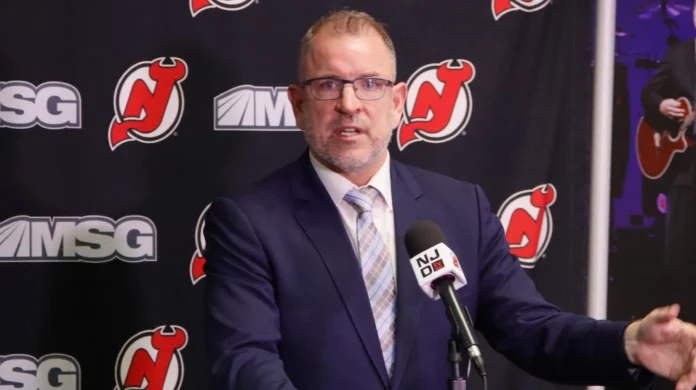
The most immediate and consequential development came on April 6, when the Devils formally parted ways with President of Hockey Operations and General Manager Tom Fitzgerald, ending a nearly six-year tenure that oversaw both the rebuilding phase and the early stages of the team’s competitive resurgence. Managing Partner David Blitzer made it clear that the organization is seeking a new direction, signaling that ownership believes the current trajectory—while not devoid of progress—has plateaued short of expectations.
This decision has cascading implications across every layer of the franchise. A new front office leader, or potentially a restructured executive hierarchy featuring both a President of Hockey Operations and a General Manager, will be tasked with redefining the team’s identity, refining its roster construction strategy, and aligning all hockey operations under a unified vision. The urgency of this hire cannot be overstated, as the Devils enter an offseason that demands decisive action across multiple fronts.
Compounding the uncertainty is the status of head coach Sheldon Keefe, whose future will be evaluated at the conclusion of the season. Keefe’s own candid assessment of the team’s elimination as “embarrassing” underscores the internal recognition that performance fell short of the standard expected from a roster featuring elite young talent. While the team showed signs of improvement late in the season—particularly with increased pace, defensive activation, and more cohesive offensive support—the broader inconsistency has left his position far from secure. Historically, front office changes often lead to coaching changes, but the final decision will ultimately rest with the incoming leadership group and their assessment of fit, philosophy, and long-term alignment.
Despite the turbulence at the organizational level, individual performances have continued to provide reasons for optimism. Jack Hughes remains the centerpiece of the franchise, recently earning recognition as the NHL’s Second Star of the Week and continuing to produce at an elite level with 72 points on the season. His dynamic offensive presence, combined with his role as a foundational piece of the Devils’ identity, reinforces the notion that this is not a rebuilding team, but rather one that is underperforming relative to its potential.
Defenseman Brenden Dillon’s nomination for the Bill Masterton Memorial Trophy further highlights the resilience and professionalism within the locker room. The award, which honors perseverance and dedication to hockey, reflects not only individual character but also the broader culture that the organization aims to sustain even amid structural change.
Recent roster moves, including the recall of winger Brian Halonen and center Marc McLaughlin from the Utica Comets, indicate that the Devils are continuing to evaluate depth options as the season winds down. These decisions, while incremental in the short term, are part of a larger assessment process that will inform offseason priorities.
At the center of the franchise’s immediate future is the search for a new executive leader, a process that is already generating significant discussion across league circles. Among the most frequently mentioned candidates is Sunny Mehta, currently serving as Assistant General Manager of the Florida Panthers. A New Jersey native with prior experience in the Devils’ analytics department, Mehta is widely regarded as a leading contender, particularly given his role in helping construct a championship-caliber team in Florida. His profile aligns with the modern NHL emphasis on data-driven decision-making and integrated roster strategy.
Brendan Shanahan, a former Devils player and recently the President of the Toronto Maple Leafs, represents another high-profile option, particularly if ownership opts to install a dual-layer leadership structure. His experience in overseeing a major market franchise and navigating complex organizational dynamics would bring a different dimension to the role.
Jason Spezza, currently an Assistant General Manager with the Pittsburgh Penguins, has emerged as a rising executive voice within the league, while Mike Gillis, known for his analytical approach and success with the Vancouver Canucks, continues to draw interest as an experienced architect capable of reshaping a roster. Additional names such as John Chayka and Tyler Dellow reflect the league’s ongoing shift toward innovation and analytics, while Doug Armstrong stands as a longshot but highly accomplished candidate whose track record includes championship success.
Whoever assumes leadership will inherit a roster with both strengths and structural challenges. The Devils are projected to have approximately $12.18 million in salary cap space, a figure that provides flexibility but also necessitates careful allocation. One of the most pressing priorities will be addressing the future of captain Nico Hischier, who becomes eligible for a contract extension on July 1. As the team’s leader and a central figure in its identity, securing Hischier’s long-term commitment will be a defining moment for the new regime.
Equally significant is the situation surrounding Simon Nemec, a young defenseman whose development and potential value have positioned him as both a cornerstone and a possible trade asset. Balancing immediate roster needs with long-term upside will be a recurring theme in the Devils’ decision-making process.
The composition of the blue line presents another area requiring immediate attention. Carrying multiple NHL-caliber defensemen has created a logjam that is no longer sustainable, and the organization will need to make strategic moves to create both clarity and cap flexibility. Veterans such as Dougie Hamilton and Brenden Dillon could factor into these discussions, particularly as the team evaluates how to optimize its defensive structure while maintaining offensive contributions from the back end.
Beyond these headline issues, a series of secondary decisions will collectively shape the roster. Dawson Mercer’s upcoming contract year, Stefan Noesen’s role following injury, Cody Glass’s recent offensive surge, and the future of players like Maxim Tsyplakov all represent pieces of a larger puzzle. The development and contract trajectories of younger players, including Arseny Gritsyuk and Paul Cotter, will further influence the team’s depth and versatility.
In goal, the situation surrounding Jacob Markstrom introduces another layer of complexity. Evaluating performance, contract structure, and potential market options will be essential as the Devils seek stability in one of the most critical positions on the ice.
What distinguishes this moment for the New Jersey Devils is not the absence of talent, but the need for cohesion, clarity, and execution at the organizational level. The core—anchored by Hughes, Hischier, and a supporting cast of skilled players—remains capable of competing at a high level. The challenge lies in constructing a system, both on and off the ice, that maximizes that potential.
The coming weeks will define the narrative. The hiring of a new President of Hockey Operations and General Manager will set the tone, establishing the philosophical framework that will guide every subsequent decision. From coaching evaluations to roster adjustments, from contract negotiations to draft strategy, each move will contribute to a broader effort to reestablish the Devils as a consistent contender.
For fans across New Jersey and beyond, this is a moment of recalibration rather than retreat. The disappointment of a missed playoff opportunity has created the conditions for meaningful change, and with the right leadership, the path forward remains both viable and compelling. The Devils are not starting over—they are refining, retooling, and preparing to take the next step in a journey that is far from complete.