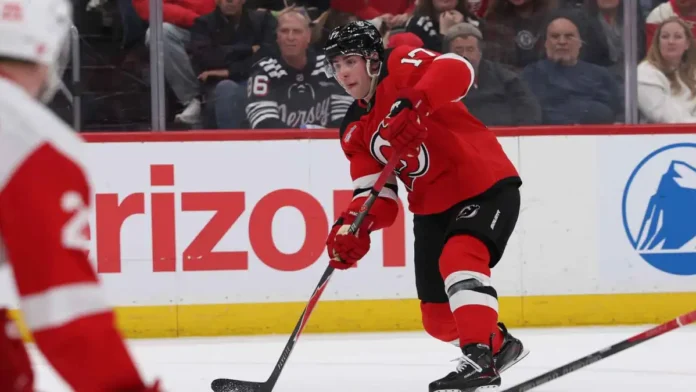

The New Jersey Devils are entering one of the most important offseasons in recent franchise history, and the next several months could ultimately determine whether the organization successfully transforms from an exciting emerging contender into a fully realized Stanley Cup threat capable of sustaining championship-level relevance deep into the future. Across the NHL, teams spend years attempting to assemble the kind of foundational talent base the Devils already possess, yet the modern salary cap era has made maintaining that core increasingly difficult once young stars begin reaching expensive second and third contracts. For New Jersey, the summer of 2026 now arrives at the exact intersection where elite young talent, rising financial pressure, roster construction decisions, trade speculation, and organizational timing all begin colliding simultaneously.
At the center of virtually every major Devils conversation sits 22-year-old defenseman Šimon Nemec, whose rapidly evolving situation has become one of the NHL’s most closely watched offseason storylines. Overseas reports recently ignited widespread speculation after claims surfaced suggesting Nemec had become frustrated with his role, deployment, and contractual situation to the point where he had requested a trade from the organization. While both Nemec and subsequent source reporting have since denied the existence of any formal trade demand, the intensity of the speculation itself revealed something equally important: league-wide executives and observers clearly understand that New Jersey may soon face an increasingly difficult balancing act regarding one of the league’s most gifted young defensemen.
The reality surrounding Nemec is considerably more complicated than simple rumor-cycle drama. This is not a fringe prospect frustrated over playing time. Nemec remains one of hockey’s premier young blue-line talents, a former second overall draft pick possessing elite skating ability, puck movement, transitional vision, and offensive upside that many evaluators still believe projects toward future top-pairing status. Players with that profile rarely become available, which explains why even loosely connected trade rumors immediately generate enormous attention throughout the hockey world.
Yet the Devils’ organizational structure has undeniably created a complicated environment around his future. The franchise already possesses one of the NHL’s most expensive blue-line financial structures, anchored by Dougie Hamilton and Luke Hughes both carrying contracts worth approximately $9 million annually. Hughes, in particular, has rapidly emerged as one of the league’s most dynamic young offensive defensemen and appears fully cemented as a long-term cornerstone around whom New Jersey intends to build. Hamilton meanwhile remains a significant veteran presence capable of producing elite offensive numbers from the back end when healthy.
That financial reality creates inevitable pressure regarding how Nemec ultimately fits into the organization’s long-term structure. Even if no genuine trade request exists, the broader hockey conversation surrounding his future reflects legitimate questions about role allocation, cap flexibility, development trajectory, and asset management. New Jersey now faces one of the most difficult roster-building dilemmas in modern hockey: how to maximize multiple elite young defensemen simultaneously while maintaining enough financial flexibility to improve the forward group and preserve roster depth.
Internally, the Devils almost certainly still view Nemec as a massive part of their future. His upside remains extraordinary, and organizations rarely move young right-shot defensemen with top-pairing potential unless the return dramatically alters the trajectory of the franchise elsewhere. However, rival teams throughout the NHL also recognize that New Jersey’s current roster structure may eventually force difficult choices, particularly if the Devils aggressively pursue additional top-six forward help this offseason.
That possibility alone explains why Nemec’s name continues surfacing within speculative trade discussions connected to impact offensive players. Around the league, teams searching for elite young defensemen understand that New Jersey may possess one of the rare assets capable of landing immediate top-line scoring help if management ultimately decides accelerating contention outweighs maintaining long-term blue-line surplus.
Importantly though, the Devils are not operating from desperation. This remains one of the NHL’s strongest young cores, led by captain Nico Hischier, superstar center Jack Hughes, Luke Hughes, Jesper Bratt, Timo Meier, and a growing collection of high-end supporting talent. The organization’s challenge is not acquiring foundational players from scratch. The challenge is optimizing an already talented roster before escalating contracts eventually limit flexibility even further.
That reality places enormous importance on Nico Hischier’s looming extension eligibility beginning July 1. The Devils captain has steadily evolved into one of the NHL’s most respected two-way centers and emotional leaders, embodying nearly every quality organizations seek in franchise leadership. Calm, intelligent, defensively elite, offensively reliable, and universally respected throughout the locker room, Hischier has become deeply intertwined with the identity of the modern Devils era.
His next contract therefore carries significance extending well beyond finances alone. An eight-year extension would effectively formalize Hischier as one of the defining faces of the organization throughout the remainder of his prime years while reinforcing the stability of the Devils’ leadership core during a period of escalating roster complexity.
From a hockey standpoint, Hischier’s value remains immense. While flashier superstars often dominate national attention, the Devils understand how extraordinarily difficult it is to find elite two-way centers capable of impacting every phase of the game. Hischier drives play responsibly, handles heavy defensive assignments, contributes offensively, kills penalties, wins difficult matchup minutes, and stabilizes the team emotionally in high-pressure situations. Players with that profile become foundational pieces for sustained contenders.
Securing his long-term future would also send an important message regarding organizational continuity during an offseason already filled with speculation surrounding contracts, cap structure, and trade possibilities. Stability around the captaincy matters, particularly for younger players continuing to develop within the organization’s system.
Meanwhile, the Devils also enter the offseason armed with the 12th overall pick in the upcoming 2026 NHL Draft following the results of the draft lottery. That selection places New Jersey in a fascinating strategic position. While some franchises drafting in the middle of the first round remain focused primarily on long-term prospect development, the Devils occupy a very different competitive timeline. Their roster is already built to compete now, which naturally creates questions regarding whether management views the pick itself as more valuable as a trade asset rather than a developmental investment.
The 12th overall selection could potentially become an important component within broader trade negotiations if New Jersey aggressively pursues immediate roster upgrades. Teams rebuilding or retooling frequently target premium draft capital in exchange for established NHL talent, and the Devils possess enough young depth to plausibly move futures if they believe another major addition could significantly elevate their championship ceiling.
At the same time, maintaining a healthy prospect pipeline remains essential within the salary cap era, especially for contenders carrying multiple expensive contracts. Cheap young contributors drafted internally often become critical lifelines for organizations attempting to balance elite talent with roster depth. The Devils therefore face another complicated calculation regarding whether maximizing the present should outweigh protecting long-term organizational sustainability.
Beyond the NHL roster itself, New Jersey also continued reinforcing developmental stability this offseason through the extension of the ECHL affiliation between the Adirondack Thunder and the Utica Comets through the 2026-27 season. While minor-league affiliation agreements rarely dominate headlines compared to NHL trade rumors or star contracts, they remain increasingly important components of modern player development infrastructure.
The continuation of the Devils-Comets-Thunder pipeline provides organizational continuity throughout multiple developmental levels, helping ensure prospects receive consistent systems, communication, and progression pathways as they advance toward NHL readiness. For franchises emphasizing long-term sustainable contention, these developmental ecosystems matter enormously.
The Devils’ broader situation ultimately reflects something many organizations across professional sports spend decades attempting to achieve: meaningful competitive relevance paired with legitimate championship potential. Yet maintaining that window becomes increasingly difficult once young stars transition from promise to expensive reality. New Jersey is now entering exactly that phase.
This offseason therefore feels less like a routine summer and more like a genuine organizational pivot point. Decisions involving Nemec, Hischier, the draft pick, roster allocation, and salary structure could collectively shape the franchise’s trajectory for years to come. The Devils possess enough talent to contend aggressively, but sustaining that trajectory requires extraordinary precision in modern roster construction.
Across the NHL, executives are watching carefully because organizations rarely possess this level of young talent simultaneously. Jack Hughes remains one of hockey’s electrifying offensive engines. Luke Hughes continues ascending toward superstardom. Hischier provides elite leadership and defensive structure. Bratt remains among the league’s most dynamic wingers. Nemec still projects enormous upside. The core itself remains exceptionally strong.
The question now becomes how management balances patience with urgency.
For New Jersey fans, that tension creates one of the most fascinating offseasons the franchise has experienced in years. The Devils are no longer rebuilding. They are no longer simply collecting prospects and future potential. They have entered the far more difficult phase where expectations become real, timelines accelerate, and every roster decision carries amplified consequences.
The encouraging reality for the organization is that these are the kinds of problems serious contenders are supposed to have. Teams struggling for relevance are not debating how to allocate multiple elite young defensemen, structure franchise-center extensions, or utilize mid-first-round picks while pursuing Stanley Cup contention. The Devils are confronting those questions precisely because their foundation has become so strong.
Now the challenge becomes transforming that foundation into something lasting.