
New Jersey’s commitment to community health and wellness continues to evolve through innovative, people-first initiatives, and in Morris County, one program stands as a defining example of how local government, law enforcement, and community organizations can work together to deliver meaningful, measurable change. The Morris County Sheriff’s Office recently celebrated the ninth anniversary of Hope One, its nationally recognized mobile outreach program, with a community resource event in Morristown that brought together leaders, service providers, and residents for a powerful demonstration of connection, access, and progress.
As highlighted across Explore New Jersey’s health & wellness coverage, programs like Hope One are reshaping how communities address some of the most pressing challenges of our time, including addiction, mental health, and homelessness. What began in 2017 as a single repurposed vehicle has grown into a comprehensive, data-driven initiative that is now influencing similar programs across the state and beyond.
The anniversary event, held at Calvary Baptist Church, marked a shift in format from previous years, evolving from a traditional symposium into a full-scale community resource fair. This change reflects the program’s core philosophy: meet people where they are, remove barriers to access, and provide direct pathways to support. More than 30 local service providers participated, offering attendees immediate connections to critical resources, including housing assistance, mental health services, addiction recovery programs, and case management through initiatives like the Morris County Department of Human Services’ Navigating Hope program.
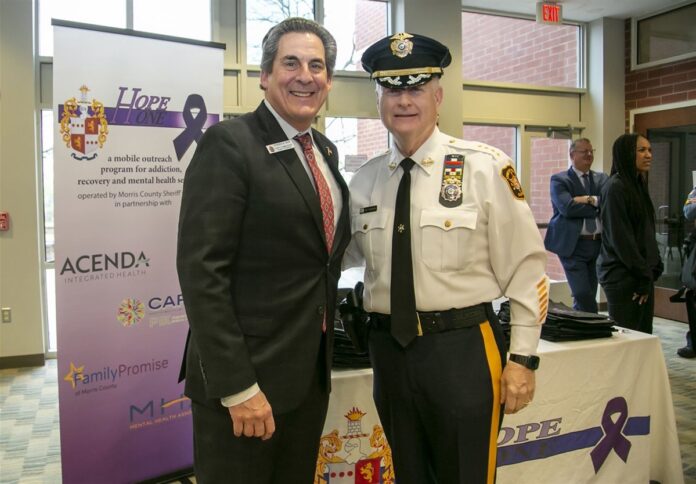
At the center of the celebration were Morris County Commissioner Director Stephen H. Shaw, Sheriff James M. Gannon, and Prosecutor Robert J. Carroll, each of whom emphasized the program’s impact and its role in redefining community outreach. Their remarks underscored a shared understanding that effective intervention requires more than policy—it requires presence, empathy, and sustained collaboration.
Hope One’s approach is built on a simple yet transformative principle: eliminate stigma and build trust. By deploying a mobile unit staffed with trained professionals directly into communities, the program removes many of the barriers that traditionally prevent individuals from seeking help. The team includes a plainclothes sheriff’s officer, a certified peer recovery specialist, and a mental health professional, creating a multidisciplinary support system that addresses both immediate needs and long-term recovery pathways.
This model has produced significant results. Since its launch, Hope One has made more than 71,700 community contacts, distributed over 13,600 naloxone kits, and facilitated more than 2,100 referrals to critical services. The program’s reach is both broad and deeply impactful, with a new contact occurring, on average, every six minutes. Perhaps most importantly, there have been 193 documented instances in which naloxone provided by the program was used to save or attempt to save a life—each one representing a direct, tangible outcome of the initiative’s work.
The program’s success is also reflected in the county’s continued investment. Over the past two years, more than $820,000 in opioid settlement funds have been allocated to support prevention efforts, recovery services, and naloxone training. The 2026 county budget further reinforces this commitment, with $300,000 dedicated to assisting individuals experiencing homelessness and an additional $150,000 focused on prevention strategies. These investments are not isolated expenditures; they are part of a broader strategy to address the interconnected challenges of addiction, housing instability, and mental health.
Beyond its core operations, Hope One has served as a catalyst for additional initiatives that expand its impact. The Hope Hub program, launched in 2021, brings together representatives from 83 social service organizations on a weekly basis to review and respond to cases involving individuals and families facing complex or high-risk situations. This collaborative model has proven highly effective, with 856 referrals processed and a reduction in acute risk achieved in 97 percent of cases.
Similarly, the Police Assisted Addiction and Recovery Initiative (PAARI), introduced in 2019, extends the program’s reach through partnerships with 26 police departments, including the Morris County Prosecutor’s Office. This initiative provides a pathway for individuals to access treatment and support through law enforcement channels, reinforcing the idea that public safety and public health are deeply interconnected.
The Sheriff’s Office Identification Card Program addresses another critical barrier: documentation. Since its inception, the program has issued 1,688 identification cards to at-risk and homeless individuals, enabling access to services that would otherwise remain out of reach. Community Connections, launched in partnership with the Prosecutor’s Office and the Superior Court of Morris County, further expands this network by assisting individuals involved in the justice system, helping 791 participants access services that support successful reintegration.
The influence of Hope One extends well beyond Morris County. Its mobile outreach model has been adopted by nine other counties across New Jersey, reflecting its effectiveness and adaptability. This expansion underscores the program’s role as a blueprint for community-based intervention, demonstrating that localized solutions can have statewide impact when built on collaboration and accountability.
The anniversary event also served as a moment of recognition for individuals who have played a key role in the program’s success. Sheriff’s Office Cpl. Chelsea Whiting, who now leads the initiative, and Madine Despeine-Udoh, director of Self Help, Advocacy and Education at the Mental Health Association, were acknowledged for their contributions to community engagement and outreach. Their work exemplifies the human element that drives the program—professionals who bring both expertise and compassion to every interaction.
What distinguishes Hope One within the broader health and wellness landscape is its ability to integrate multiple systems into a cohesive, responsive framework. It operates at the intersection of law enforcement, healthcare, and social services, creating a model that is both proactive and adaptive. By focusing on prevention, early intervention, and sustained support, the program addresses the root causes of addiction and mental health challenges while providing immediate assistance to those in need.
In the context of New Jersey’s ongoing efforts to enhance community health, Hope One represents a significant advancement in how services are delivered and accessed. It reflects a shift toward models that prioritize accessibility, reduce stigma, and emphasize collaboration across sectors. This approach not only improves outcomes for individuals but also strengthens the resilience of communities as a whole.
As the program enters its tenth year, its trajectory suggests continued growth and innovation. The foundations established over the past nine years—partnership, trust, and measurable impact—provide a strong platform for future expansion. For residents of Morris County and beyond, Hope One stands as a reminder that effective solutions are built not just on resources, but on relationships.
The ninth anniversary celebration was more than a milestone; it was a reaffirmation of a mission that continues to evolve while remaining grounded in its core purpose: to meet people where they are, to provide support without judgment, and to create pathways to recovery and stability. In doing so, Hope One has not only changed lives—it has redefined what community outreach can achieve when driven by vision, collaboration, and an unwavering commitment to care.