

Leyla McCalla
Leyla McCalla Brings Her New Album and Five Centuries of Diaspora History to Montclair This September
September 24 @ 7:30 PM – 11:30 PM
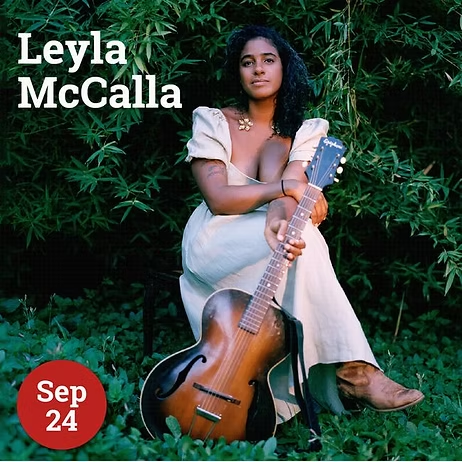
Outpost in the Burbs, the Montclair concert venue that has built its reputation over more than two decades on presenting serious, artistically ambitious musicians in an intimate setting that most comparably sized rooms cannot match for programmatic depth, has announced that Leyla McCalla will perform on Thursday, September 24 at 7:30 p.m. at 40 South Fullerton Avenue. The show arrives in support of Sun Without the Heat, McCalla’s fifth studio album, released on ANTI- Records in April 2026, and represents one of the more substantive single-artist performance opportunities available in New Jersey this fall — a chance to hear, in a room small enough that the music fills it completely, a musician who has spent the last decade building one of the most intellectually and sonically distinctive catalogs in contemporary American folk, and who has now arrived at a body of work that synthesizes every major influence of her career into something that sounds like nothing else currently being recorded.
McCalla was born in New York City to Haitian immigrants and activists, and the specific cultural formation that origin produced — the intersection of Haitian Kreyol musical tradition, the African American folk and string band heritage she absorbed through years of performing with the Carolina Chocolate Drops, the political consciousness that came directly from her parents’ generation of Haitian activism, and the classical cello training that gives her instrumental work its structural foundation — is the basis on which everything she has recorded has been built. She plays cello, tenor banjo, and guitar, and sings in English, French, and Haitian Kreyol, a multilingual practice that is not a feature or a novelty but a reflection of the actual linguistic world her music inhabits. She is a founding member of Our Native Daughters, the Black string band supergroup formed with Rhiannon Giddens, Amythyst Kiah, and Allison Russell, and an alumna of the Grammy Award-winning Carolina Chocolate Drops — associations that place her within one of the most significant artistic projects in recent American roots music, the sustained effort to recover and recenter the Black origins of the banjo and string band traditions that have been culturally whitewashed across generations of American folk and bluegrass history.
Sun Without the Heat represents a deliberate shift from the documentary gravity of her previous album, Breaking the Thermometer, which was the album companion to a multidisciplinary stage work commissioned by Duke Performances telling the story of the journalists at Radio Haiti who risked their lives to report news in Haitian Kreyol during periods of brutal political suppression. That project — named one of the best albums of 2022 by the Guardian, Variety, Mojo, and NPR Music, and the source of the song Dodinin, which appeared on Barack Obama’s annual list of personal favorites — demanded a specific emotional register: witness, documentation, grieving. Sun Without the Heat asks something different of her and of her listeners. McCalla has described the album as an intentional reach toward playfulness and joy, a recognition that urgency in music does not require heaviness as its constant companion, and that the capacity to hold both levity and weight simultaneously is itself a political and personal statement about the conditions that make human flourishing possible.
The album’s sonic architecture reflects the breadth of McCalla’s influences in ways that her previous recordings, however accomplished, had not fully explored. Afrobeat, Ethiopian modal scales, Brazilian Tropicalismo, American folk and blues — these are not influences she is name-checking or sampling superficially. They are the musical vernaculars she has been absorbing across years of performance and study, and Sun Without the Heat is the first recording where they appear simultaneously rather than sequentially. Recorded in nine days at Dockside Studios in New Orleans under the production direction of Maryam Qudus, with her longtime collaborators Shawn Myers on percussion and drums, Pete Olynciw on electric bass and piano, and Nahum Zdybel on guitars, the album’s most unusual characteristic is how completely it sounds like it was built in real time rather than assembled from pre-existing plans. McCalla has described going into the recording sessions without the structured framework she normally brings to the studio, allowing the songs and their shapes to emerge through the process itself. The result is music with the quality of something genuinely discovered rather than executed.
The album’s title track — and the most intellectually explicit statement of the project’s underlying argument — draws its central image and much of its emotional force from a 1857 speech by Frederick Douglass, delivered to a largely white abolitionist audience six years before the Emancipation Proclamation. Douglass was addressing the comfortable distance that reform-minded white Americans maintained between their stated ideals and the sustained, costly effort that actual abolition would require — describing the expectation of crops without the labor of plowing, rain without thunder, ocean without the roar of its waters. The speech was an argument about the price of genuine transformation: that liberation and equity are not available without the willingness to bear the discomfort, the conflict, and the active exertion that real change demands from those who claim to want it. McCalla weaves Douglass’s language into a song whose central lyric — drawn from her engagement with Susan Raffo’s 2022 book Liberated to the Bone — extends his argument into the present: you can’t have the sun without the heat. The warmth without the burning. The outcome without the process of becoming.
That argument — about what transformation actually costs and what it requires of the people who want to participate in it — runs through the album’s full ten tracks, alongside the lyrical engagement with the Black feminist Afrofuturist thinkers whose work has shaped McCalla’s thinking across this creative period. Octavia Butler, Alexis Pauline Gumbs, and adrienne maree brown are the intellectual companions whose frameworks McCalla has been inhabiting while writing, and the influence of their approach to imagination, community, and the possibility of genuinely different futures is audible in the album’s relationship to time — its willingness to look backward at history and forward at possibility simultaneously, holding grief and hope in the same musical moment without requiring either to resolve into the other.
Outpost in the Burbs has been presenting this caliber of artist in Montclair since 1999, building the kind of loyal audience that serious independent venues develop when their programming consistently delivers on the implicit promise that showing up for their calendar will reward careful attention. The room at 40 South Fullerton Avenue holds its audiences close to the music in the specific way that smaller venues do, which for a musician like McCalla — whose work rewards the kind of attentiveness that disappears in larger halls — is a meaningful part of the argument for attending. The show begins promptly at 7:30 p.m., with doors opening thirty minutes prior. All sales are final. Tickets are available through Outpost in the Burbs directly, and for an album and an artist of this specific caliber, advance purchase is the practical approach.











