

What began as complaints from detainees inside a federal immigration detention facility has evolved into one of the most volatile and politically charged confrontations unfolding anywhere in New Jersey. Over the course of several days, the area surrounding Delaney Hall in Newark transformed from a site of peaceful demonstrations into the center of a rapidly escalating standoff involving detained immigrants, family members, immigrant rights advocates, federal immigration authorities, elected officials, journalists, and ultimately the New Jersey State Police.
The conflict has drawn national attention not only because of the allegations being raised by detainees and advocacy groups, but because it touches on some of the most contentious issues facing the country today: immigration enforcement, detention conditions, federal versus state authority, government transparency, public protest rights, and the treatment of individuals held in immigration custody.
As demonstrations continued to grow outside the facility, reports of hunger strikes, allegations of retaliation, clashes between protesters and federal agents, arrests, chemical irritants, political intervention, and the deployment of state law enforcement transformed Delaney Hall into a symbol of a much larger national debate.
At the center of the controversy are the detainees themselves.
According to family members, advocacy organizations, attorneys, and individuals communicating from inside the facility, hundreds of detained immigrants launched a coordinated hunger and labor strike during Memorial Day weekend. Participants reportedly sought to draw attention to what they described as deteriorating living conditions and treatment inside the detention center.
Among the complaints repeatedly raised were allegations of spoiled or decaying food, inadequate medical treatment, poor ventilation systems, overcrowded conditions, prolonged detention periods, and concerns regarding access to communication with family members and legal representatives.
Advocates supporting the detainees argued that the strike represented a desperate effort by individuals who felt they had exhausted traditional channels for expressing concerns.
The hunger strike quickly became the catalyst for a much broader confrontation.
Family members gathered outside Delaney Hall seeking information about loved ones inside the facility. Advocacy organizations organized demonstrations demanding greater transparency and independent inspections. Religious leaders, community activists, legal observers, and immigrant rights groups joined the growing crowds.
What began as a solidarity movement soon evolved into a sustained protest presence outside the facility.
According to activists and family members, tensions intensified when reports emerged that detainees believed to be organizing or leading the strike were being transferred to other facilities. Protesters argued that such transfers were intended to weaken the movement and isolate participants from their support networks.
Federal officials have disputed many of the claims being circulated by activists.
The Department of Homeland Security and representatives associated with the facility’s operations denied allegations regarding widespread mistreatment and challenged descriptions of the events unfolding inside Delaney Hall.
Federal authorities have maintained that some of the reported disturbances involved altercations between detainees rather than organized hunger strike activity. Officials have also defended actions taken by facility personnel as necessary responses to maintain order and safety.
Those competing narratives quickly spilled beyond the facility walls.
Outside Delaney Hall, protesters began organizing larger demonstrations and forming human chains near entrances and access points used by law enforcement vehicles and facility personnel.
As crowds grew, so did concerns about potential confrontations.
Witnesses described increasingly tense interactions between demonstrators and federal agents stationed around the facility. Protesters accused authorities of attempting to intimidate participants. Federal officials countered that demonstrators were interfering with operations and creating safety concerns.
The situation reached a breaking point when efforts were made to clear access routes around the detention center.
What followed became some of the most dramatic scenes yet witnessed during the ongoing standoff.
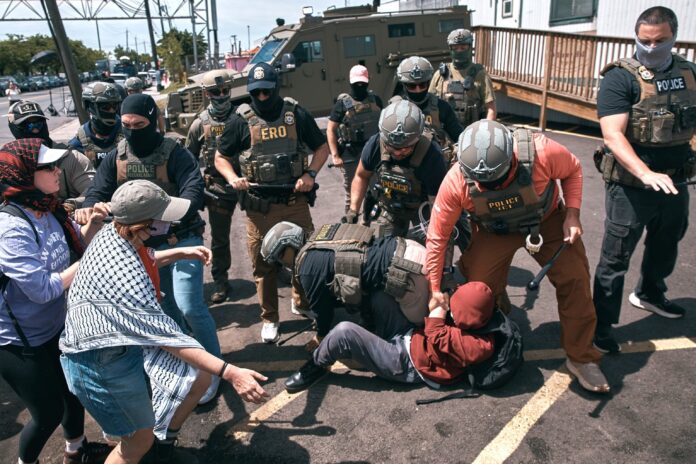
Video footage, eyewitness accounts, and photographs captured chaotic moments as officers and protesters collided. Demonstrators reported being struck with batons, pushed back by riot formations, and exposed to pepper spray and other chemical irritants. Federal authorities argued that force became necessary after protesters blocked operations and allegedly engaged in aggressive behavior toward law enforcement personnel.
The conflicting accounts have become a defining feature of the Delaney Hall controversy.
Activists describe a disproportionate use of force against peaceful demonstrators and community members seeking accountability. Federal officials contend that officers were responding to unlawful actions that endangered safety and interfered with federal operations.
The result was a series of confrontations that generated headlines far beyond New Jersey.
Among the most notable developments was the involvement of elected officials who attempted to gain access to the facility or inspect conditions firsthand.
Several lawmakers publicly criticized what they described as restrictions on oversight efforts and raised concerns regarding access for inspectors and government representatives.
Calls for greater transparency intensified as questions emerged regarding who could enter the facility, what areas could be inspected, and what conditions existed inside.
The political dimensions of the dispute grew substantially when state leaders became directly involved.
Governor Mikie Sherrill joined other elected officials in expressing concern regarding conditions at Delaney Hall and the ongoing confrontations outside the facility. State leaders repeatedly called for greater access, increased transparency, and independent evaluation of conditions being reported by detainees and advocacy groups.
At the same time, state officials found themselves confronting a separate challenge.
The growing crowds, repeated clashes, and increasingly volatile atmosphere raised concerns about public safety.
As tensions continued mounting, New Jersey officials sought a solution capable of preventing further violence while preserving the rights of demonstrators to assemble and express their views.
The result was a significant shift in responsibility around the facility.
Following negotiations between state and federal authorities, the New Jersey State Police assumed a much larger role in managing the perimeter surrounding Delaney Hall.
State Police officers established extensive security zones, erected barricades, created designated protest areas, and worked to physically separate groups supporting different viewpoints.
The move represented an effort to de-escalate a situation that many feared could spiral further out of control.
Yet even with state law enforcement assuming responsibility for the exterior environment, tensions remained extraordinarily high.
Nighttime demonstrations continued.
Crowds remained active.
Protesters vowed to maintain pressure until detainees’ concerns were addressed.
Federal authorities continued defending their actions and policies.
Meanwhile, journalists documenting events found themselves operating in increasingly challenging circumstances.
Several reporters and photographers covering the demonstrations described chaotic conditions as confrontations unfolded around them. One photojournalism student covering events characterized the experience as unlike anything he had previously encountered, describing an atmosphere of uncertainty and fear as law enforcement actions and crowd reactions unfolded simultaneously.
The presence of journalists further underscored the national significance of the story.
What is happening at Delaney Hall has become more than a local issue.
The detention center now sits at the intersection of multiple national conversations involving immigration enforcement, detention practices, protest rights, government accountability, law enforcement tactics, and political oversight.
Supporters of the demonstrations argue that the events expose systemic problems requiring immediate attention. They contend that the allegations raised by detainees deserve independent investigation and that public pressure remains necessary to achieve meaningful reforms.
Federal officials and supporters of current immigration enforcement policies maintain that authorities are carrying out lawful responsibilities and that many criticisms fail to account for operational realities involved in managing detention facilities.
Those opposing viewpoints are unlikely to disappear anytime soon.
If anything, the events of recent days suggest that Delaney Hall may remain a focal point of debate for weeks and potentially months ahead.
The immediate future remains uncertain.
Questions continue regarding the status of detainees participating in hunger strikes. Investigations into clashes outside the facility are ongoing. Legal challenges and political disputes continue to emerge. State and federal officials remain engaged in discussions regarding oversight and facility operations.
What is already clear, however, is that Delaney Hall has become one of the most closely watched locations in New Jersey.
A detention center that once operated largely outside public attention now finds itself at the center of a highly visible and deeply emotional confrontation involving hundreds of people, multiple layers of government, and issues that resonate far beyond Newark’s city limits.
As protesters continue gathering, state police maintain their presence, elected officials demand answers, and detainees press their concerns from inside the facility, Delaney Hall remains a powerful illustration of how local events can quickly evolve into national flashpoints.
For New Jersey, the unfolding situation represents one of the most consequential law-and-order stories of the year, with implications that extend well beyond the fences surrounding a single detention center. It is a story about accountability, authority, public protest, and human dignity—a story whose next chapter is still being written.
















