
As anticipation continues building around the official opening of the Bruce Springsteen Center for American Music at Monmouth University, one of the institution’s earliest public programs is already signaling the broader cultural ambitions behind the project. Rather than launching solely with nostalgia, celebrity appearances, or conventional music-history retrospectives, the center is positioning itself as a serious institution focused on exploring the deeper, more expansive story of American music itself — including the voices, traditions, and communities that helped shape the country’s artistic identity long before modern commercial music industries ever existed.
That mission comes sharply into focus on Wednesday, June 3, 2026, when the Springsteen Center hosts “The Native American Music Experience,” a major free public concert and cultural program at Pollak Theatre in West Long Branch. Presented in partnership with Hard Rock International, which is owned by the Seminole Tribe of Florida, the evening will serve both as a celebration of Indigenous musical traditions and as one of the centerpiece events leading into the center’s official grand opening week.
The significance of the event extends far beyond a single concert.
At a time when cultural institutions across the country are increasingly reassessing how American history is presented, the Springsteen Center appears intent on framing American music not as a narrow commercial timeline dominated solely by mainstream genres and celebrity narratives, but as a far broader cultural continuum shaped by regional traditions, migration, resistance, oral storytelling, spirituality, and Indigenous influence. “The Native American Music Experience” immediately establishes that perspective at the very beginning of the center’s public life.
The choice feels particularly meaningful in New Jersey, a state whose musical identity has long been tied to cultural intersection and artistic hybridity. Through Explore New Jersey’s continuing arts, sports, and cultural coverage, it has become increasingly clear that many of the state’s most important modern institutions are no longer content simply preserving legacy. They are attempting to reinterpret it.
The Bruce Springsteen Center for American Music appears positioned squarely within that movement.
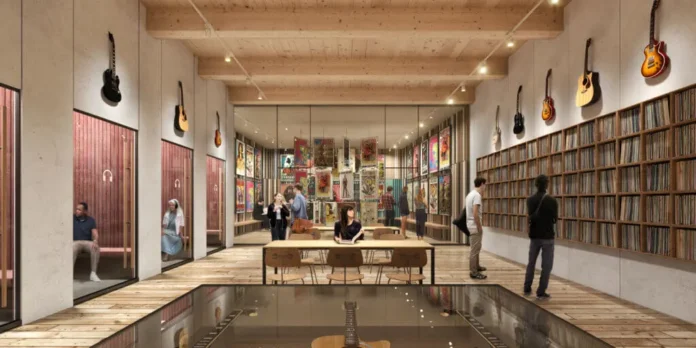
Located at Monmouth University, the new 32,000-square-foot facility has been designed not merely as a museum dedicated to Bruce Springsteen’s career, but as a larger educational and cultural institution examining how American music intersects with politics, social change, labor history, migration, identity, regional storytelling, and collective memory. Springsteen’s work naturally functions as an anchor within that conversation, but the institution’s broader vision appears far more expansive than a traditional artist-centered museum experience.
“The Native American Music Experience” may ultimately become one of the clearest early examples of that philosophy in action.
The evening’s lineup reflects remarkable artistic range, bringing together performers, poets, musicians, and storytellers whose work spans multiple genres and generations while remaining deeply connected to Indigenous identity and creative expression. The program includes performances by the Osceola Brothers, the Seminole Tribe-based rock band whose sound blends contemporary rock structures with cultural influence rooted in tribal identity and Southern musical traditions. Acclaimed singer-songwriter and lap steel guitarist Pura Fé will also perform, bringing her internationally respected fusion of blues, folk, and Indigenous musical heritage to the stage.
Gary Farmer & the Dish and Spoon Band add another dimension entirely. Farmer, widely known to many audiences through his acting career, has long maintained a parallel presence within music, where his work frequently incorporates blues-rock structures alongside Native storytelling traditions and social commentary. The inclusion of the Julia Keefe Indigenous Big Band further expands the evening’s musical scope by connecting jazz traditions with Indigenous compositional perspectives, demonstrating how Native artists have continually contributed to and reshaped American musical language across genres often discussed separately from Indigenous influence.
Perhaps most significantly, the evening will also feature poetry and spoken-word contributions from Joy Harjo, the former United States Poet Laureate and member of the Muscogee Nation. Harjo’s presence elevates the event beyond performance alone. Her work has consistently explored memory, displacement, spirituality, land, music, and survival through language that operates simultaneously as literature, history, and cultural preservation. Including poetry alongside live music reinforces the broader thematic structure of the evening: American music cannot be understood fully without understanding storytelling itself.
That larger idea may ultimately define the Springsteen Center’s long-term cultural importance.
Because American music history is often presented through simplified commercial narratives centered around chart success, recording industries, and celebrity mythology. What gets lost in that approach are the foundational cultural traditions that predate commercial recording entirely. Indigenous music traditions, oral histories, ceremonial rhythms, storytelling structures, and vocal techniques helped shape the broader architecture of American music in ways often overlooked by mainstream institutions.
This event appears designed to confront that omission directly.
The partnership with Hard Rock International also carries deeper symbolic significance than casual observers may initially realize. Because Hard Rock is owned by the Seminole Tribe of Florida, the collaboration represents not simply corporate sponsorship, but Indigenous ownership participating directly in the preservation and presentation of Indigenous cultural history within a major American music institution. That distinction matters within the larger context of representation and cultural authority.
The concert also arrives during a transformative moment for Monmouth University itself. The university’s investment in the Bruce Springsteen Center for American Music signals an increasingly ambitious role within New Jersey’s cultural and educational landscape. By positioning the institution as both museum and active programming hub, Monmouth is creating a space capable of hosting ongoing national conversations surrounding music, identity, politics, history, and artistic influence.
The opening week schedule reflects those ambitions clearly.
The sold-out “America 250: A Jersey Shore Celebration” on May 29 has already demonstrated enormous public interest surrounding the center’s launch programming. Additional major events, including “Music America: The Songs that Shaped Us,” featuring Bruce Springsteen, Jon Bon Jovi, and other artists at the OceanFirst Bank Center on June 4 and 5, will further expand the institution’s national profile ahead of the official June 7 public opening.
Yet “The Native American Music Experience” may prove to be one of the week’s most culturally important events precisely because it shifts attention away from celebrity-centered spectacle and toward historical continuity.
That is where the evening gains real depth.
The program is not simply presenting Indigenous artists as a separate cultural category disconnected from broader American music traditions. Instead, it frames Indigenous music as central to the story itself. The event argues implicitly that American music history cannot be fully understood without recognizing Indigenous contributions that existed long before rock, country, folk, blues, jazz, or modern commercial genres took shape.
For New Jersey audiences, the event also reinforces how dramatically the state’s cultural footprint continues evolving. New Jersey has long produced globally influential artists across virtually every major genre, but institutions capable of exploring those connections thoughtfully and historically have often lagged behind the state’s artistic output. The Springsteen Center appears intent on changing that.
Importantly, the concert remains free to the public, though registration is required due to expected demand. That accessibility aligns with the broader ethos surrounding the opening week itself, which appears designed not merely as a high-profile launch, but as an attempt to establish the center as a living public institution rooted in education, dialogue, and community participation.
In many ways, “The Native American Music Experience” sets the tone for what the Bruce Springsteen Center for American Music may ultimately become.
Not a shrine.
Not nostalgia.
Not celebrity preservation.
But a place where the larger story of American music — complicated, layered, unfinished, and deeply interconnected — can be explored honestly through the artists and communities who continue shaping it.