
As New Jersey prepares for the arrival of the FIFA World Cup 2026, much of the public conversation has understandably focused on stadiums, transportation, tourism infrastructure, global media attention, and the extraordinary logistical undertaking required to host one of the largest sporting events in modern history. Yet quietly unfolding alongside those preparations is another story that may ultimately define how visitors remember the region long after the final whistle blows: the food.
And nowhere is that cultural conversation becoming more visible than in Newark.
With the return of Savor Newark, city officials, chefs, entrepreneurs, restaurateurs, creatives, and business leaders are positioning Newark’s culinary identity not simply as a supporting attraction surrounding the World Cup, but as one of the defining cultural experiences attached to New Jersey’s global moment. The initiative represents far more than a food festival or restaurant showcase. It is an ambitious attempt to place Newark’s immigrant communities, neighborhood food culture, entrepreneurial spirit, and evolving hospitality economy directly into the international spotlight as millions of visitors prepare to descend upon the region next year.
At a time when cities worldwide increasingly compete through culture as much as infrastructure, Newark appears determined to make cuisine part of its global introduction.
That strategy makes sense.
Because while stadiums host matches, cities are remembered through experience.
The restaurants.
The neighborhoods.
The late-night conversations.
The music drifting from open windows.
The bakeries opening before sunrise.
The family-owned dining rooms passed down through generations.
The aromas that define entire blocks before a visitor even reaches the front door.
Those are the details that stay with people.
Savor Newark is attempting to capture exactly that.
Positioned as Newark’s premier culinary symposium and cultural platform, Savor Newark has rapidly evolved into one of the city’s most important efforts to connect food, economic development, tourism, entrepreneurship, and cultural storytelling into a unified civic identity. Organized through a partnership involving creative agency Plusable and Invest Newark, the initiative reflects a broader understanding that food is not merely hospitality. It is infrastructure. It is commerce. It is culture. It is immigration history. It is small business development. It is neighborhood identity. And increasingly, it is one of the most powerful economic engines urban centers possess.
For Newark, that realization arrives at a particularly important moment.
The city is entering one of the most internationally visible periods in its modern history as the FIFA World Cup 2026 transforms the entire New York-New Jersey region into a month-long global destination. Through expanded coverage surrounding New Jersey’s World Cup 2026 preparations, it has become increasingly clear that state and local leaders are aggressively working to ensure economic opportunities connected to the tournament extend beyond the immediate footprint of MetLife Stadium.
That includes Newark.
And Savor Newark may become one of the city’s most effective vehicles for translating international tourism into direct local economic participation.
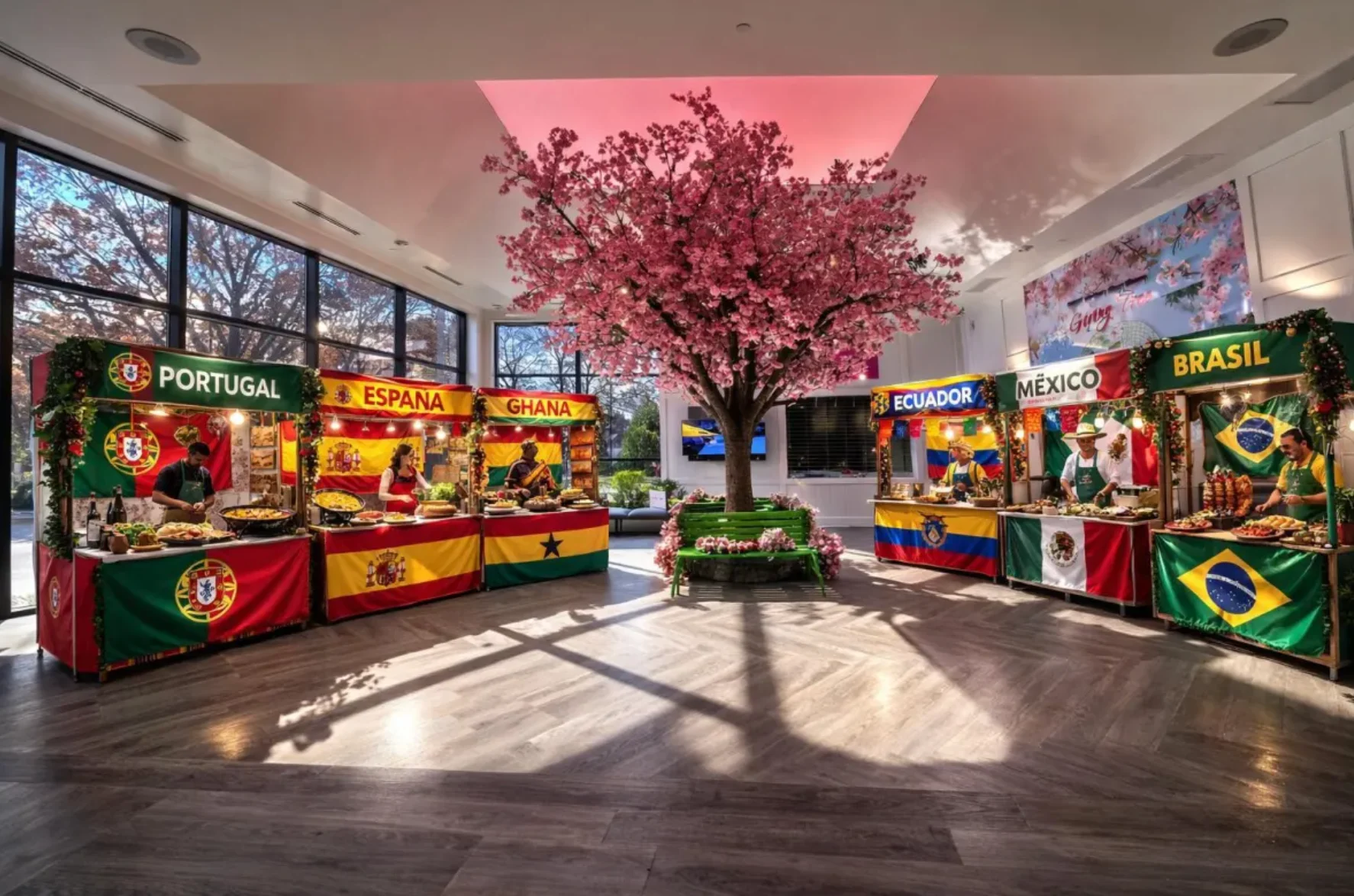
The centerpiece of the initiative arrives on May 16, 2026, with Savor Newark 2026: The Culinary Cup, a large-scale symposium and culinary celebration scheduled for the Cherry Blossom Welcome Center at Branch Brook Park. Designed as Newark’s official kickoff to FIFA World Cup festivities, the free public event combines chef demonstrations, culinary tastings, cultural storytelling, business discussions, panel conversations, and live programming intended to showcase the extraordinary diversity embedded within Newark’s food ecosystem.
But reducing the event to a food festival misses the larger point entirely.
What Newark is building is narrative.
The city wants visitors to understand that Newark’s food culture is inseparable from the communities that created it.
That means Portuguese restaurants in the Ironbound.
Brazilian bakeries and rodizios.
Cape Verdean cooking traditions.
West African cuisine.
Caribbean food culture.
Latin American influences.
Soul food institutions.
Family-owned cafes.
Independent food entrepreneurs.
Multi-generational businesses.
Corner restaurants operating as neighborhood anchors for decades.
Savor Newark is designed to place all of those stories into one larger civic identity.
Importantly, the initiative also reflects how dramatically Newark’s public perception has evolved during the last decade. Once discussed nationally almost exclusively through outdated narratives surrounding crime or economic struggle, Newark is increasingly presenting itself as one of the Northeast’s most dynamic cultural cities — one built not around corporate reinvention alone, but around authentic neighborhood identity and immigrant-driven entrepreneurial growth.
Food becomes one of the clearest entry points into that story.
The Ironbound District alone has become one of the most respected dining destinations anywhere in the tri-state region, drawing visitors from New York City, Philadelphia, North Jersey, and beyond for its concentration of Portuguese, Spanish, Brazilian, and international cuisine. Yet Savor Newark intentionally expands the lens beyond a single district, arguing that the city’s culinary identity exists across multiple neighborhoods and communities.
That broader approach matters economically.
Because one of the primary goals behind the initiative is ensuring that local businesses — particularly independent operators — benefit directly from increased tourism activity tied to FIFA World Cup traffic. Large international events often generate enormous economic headlines while smaller neighborhood businesses struggle to access meaningful participation. Savor Newark appears specifically designed to prevent that disconnect.
Food becomes the mechanism for local inclusion.
The platform’s emphasis on storytelling reinforces that strategy further.
Through the Savor Newark podcast and accompanying media initiatives, chefs, restaurant owners, immigrant entrepreneurs, and community voices are given space to discuss not simply menus, but migration stories, business challenges, cultural preservation, generational transitions, and neighborhood identity. The result is a culinary initiative that feels far more grounded than traditional tourism marketing campaigns often do.
That authenticity may ultimately become Newark’s greatest advantage.
Because modern travelers increasingly seek cities with cultural depth rather than polished artificiality.
And Newark has depth everywhere.
You can feel it in the bakeries.
In the corner cafes.
In the butcher shops.
In the soccer bars filled during international matches.
In the longstanding restaurants where entire communities gather around food that connects directly to family history and homeland memory.
Savor Newark understands that culinary culture is not just about consumption.
It is about belonging.
The timing of the initiative also aligns perfectly with the larger global energy surrounding FIFA World Cup 2026. Soccer itself functions as one of the world’s most culturally interconnected sports, with immigrant communities often serving as the emotional heartbeat of tournament culture throughout host cities. Newark’s international population naturally positions the city as a uniquely authentic environment for that atmosphere to thrive.
The city is not manufacturing international culture for tourists.
It already lives it every day.
That distinction becomes increasingly important as New Jersey prepares for a level of international visibility unlike anything the region has experienced in generations. Visitors arriving for the World Cup will not simply be attending matches. They will be searching for atmosphere, identity, local flavor, and memorable experiences between games.
Newark intends to give them all of it.
At the same time, Savor Newark also reflects broader economic development trends reshaping American cities nationwide. Culinary economies now play major roles in urban revitalization strategies because restaurants, hospitality spaces, and food-centered experiences generate tourism, foot traffic, employment, branding opportunities, and neighborhood investment simultaneously.
Cities increasingly compete through culture.
And culture often begins at the table.
For Newark, the return of Savor Newark signals confidence in the city’s ability to stand not merely as a transportation corridor adjacent to New York City, but as a destination worthy of international attention in its own right.
That confidence feels increasingly justified.
Because as FIFA World Cup 2026 approaches, New Jersey’s most compelling global story may not simply be the matches themselves.
It may be the communities surrounding them.
And in Newark, those communities are preparing to introduce themselves through food.