
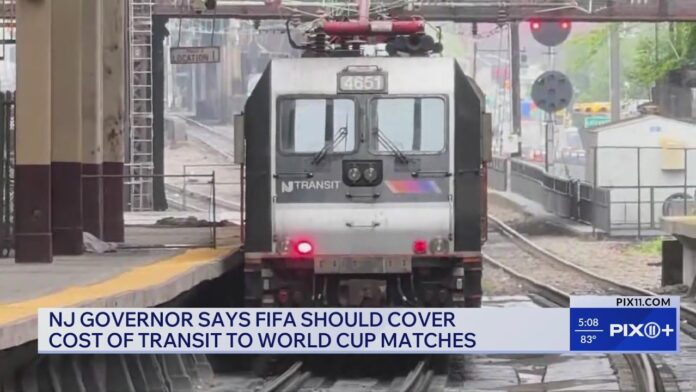

As New Jersey prepares to become one of the central stages for the FIFA World Cup 2026, a growing debate surrounding transportation costs, public funding, and corporate responsibility is beginning to reveal the immense financial and logistical pressure that accompanies hosting one of the largest sporting events on Earth. At the center of that conversation now stands Governor Mikie Sherrill, who is making it abundantly clear that New Jersey taxpayers will not be expected to subsidize the operational burden tied to transporting international soccer crowds to MetLife Stadium during next summer’s tournament.
The issue escalated rapidly this week after concerns emerged over the cost of round-trip NJ Transit service between New York Penn Station and MetLife Stadium during FIFA World Cup events. Originally projected to cost fans approximately $150 round-trip for the brief 18-mile journey, the proposed pricing structure immediately triggered backlash from commuters, residents, sports fans, and public officials alike. Within days, NJ Transit revised the proposed cost downward to $105, but even with that reduction, the controversy surrounding who ultimately pays for the transportation infrastructure tied to FIFA’s arrival remains very much alive.
Governor Sherrill, speaking candidly to reporters, has positioned herself firmly on one side of the debate. Her message has been direct, disciplined, and politically significant: New Jersey residents should not be financially responsible for underwriting a global event that is expected to generate enormous revenues for FIFA and its corporate partners.
“I said from the start I didn’t want this put on the back of the New Jersey taxpayers,” Sherrill stated during remarks that quickly became one of the defining political soundbites surrounding New Jersey’s World Cup preparations. “Certainly, FIFA should take on some of this burden as they stand to make millions.”
That statement reflects a broader tension now emerging across host regions worldwide as governments balance the economic prestige associated with hosting the FIFA World Cup against the very real costs attached to security, transportation, infrastructure, staffing, crowd management, and public services. While FIFA often presents the tournament as an economic catalyst capable of generating tourism, investment, and international visibility, local governments increasingly face scrutiny regarding who absorbs the operational realities once the cameras arrive.
In New Jersey’s case, transportation has become one of the most visible flashpoints.
MetLife Stadium in East Rutherford will host multiple marquee FIFA World Cup 2026 matches, including the tournament final, placing New Jersey at the center of one of the largest sporting spectacles in modern history. Millions of global viewers will see the region showcased throughout the month-long event, while hundreds of thousands of visitors are expected to move through transit systems, hotels, restaurants, entertainment districts, airports, and public gathering spaces throughout the state.
That opportunity carries undeniable economic upside.
But it also carries enormous logistical costs.
NJ Transit officials estimate that expanded World Cup-related rail service alone could cost approximately $48 million, a figure that immediately intensified concerns regarding how those expenses would be covered without impacting daily commuters or burdening state taxpayers already navigating broader economic pressures. Governor Sherrill has repeatedly emphasized that ordinary residents should not experience fare increases or financial consequences linked to FIFA operations.
According to NJ Transit CEO Kris Kolluri, the governor’s position was communicated clearly from the outset.
“Governor Sherrill made two broad points,” Kolluri explained. “First, she would not impose financial burden on New Jersey taxpayers or commuters, but said the World Cup was an opportunity for New Jersey to showcase the state, the economy and its culture and we are excited to host the games.”
That balancing act now defines the state’s entire approach toward FIFA 2026 preparations.
On one hand, the World Cup represents an extraordinary international platform capable of elevating New Jersey’s tourism economy, hospitality sector, entertainment industry, and global visibility in ways few events can match. The tournament is expected to drive massive spending throughout North Jersey, the Meadowlands corridor, Jersey City, Newark, Hoboken, and surrounding regions while also feeding economic activity into South Jersey through statewide fan festivals and community initiatives already being organized under the broader FIFA World Cup 2026 umbrella.
The state has aggressively leaned into that opportunity through initiatives connected to the growing network of World Cup fan experiences being planned throughout New Jersey. Through programs highlighted across Explore New Jersey’s World Cup coverage, officials and regional organizers have already begun positioning the state as more than simply a host venue. New Jersey wants to become an active cultural participant in the tournament itself.
That includes large-scale public viewing festivals, youth soccer initiatives, entertainment events, hospitality activations, and international tourism campaigns stretching from Newark and Jersey City to Camden County and the Jersey Shore. Massive fan festivals are planned at Liberty State Park, while Sports Illustrated Stadium in Harrison will host large-scale family programming including the upcoming FIFA World Cup 2026 Family Day featuring KIDZ BOP LIVE. Additional community-centered programming tied to the NJ World Cup Community Initiative is expected to spread economic activity beyond the immediate Meadowlands footprint.
Yet despite the excitement, the transportation issue underscores a larger reality often overlooked during major-event announcements.
Mega-events create winners and losers financially depending on how costs are allocated.
Sherrill appears determined to ensure New Jersey residents do not become the latter.
The governor’s comments also subtly reflect growing skepticism among state and local governments nationwide regarding how international sporting organizations distribute financial responsibility. FIFA, while enormously profitable, has frequently faced criticism globally over the public costs associated with tournament infrastructure, policing, transportation upgrades, and operational services.
In this case, New Jersey officials appear to be pressuring FIFA and corporate sponsors to contribute more directly toward offsetting transit-related expenses rather than allowing those costs to migrate onto the public sector.
“We’ve gone out to corporate sponsors to try to get those costs lowered and we’ve seen a great response from them,” Sherrill explained. “So I’m happy they’ve come forward. I’m waiting to see if FIFA will come through although we’re not holding our breath.”
That line may ultimately become one of the defining political summaries of New Jersey’s World Cup strategy.
Because while state officials clearly recognize the enormous value attached to hosting the world’s most-watched sporting event, they are simultaneously signaling that prestige alone is not sufficient justification for unchecked public spending.
The numbers themselves help explain why the issue escalated so quickly.
Under normal conditions, a round-trip NJ Transit ticket from New York Penn Station to MetLife Stadium costs approximately $12.90. The proposed World Cup pricing structure that initially surged toward $150 represented more than an eleven-fold increase, immediately generating national headlines and criticism across sports media, commuter advocacy groups, and social media platforms.
Even the revised $105 price point remains dramatically higher than standard fare structures, though officials argue those costs reflect expanded service demands, crowd management requirements, and operational complexities associated with handling World Cup-scale attendance.
Sales for transportation packages are expected to begin soon, adding additional urgency to negotiations involving FIFA, corporate sponsors, and transit authorities.
Meanwhile, the broader economic implications continue to expand beyond transportation alone.
Hotels throughout North Jersey are already preparing for unprecedented demand spikes tied to the tournament. Restaurants, bars, breweries, retailers, event venues, and entertainment districts are actively positioning themselves to capitalize on the projected international tourism wave expected to sweep through the region. Sports bars across Newark, Hoboken, Jersey City, Morristown, Asbury Park, Atlantic City, and the Meadowlands corridor are expected to become gathering points for fans representing dozens of nations throughout the tournament.
MetLife Stadium itself will become one of the focal points of the entire World Cup.
And with that visibility comes immense pressure to execute flawlessly.
Transportation reliability will be essential not only for fan experience but also for New Jersey’s international reputation during one of the most heavily televised events in global sports. Any logistical breakdowns would instantly become worldwide headlines, which helps explain why transit planning has become such a high-stakes issue politically and operationally.
Still, Sherrill’s stance suggests New Jersey is attempting to establish a framework that supports international tourism and economic growth without sacrificing fiscal discipline.
That distinction matters.
Because increasingly, residents want transparency regarding how public dollars are used when major corporations and international organizations enter local markets promising economic impact. The governor’s refusal to allow taxpayers to absorb World Cup transit costs appears designed not merely as a transportation policy decision, but as a broader statement about accountability, public priorities, and financial responsibility.
For New Jersey, the FIFA World Cup 2026 represents both extraordinary opportunity and enormous complexity.
The state is preparing to welcome the world.
But Governor Mikie Sherrill is making it clear that welcoming the world should not come with an unlimited invoice for New Jersey residents.
















