

- This event has passed.
Cerus Quartet
Cerus Quartet Arrives in New Jersey: A Defining Moment for the Saxophone’s Rise in 21st-Century Classical Music
April 9 @ 8:00 PM – 11:30 PM
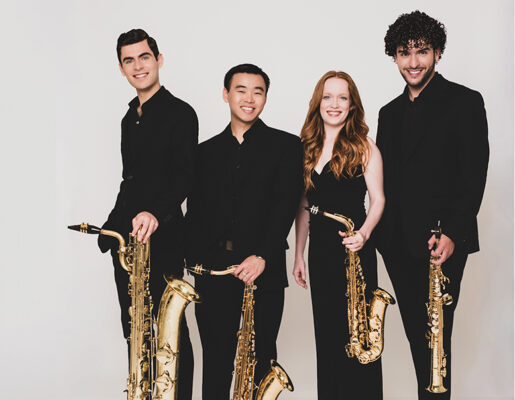
New Jersey’s live music landscape continues to assert its sophistication and forward momentum, and on Thursday, April 9, 2026, that evolution takes center stage with the arrival of the Cerus Quartet—one of the most decorated and rapidly ascending chamber ensembles in the country. Scheduled for a 7:00 PM performance, this concert is far more than a traditional recital; it is a statement about where classical music is heading and how New Jersey is positioning itself at the forefront of that transformation.
At a time when audiences are increasingly seeking performances that challenge expectations and expand the boundaries of genre, the Cerus Quartet delivers a program that is both intellectually rigorous and emotionally resonant. Founded in 2022 and already carrying a résumé defined by major national competition victories and high-profile premieres, the ensemble has quickly established itself as a defining voice in contemporary chamber music. Their mission is precise and ambitious: to elevate the saxophone quartet from a niche configuration to a central force within the classical canon of the 21st century.
That mission is not theoretical—it is actively unfolding in real time. Cerus Quartet’s trajectory includes top honors at the 2025 Concert Artists Guild Louis and Susan Meisel Competition, a Gold Medal at the 2025 Fischoff Chamber Music Competition, and first-place finishes at the 2024 MTNA National Chamber Music Competition and the 2023 Briggs Competition. These accolades are not simply markers of success; they represent a broader validation of the ensemble’s artistic approach and the growing relevance of the saxophone within serious classical performance contexts.
The quartet’s name, drawn from Greek mythology, encapsulates its philosophy. Cerus, a wild bull transformed by Persephone, symbolizes the conversion of chaos into controlled beauty—a concept that directly informs the ensemble’s sound. The saxophone, long associated with jazz and popular music, becomes in their hands a refined, expressive instrument capable of delivering the nuance, precision, and depth traditionally reserved for strings or piano. This transformation is not merely technical; it is conceptual, redefining how audiences perceive the instrument itself.
The ensemble—Roberto Campa on soprano saxophone, Laura Ramsay on alto, Kyle Kato on tenor, and Samuel Dishon on baritone—operates with a level of cohesion that reflects both technical mastery and a shared artistic vision. Each player brings a distinct tonal identity, yet the group functions as a unified organism, capable of navigating complex arrangements and dynamic shifts with remarkable clarity. Their collective sound is both expansive and controlled, allowing them to move seamlessly between stylistic eras and compositional languages.
The April 9 program is structured as a comprehensive exploration of that versatility. It opens with Pedro Iturralde’s “Pequeña Czarda,” a work that blends classical structure with folkloric influence, immediately establishing the quartet’s ability to balance precision with expressive freedom. From there, the program moves into a series of transcriptions that highlight the ensemble’s adaptability, including selections from Cecile Chaminade that translate piano-driven textures into a multi-layered saxophone dialogue.
Astor Piazzolla’s “Milonga del Angel” introduces a different emotional register, drawing on the rhythmic and harmonic language of Argentine tango while allowing the quartet to explore phrasing and tonal color in a way that feels both intimate and expansive. This is followed by one of the program’s central pillars: Alexander Glazunov’s Saxophone Quartet in B-flat Major, Op. 109, a work that stands as one of the few canonical pieces written specifically for the ensemble’s instrumentation. Through its series of variations and stylistic references, the piece becomes a showcase for the quartet’s interpretive range, moving from lyrical passages to technically demanding scherzo sections with fluid precision.
The program’s second half continues to push boundaries, incorporating contemporary work such as Emma O’Halloran’s “Night Music,” which introduces modern harmonic language and atmospheric textures that align with the quartet’s forward-looking identity. The performance concludes with a transcription of Felix Mendelssohn’s String Quartet No. 6 in F minor, a bold choice that underscores the ensemble’s commitment to reimagining classical masterworks. By translating a piece originally conceived for strings into the language of saxophones, Cerus not only demonstrates technical prowess but also invites audiences to hear familiar compositions through an entirely new lens.
This kind of programming reflects a broader trend within the classical music world, where innovation is no longer optional—it is essential. Audiences are increasingly drawn to performances that offer both familiarity and discovery, and the Cerus Quartet delivers on both fronts. Their ability to juxtapose canonical works with contemporary compositions creates a listening experience that feels cohesive yet constantly evolving.
From a regional perspective, this performance reinforces New Jersey’s growing role as a destination for high-caliber live music. The state’s venues are no longer simply hosting touring acts; they are curating experiences that align with global artistic movements while maintaining a strong connection to local audiences. This alignment is evident across Explore New Jersey’s music coverage, where programming consistently reflects a balance between tradition and innovation.
Accessibility remains a key component of this event’s appeal. With ticket pricing structured at $28 for general admission, $23 for members, and a reduced rate of $18 for attendees under 25, the performance is positioned to reach a broad audience. This pricing strategy not only encourages attendance but also supports the long-term sustainability of live music by fostering engagement across generations. The inclusion of a modest service fee reflects standard industry practice, while box office support ensures that ticket purchasing remains straightforward and accessible.
The significance of this performance extends beyond a single evening. It represents a convergence of artistic excellence, institutional support, and audience engagement that defines the current moment in New Jersey’s cultural evolution. The Cerus Quartet is not simply performing—they are participating in a larger dialogue about what classical music can be and who it is for.
As the ensemble takes the stage on April 9, the expectation is not just for a technically flawless performance, but for an experience that challenges, inspires, and redefines. In a landscape where the boundaries of genre continue to blur and the definition of classical music expands, the Cerus Quartet stands as a clear example of what is possible when tradition meets innovation with purpose and precision.











