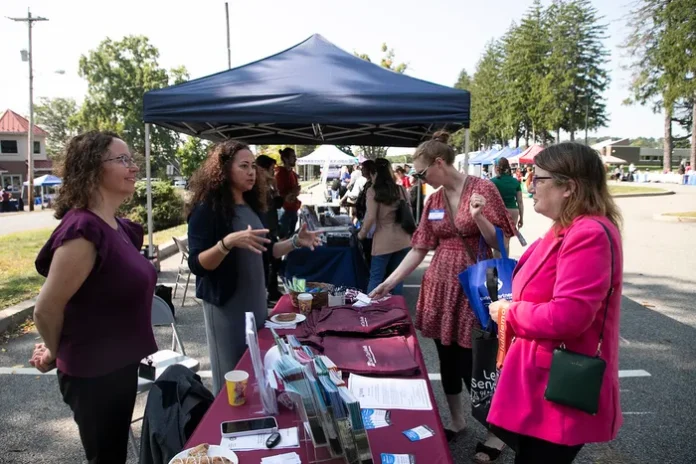

On a cold January morning in the heart of Morristown, a powerful display of collaboration unfolded as Morris County leaders, nonprofit advocates, faith partners, and frontline service teams came together to deliver one of the region’s most important annual community initiatives: Project Homeless Connect 2026.
Hosted inside St. Peter’s Episcopal Church, the large-scale resource fair brought immediate, no-cost assistance directly to residents experiencing homelessness or facing the imminent risk of losing their housing. Organized through a partnership between the Morris County Department of Human Services and the Mental Health Association of Essex and Morris, Inc., the event drew more than 40 service organizations under one roof, transforming the church into a one-stop access point for help, stability, and renewed opportunity.
Since first being launched locally in 2009, Project Homeless Connect has grown into a cornerstone of Morris County’s response to housing instability. This year’s gathering continued that legacy by connecting individuals and families with housing navigation services, mental health and substance use support, benefits enrollment, medical and behavioral health referrals, food access, and essential daily necessities, all delivered in a coordinated, welcoming environment designed to remove barriers and restore dignity.
Welcoming participants and guiding the program was Viktorija Spasova, program director of the Mental Health Association’s Programs for Assistance in Transition from Homelessness, commonly known as PATH. Throughout the morning, she introduced community leaders and partners whose organizations form the backbone of Morris County’s safety net.
Among those addressing attendees were the Rev. Canon Robert Picken of St. Peter’s Episcopal Church, Mental Health Association Chief Executive Officer Robert “Bob” Davison, Morris County Commissioner Christine Myers, New Jersey State Senator Anthony M. Bucco, and a community member who shared their personal experience navigating homelessness and recovery. Their remarks underscored a consistent message: progress is possible when systems work together and people are met with compassion rather than judgment.
Commissioner Myers spoke directly to participants, emphasizing that the services available at the event are designed not only to address immediate crises, but to help residents reclaim independence and long-term stability.
The resources assembled, she explained, exist to support people as they rebuild—helping them regain confidence, restore connections, and move forward without being defined by a moment of hardship. She also offered heartfelt thanks to the volunteers, nonprofit professionals, outreach teams, and advocates who make events like Project Homeless Connect possible year after year.
Behind the scenes, Morris County’s Office of Temporary Assistance operated its Navigating Hope mobile outreach unit throughout the event, offering on-site guidance and referrals for housing and emergency assistance programs. Nearby, the Morris County Sheriff’s Office Hope One team engaged directly with attendees, providing behavioral health support, peer outreach, and connections to treatment and recovery services.
The logistical coordination for the 2026 event began months earlier. Starting in October, the Mental Health Association worked alongside St. Peter’s Episcopal Church and the county’s Human Services Department to organize large-scale donation drives. Community members and partner organizations contributed food, winter clothing, shoes, hygiene products, and other daily essentials, ensuring that guests left not only with service referrals, but with immediate, practical support for everyday needs.
Project Homeless Connect also serves as a powerful reminder that homelessness is not only a housing issue—it is deeply connected to mental health, economic instability, medical access, family disruption, and social isolation. Morris County’s approach reflects that reality by integrating public agencies, healthcare providers, legal and benefits specialists, community organizations, and faith-based partners into a single coordinated response.
The event’s collaborative spirit mirrors the broader civic network that defines Morris County, where social service agencies, educational institutions, community organizations, and cultural partners often intersect in meaningful ways, strengthening both social well-being and community life across the region’s creative and civic landscape, including organizations that contribute to the state’s vibrant arts and cultural community featured through Explore New Jersey’s coverage of New Jersey’s art and culture scene.
The urgency surrounding homelessness has only intensified statewide. Senator Bucco addressed the growing pressure facing service providers and residents alike, noting that rising costs of living have forced many households to make impossible choices between housing, food, utilities, and healthcare. He also warned that recent federal-level changes could delay funding for frontline agencies by as much as six months, placing additional strain on organizations already operating at capacity. State leaders have estimated a potential multi-million-dollar shortfall that could directly affect homelessness and behavioral health programs across New Jersey.
In response to those challenges, Morris County continues to reinforce its local safety net. The Board of County Commissioners has once again approved a $300,000 annual investment dedicated to homelessness prevention and emergency assistance. That funding supports eviction prevention, utility restoration, emergency shelter placement, and housing stabilization efforts that help families remain safely housed and avoid deeper, long-term crises.
For many residents, those interventions make the difference between temporary hardship and permanent displacement.
Davison, who has worked in human services and behavioral health for more than four decades, described Morris County’s government as uniquely responsive when residents are struggling with mental illness, addiction, or homelessness. He emphasized that sustained public investment and cross-agency collaboration are critical to delivering real outcomes, especially as the needs of vulnerable populations grow more complex.
Beyond providing direct assistance, Project Homeless Connect also plays a crucial role in shaping how Morris County understands homelessness itself.
The 2026 event marked the official kickoff of the county’s annual federally required Point-in-Time count, a comprehensive survey conducted across the community to identify how many individuals and families are experiencing homelessness on a single night. The data collected helps guide future funding allocations, program development, and service strategies at both the county and state levels.
The most recent completed count, conducted in January 2025, identified 618 men, women, and children experiencing homelessness in Morris County. While that figure represented a nine percent decrease from the previous year locally, homelessness rose by eight percent statewide during the same period—highlighting both the progress achieved in Morris County and the broader regional pressures impacting housing stability.
Following the Morristown event, Morris County Human Services outreach teams continued survey efforts throughout the community, connecting with individuals to complete the Point-in-Time questionnaires and record where people slept on the night of January 27, 2026. Participation in the count allows residents to be represented in the data that ultimately drives funding decisions, policy direction, and future service investments.
For many attendees, the experience of Project Homeless Connect extends far beyond a single day. The relationships established with case managers, outreach workers, benefits specialists, and healthcare professionals often become the first step in longer pathways toward permanent housing, employment support, recovery services, and family reunification.
Equally important, the event reinforces a broader cultural shift in how homelessness is addressed in Morris County—one that prioritizes dignity, accessibility, and coordinated care rather than fragmented referrals and long wait times. By eliminating transportation barriers and bringing services into a trusted community setting, organizers create an environment where residents feel seen, respected, and empowered to ask for help.
As housing costs, healthcare expenses, and economic pressures continue to reshape communities across New Jersey, initiatives like Project Homeless Connect remain essential pillars of local resilience. In Morristown, the 2026 gathering demonstrated that meaningful progress is built through sustained partnerships, reliable public investment, and a shared commitment to ensuring that every resident—regardless of circumstance—has access to stability, support, and a genuine path forward.