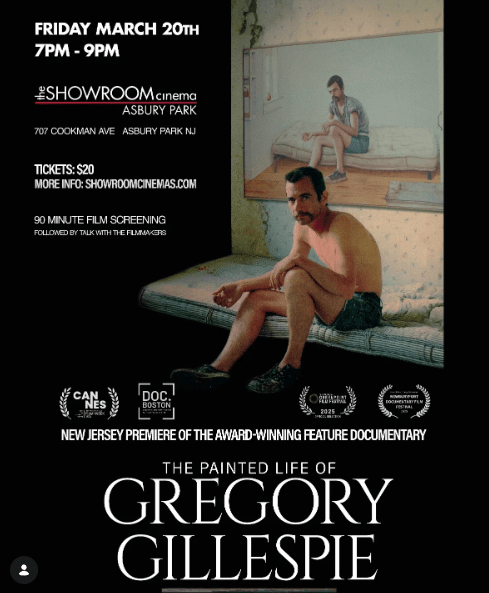

New Jersey’s cultural landscape continues to deepen its reputation as one of America’s most compelling artistic crossroads, and this March it welcomes a powerful cinematic homecoming that bridges fine art, film, and the Garden State’s own creative legacy. The award-winning documentary “The Painted Life of Gregory Gillespie” will make its highly anticipated New Jersey premiere on March 20, 2026 at The ShowRoom Cinema, introducing audiences to the extraordinary and often turbulent life of visionary American painter Gregory Gillespie.

Directed by filmmaker Evan Goodchild of Goodchild Media, the feature-length documentary represents a significant artistic milestone. It is both the director’s debut feature and a deeply personal exploration of Gillespie’s haunting and influential work—an exploration that comes full circle in New Jersey, the state where the artist’s journey first began.
For New Jersey audiences, the premiere carries special resonance. Gillespie grew up in Roselle Park, and the screening serves as a symbolic return of his story to the communities that shaped his earliest creative instincts.
The event also reinforces Asbury Park’s growing status as a hub for independent film culture, anchored by the vibrant programming and cinematic leadership of The ShowRoom Cinema.
A Documentary That Explores the Mind Behind Visionary Realism
“The Painted Life of Gregory Gillespie” is not simply a biographical documentary—it is an immersive exploration of artistic psychology, creative obsession, and the often fragile boundary between brilliance and turmoil.
The film traces Gillespie’s evolution from a troubled childhood in suburban New Jersey to international recognition as one of the most distinctive painters of the late twentieth century. Along the way, it examines the emotional and intellectual forces that shaped his work and his life.
Gillespie became widely known for a painting style he described as “visionary realism,” a complex approach that fused classical European technique with surrealist imagination and deeply personal symbolism.
His canvases often feel like psychological landscapes. Meticulously rendered forms collide with dreamlike imagery, intimate self-portraits confront viewers with unsettling emotional intensity, and still lifes evolve into allegories of identity, spirituality, and mortality.
The documentary captures this creative process with remarkable depth, revealing how Gillespie’s art emerged from both disciplined craft and spontaneous experimentation.
The Discovery That Sparked the Film
The origin of the documentary is itself an extraordinary story.
Director Evan Goodchild first encountered Gillespie’s legacy in an unexpected way—by discovering that he was living in the very studio where the artist had once worked and where Gillespie ultimately ended his life.
That discovery ignited a creative investigation that would grow into a full-scale documentary project. As Goodchild began researching Gillespie’s work, he uncovered a trove of personal material that offered rare insight into the painter’s mind.
Central to the film are 118 personal journals kept by Gillespie throughout his life. These writings reveal the internal struggles, philosophical reflections, and creative breakthroughs that defined his career.
Combined with archival footage and interviews with major figures in the art world, the documentary builds a layered portrait of an artist whose influence continues to resonate decades after his death.
Rare Archival Material and Art World Voices
One of the most compelling aspects of the film is its extensive use of rare archival footage and historical materials that have rarely been seen by the public.
Through these materials, viewers gain unprecedented access to Gillespie’s artistic evolution—from early student work to the monumental paintings that established his reputation.
The film also features interviews with influential figures from across the art community, including curators, historians, and fellow artists who witnessed Gillespie’s career unfold.
Among them is former Whitney Museum director Adam Weinberg, whose perspective places Gillespie within the broader narrative of American contemporary art.
Painter William Beckman also contributes insights into Gillespie’s artistic process, discussing the unique technical precision and emotional intensity that set his work apart.
Together, these voices help contextualize Gillespie’s legacy within the larger framework of twentieth-century art history.
The Painter Who Bridged Renaissance Technique and Modern Expression
What made Gregory Gillespie such a distinctive figure in American art was his ability to combine the meticulous craftsmanship of Renaissance painting with the psychological exploration of modernism.
During his studies in Italy, Gillespie immersed himself in the traditions of classical painting. The influence of Italian Renaissance masters can be seen in the precision of his brushwork, the structure of his compositions, and the luminous treatment of form and light.
Yet Gillespie never confined himself to historical imitation.
Instead, he developed a deeply personal approach that incorporated surreal imagery, symbolic abstraction, and what he called “rorschaching.”
This method involved creating spontaneous marks or shapes on the canvas and then interpreting them visually—allowing subconscious imagery to emerge organically.
The result was artwork that felt both meticulously constructed and emotionally raw.
His paintings often explored themes of identity, sexuality, spirituality, and mortality. Self-portraits in particular became a central component of his work, confronting viewers with intensely introspective imagery that blurred the line between autobiography and metaphor.
A Legacy Preserved in Major Museums
Despite the deeply personal nature of his work, Gillespie achieved significant institutional recognition during his lifetime.
His paintings now reside in some of the most respected collections in the world, including the Metropolitan Museum of Art, the Whitney Museum of American Art, and the Hirshhorn Museum and Sculpture Garden.
The Hirshhorn notably mounted a major retrospective of Gillespie’s work when he was only 41 years old—an extraordinary recognition that cemented his place within the American art canon.
Yet despite these achievements, Gillespie remained a somewhat enigmatic figure in art history. His work defied easy categorization, existing somewhere between classical realism, surrealist dream imagery, and deeply personal psychological exploration.
This complexity is precisely what makes his story so compelling for contemporary audiences.
The ShowRoom Cinema and Asbury Park’s Film Culture
The decision to host the New Jersey premiere at The ShowRoom Cinema underscores the venue’s growing influence as a cornerstone of independent film culture in the region.
Located in the heart of downtown Asbury Park, the cinema has become known for championing artist-driven films, documentaries, and independent storytelling that often fall outside mainstream distribution channels.
Through curated screenings, filmmaker events, and community engagement programs, the venue has transformed into one of the most dynamic cultural institutions on the Jersey Shore.
For audiences attending the March 20 screening, the experience promises more than just a film—it offers an opportunity to engage with a powerful artistic narrative within one of the state’s most vibrant creative communities.
The screening also aligns with the ongoing coverage of film, television, and media developments across the Garden State featured through Explore New Jersey’s Film & TV coverage, which continues to spotlight emerging productions, independent filmmakers, and cultural events shaping the region’s entertainment industry.
The Film’s Expanding National Screening Tour
The Asbury Park premiere is part of a broader national screening tour that has brought the documentary to museums, galleries, and art institutions across the country.
Following earlier screenings in Massachusetts and Philadelphia, the New Jersey event marks one of the most meaningful stops on the tour, given Gillespie’s roots in the state.
Upcoming presentations will continue the film’s journey through the national arts circuit, including a screening at the Vero Beach Museum of Art later in the spring.
The tour reflects growing interest in Gillespie’s work among contemporary audiences who are rediscovering his paintings through exhibitions, publications, and now documentary film.
Why Gregory Gillespie’s Story Matters Today
More than two decades after his passing, Gregory Gillespie’s work remains strikingly relevant.
In an era where artists increasingly explore themes of identity, psychology, and personal narrative, Gillespie’s paintings feel remarkably prescient.
His willingness to confront vulnerability, inner conflict, and existential questions through visual art resonates strongly with modern viewers seeking authenticity and emotional depth.
“The Painted Life of Gregory Gillespie” brings that legacy into focus for a new generation—offering not only a portrait of a singular artist but also a meditation on the nature of creativity itself.
For New Jersey audiences, the premiere represents something even more meaningful: the rediscovery of an artist whose roots began in the Garden State before his work reached museums and galleries around the world.
A Homecoming for a Visionary Artist
When the lights dim at The ShowRoom Cinema on March 20, the story unfolding on screen will travel through decades of artistic struggle, discovery, and triumph.
It will move from the suburban streets of Roselle Park to European studios, from museum galleries to the private journals of a man searching for meaning through art.
And in doing so, it will return Gregory Gillespie’s legacy to the state where his creative journey first began.
For New Jersey’s arts community, the screening stands as both a celebration and a rediscovery—an opportunity to recognize one of the state’s most fascinating artistic figures and to experience a documentary that captures the beauty, complexity, and intensity of a life lived through paint.