
The New Jersey Devils are not going quietly. Not now, not with momentum building, not with their young core producing at an elite level, and certainly not with pride, identity, and the expectations of a franchise still very much in transition shaping every shift. As of March 30, 2026, the Devils sit seventh in the Metropolitan Division with a 38-33-2 record, their playoff probability reduced to a razor-thin margin. Yet what is unfolding on the ice tells a far more compelling story than the standings alone suggest.
This is a team playing its most cohesive, urgent hockey of the season at precisely the moment when the stakes are highest—even if the math suggests the climb is nearly impossible. And in New Jersey, that matters.
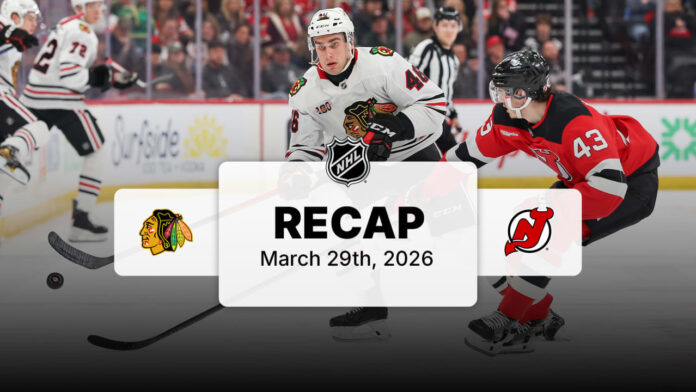
Returning home after a difficult road loss to the Carolina Hurricanes, the Devils had no luxury of reflection. The turnaround was immediate, the response required instant. Less than 24 hours later, they faced the Chicago Blackhawks in a game that demanded energy, execution, and resilience. What followed was one of the most telling performances of their season—a 5-3 comeback victory that underscored exactly who this team is becoming.
At the center of it all is Jack Hughes, who continues to redefine what elite offensive leadership looks like in New Jersey. Since returning from international play, Hughes has been operating at a pace that places him among the league’s most dangerous playmakers, compiling 27 points in just 16 games. Against Chicago, he once again dictated tempo, controlled possession, and elevated the attack in critical moments. His performance was not just productive—it was commanding, the kind that shifts momentum across an entire bench.
But the Devils’ recent surge is not a one-player narrative. It is structural. It is cultural. It is the result of a roster that, despite adversity, is finding rhythm late in the year. Over their last eight games, the Devils have gone 6-2-0, a stretch that reflects improved defensive discipline, opportunistic scoring, and a renewed commitment to pace. These are not empty wins—they are hard-earned, system-driven results that hint at a team beginning to align with its long-term identity.
Captain Nico Hischier continues to anchor that identity. Recently reaching the 600-game milestone in his NHL career, Hischier represents the connective tissue of this roster—a two-way presence whose leadership extends far beyond the scoresheet. His consistency, positional awareness, and ability to stabilize key moments have been instrumental during this late-season push, reinforcing the foundation the Devils are building around.
The current roster configuration reflects both necessity and forward-thinking management. Injuries have tested depth, most notably with Luke Hughes landing on long-term injured reserve earlier this year. Yet the response from the front office has been decisive. The additions of Nick Bjugstad and Maxim Tsyplakov have provided complementary depth, size, and situational versatility, while the departure of Ondrej Palat signals a continued recalibration of the team’s competitive window and roster balance.
What emerges from these moves is a clearer picture of intent. The Devils are not clinging to the present—they are shaping the future in real time. Every lineup adjustment, every call-up, every transaction reflects an organization that understands where it stands and where it needs to go.
Still, the immediate focus remains on the ice, and the schedule offers no relief. A high-stakes matchup against the New York Rangers looms next, a game that carries both competitive and emotional weight. Rivalry games at this stage of the season amplify everything—intensity, execution, consequence. For the Devils, it is another opportunity to validate their late-season surge against one of the league’s most recognizable opponents.
For fans across the state, this stretch has taken on a different meaning. It is no longer solely about postseason qualification. It is about witnessing growth, resilience, and the emergence of a team that refuses to disengage, regardless of the odds. It is about seeing a young core translate potential into performance, night after night, against opponents with far more immediate stakes.
And that is why attention around the Devils continues to build, both inside arenas and across platforms like <a href=”https://explorenewjersey.org/new-jersey-devils/”>Explore New Jersey’s Devils coverage</a>, where the evolving narrative of this team is being tracked in real time. Because what is happening now is not a footnote—it is a signal.
The numbers may say the path to the playoffs is nearly closed. The projections may place the Devils on the outside looking in. But inside the locker room, and increasingly on the ice, there is a different reality taking shape. This is a team accelerating, not retreating. A roster discovering its edge. A franchise leaning into its next era with conviction.
And if this late-season surge is any indication, the most important chapters of Devils hockey are not behind them—they are just beginning to take form.