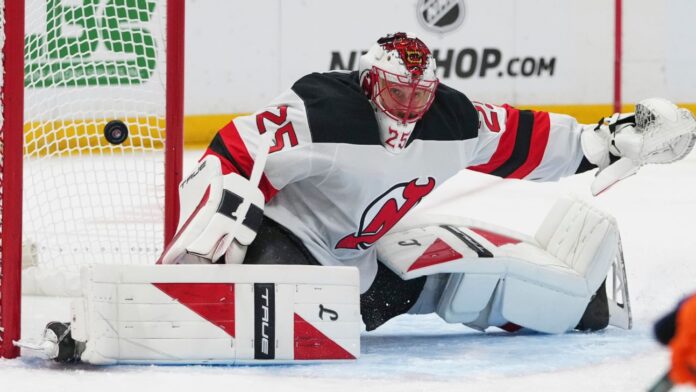

The New Jersey Devils entered this season with expectations as sharp as skates on fresh ice. After flashes of brilliance early in the schedule, the promise has begun to blur, replaced by missed opportunities, restless fan concern, and a growing sense that the team’s most critical position has become its most precarious problem. A narrow 4–3 loss to Winnipeg this week served as another reminder that the margin for error is razor thin, and that in today’s NHL, shaky goaltending can undo even the most carefully constructed roster.
The night against the Jets was eventful beyond the scoreboard. A midgame trade sent veteran winger Ondrej Palat across the Hudson, signaling that management is already tinkering with chemistry in search of a spark. At the same time, new arrival Maxim Tsyplakov was introduced to fans, adding another intriguing name to a lineup still searching for rhythm. But roster movement and fresh faces cannot disguise the deeper issue forming at the heart of the team’s struggles: the crease.
Goaltending has haunted this franchise before, and longtime Devils followers have seen this movie play out in different eras. A decade ago, the organization wrestled with balancing loyalty to a legendary veteran while a younger, more statistically effective netminder waited in the wings. That decision-making cost valuable points in a season where every one mattered. Today, the situation feels uncomfortably familiar. Once again, the Devils find themselves giving more starts to a struggling veteran while a more consistent alternative sits nearby, ready yet underutilized.
This season’s numbers paint a stark picture. New Jersey’s offense has been near the bottom of the league in scoring, leaving almost no room for error in goal. When goals are hard to come by, the goaltender must steal points. Instead, the team has watched too many games slip away after soft rebounds, late reactions, and misread plays. The defensive system has tightened under the current coaching staff, yet the results in net have not followed. When a team plays more responsibly in its own zone and still leaks goals, the spotlight naturally lands on the last line of defense.
Jacob Markstrom arrived with the reputation of a proven NHL starter, the kind of acquisition meant to finally stabilize years of uncertainty in goal. The organization invested heavily to bring him in and then doubled down with a contract extension meant to lock in security for seasons to come. But performance has cratered. Too many appearances have ended with three or more goals allowed. Advanced metrics place him among the league’s lowest-performing starters, from save percentage to goals saved above expected. Even more alarming, low-danger shots—routine saves NHL goalies must make—have become an ongoing struggle. When a goaltender fails to stop the easy ones and also cannot bail the team out on high-danger chances, wins become rare commodities.
Meanwhile, Jake Allen has quietly delivered steadier results. He is not a long-term franchise solution, but in the here and now, he has outperformed his counterpart across nearly every meaningful measure. Yet he continues to receive fewer starts. The parallel to past Devils seasons is impossible to ignore: a team on the playoff bubble choosing sentiment, reputation, or contractual commitment over the goaltender giving the best chance to win each night.
History shows how damaging such decisions can be. In seasons past, New Jersey cycled through struggling netminders, many of whom eventually exited the league or were moved aside after extended runs of poor performance. Coaching systems were blamed, defensive coverage was questioned, but the common denominator remained the same. Pucks found the back of the net at critical moments, and standings points evaporated.
What makes the current predicament even more troubling is that this time, the Devils are playing a more structured defensive game. They are not the run-and-gun, high-risk team of recent years. They are trying to limit quality chances. And yet the goals still come. That suggests the issue is no longer tactical but personnel-based. When an organization invests significant assets to fix a long-standing weakness and ends up with results worse than previous stopgap solutions, it becomes a foundational concern rather than a passing slump.
The contract extension looming ahead adds another layer of complication. Long-term commitments to aging goaltenders rarely age gracefully in the NHL. When a player’s performance dips before the extension even begins, the financial and roster implications become severe. Unlike underperforming skaters, a struggling goaltender cannot be hidden on a lower line or rotated out of sight. Every appearance directly affects results. Every mistake is magnified. And every lost point narrows the postseason path.
The Devils’ schedule offers a potential solution. With few back-to-back games before the Olympic break and a manageable run of opponents, there is an opportunity to hand the net to the more reliable option without overworking him. The coach has acknowledged that the team struggles to score at even strength, meaning goaltending decisions carry even greater weight. When offense is scarce, the team must choose the goalie most likely to keep games within reach.
Fans understand that no single player is solely responsible for a team’s fortunes. Defensive breakdowns happen. Forwards miss assignments. Pucks take bad bounces. But the consistent pattern of goals allowed on routine shots, combined with a widening statistical gap between the two available goaltenders, suggests that stubborn adherence to a predetermined plan may be costing the team its season.
This franchise has seen what happens when loyalty overrides logic. The lesson then was painful. The lesson now feels urgent. If New Jersey intends to remain in the playoff hunt, adaptability is essential. The front office made a bold move to acquire a veteran goaltender. The coaching staff now faces the equally bold decision of recognizing when the experiment is failing in real time.
The Devils’ story has always been one of reinvention, resilience, and the willingness to evolve. From dynasty years to rebuilds, from legends in net to rising stars on the blue line, the team’s identity has been shaped by decisive action. That tradition is being tested again.
For fans following every twist of the season, comprehensive coverage of the New Jersey Devils continues to track the pulse of the team, the roster, and the road ahead. What happens next in the crease may determine not just the outcome of this season, but the direction of the franchise moving forward.
Because in the NHL, hope is not a strategy. And for the Devils, the time to choose the right path in goal is now.