
New Jersey’s spring sports calendar reaches a national level of competition and visibility as the 27th Annual Knecht Cup Regatta returns to Cooper River Park on April 11 and 12, 2026. Recognized as one of the largest and most competitive collegiate rowing events in the United States, the Knecht Cup has evolved into a cornerstone event within the sport, drawing elite programs from across the country to a venue that has become synonymous with high-performance racing. As part of the broader athletic landscape consistently highlighted across Explore New Jersey’s sports coverage, this regatta represents both a major competitive platform and a defining annual event for the region.
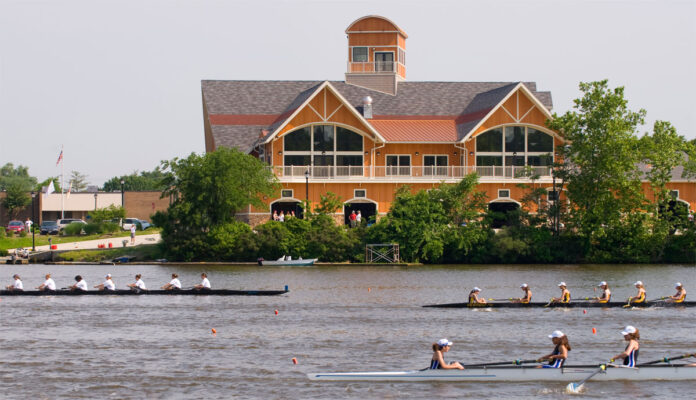
Set along the Cooper River in Cherry Hill and Pennsauken, the regatta takes place on a 2,000-meter, six-lane, fully buoyed course widely regarded as one of the premier rowing venues in the country. Designed to meet international standards, the course provides consistent conditions that allow for precise, head-to-head competition, making it an ideal setting for collegiate crews seeking to measure performance at a high level. Over the course of the two-day event, more than 76 collegiate rowing programs are expected to compete, generating upwards of 389 race entries across a tightly scheduled series of heats, semifinals, and finals.
The structure of the Knecht Cup is built on scale and efficiency. Racing begins each morning at approximately 7:30 a.m. and continues through the late afternoon, concluding around 5:30 p.m., with events organized to maximize course utilization while maintaining competitive integrity. This format allows for a broad range of race categories, from varsity-level events to developmental and inclusion-based competitions, ensuring that the regatta reflects the full spectrum of collegiate rowing.
For 2026, the Knecht Cup introduces a series of expansions that reinforce its position at the forefront of the sport. Fourteen new events have been added to the program, accompanied by the introduction of new trophies that recognize both performance and legacy. Among these is the Women’s Varsity Pair trophy, honoring Ann and Marie Jonik, whose contributions to the sport continue to resonate within the rowing community. These additions are not merely incremental; they represent a deliberate effort to expand competitive opportunities while acknowledging the individuals and milestones that have shaped the sport’s development.
A significant area of growth for this year’s regatta is the expanded Para and Inclusion racing program. Events now include PR1, PR2, and PR3 single sculls, as well as inclusion double sculls, reflecting a broader commitment to accessibility and diversity within competitive rowing. This expansion aligns with larger trends across the sport, where inclusion is increasingly integrated into event structure rather than treated as a separate category. By incorporating these races into the main program, the Knecht Cup continues to position itself as a progressive and comprehensive event within the national rowing calendar.
The spectator experience is equally well developed, reinforcing the regatta’s status as both a competitive and community-focused event. Admission remains free, allowing audiences to engage with high-level collegiate athletics without barrier. On-site amenities include concession areas and designated viewing zones, while large Jumbotron screens positioned near the finish line provide live race coverage, ensuring that spectators can follow the action in real time regardless of their location along the course. The Grandstand area at North Park Drive and Donahue Avenue serves as a central viewing point, offering a clear perspective on race finishes and award presentations.
Additional programming enhances the connection between athletes and spectators. On Sunday morning at 9:00 a.m., an autograph session featuring members of the USRowing National Team will take place at the USRowing tent, providing an opportunity for fans to engage directly with athletes competing at the highest levels of the sport. This element reinforces the event’s role not only as a competition but as a platform for community engagement and inspiration.
The historical foundation of the Knecht Cup adds further significance to its modern-day impact. Established in 1999, the regatta honors the legacy of William J. “Bill” Knecht, an Olympic gold medalist whose contributions to rowing extend beyond competition to the development of the Cooper River course itself. His vision helped establish the venue as a premier racing site, and the regatta continues to reflect that standard. The event also pays tribute to Ana Tamas Knecht, a distinguished athlete and coach whose influence has shaped generations of rowers. Together, these legacies provide a framework that connects the event’s competitive present with its historical roots.
Within the broader context of New Jersey’s sports infrastructure, the Knecht Cup Regatta stands as a clear example of how the state continues to host events of national significance. As reflected across Explore New Jersey’s sports platform, the region’s ability to support large-scale competitions is driven by a combination of venue quality, organizational expertise, and sustained investment in athletic programming. The Cooper River course, in particular, has become a focal point for this activity, attracting events that elevate both the local and national profile of the sport.
As April 11 and 12 approach, the 27th Annual Knecht Cup Regatta is positioned to deliver a comprehensive display of collegiate rowing at its highest level. It is an event defined by scale, precision, and competitive intensity, supported by a venue and organizational structure capable of meeting those demands. For athletes, it represents a critical opportunity to compete against top-tier programs; for spectators, it offers direct access to one of the most dynamic and technically demanding sports in the collegiate landscape. Within New Jersey’s 2026 calendar, the Knecht Cup remains a benchmark event, reinforcing the state’s role as a central hub for elite athletic competition.