
For all intents and purposes, the season narrative surrounding the New Jersey Devils had begun to tilt toward frustration. A five-game losing streak, uneven defensive execution, and offensive conservatism had many questioning whether the stretch run would be more about evaluation than pursuit.
Then came Saturday night in St. Louis.
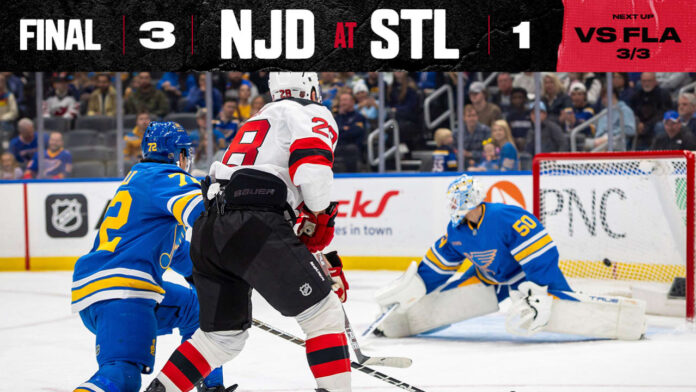
In a 3–1 victory over the St. Louis Blues at Enterprise Center, the Devils delivered arguably their most structurally complete performance in weeks. It was not flawless. It was not dominant wire-to-wire. But it was intentional, aggressive, and anchored by elite goaltending at critical moments.
With roughly 20 games remaining and the March 6 trade deadline approaching, this was more than two points. It was a statement that the Devils are not ready to fade quietly.
For continued Devils coverage, analysis, and standings updates, visit Explore New Jersey’s dedicated New Jersey Devils page.
First Period: Sloppy Execution, But Survive and Adjust
The opening 20 minutes were disjointed.
The Devils generated only three high-danger chances and were charged with seven official giveaways, including miscues from Dawson Mercer, Connor Brown, Nick Bjugstad, Nico Hischier, Simon Nemec, and Timo Meier. Puck management was inconsistent, and zone exits lacked rhythm.
A particularly instructive sequence occurred on the penalty kill after Dougie Hamilton was whistled for tripping. Luke Hughes made an outstanding read, intercepting a pass in the defensive zone and skating the puck out with confidence. After crossing center ice, Hughes fed Nick Bjugstad, triggering a controlled entry with Jesper Bratt. But an extra pass between Bjugstad and Bratt killed the shooting lane and resulted in a counterattack the other way.
This play symbolized a recurring Devils theme: a tendency toward over-perfection. Hughes has the skating and hands to attack himself in that scenario. When the defenseman makes a read like that, the coaching staff should encourage assertiveness, not deference.
The first period ended scoreless, but not because of dominance. It ended because the Devils absorbed pressure without breaking.
Second Period: The Best 20 Minutes in Months
If the first period was uncertain, the second was authoritative.
The Devils flipped the territorial battle entirely, posting overwhelming five-on-five metrics:
• 72.97% Corsi For
• 14–3 shot advantage
• 19–2 scoring chances
• 8–0 high-danger chances
• 94.11% expected goals share
That is not a good period. That is territorial control at an elite level.
Jesper Bratt drew an early penalty, though the first power-play unit struggled to establish rhythm without its typical personnel combinations. Timo Meier’s early look from the slot was turned aside by Jordan Binnington, but the pressure continued.
Moments later, Meier delivered the breakthrough.
Coming down the right wing with pace, Meier roofed a shot over Binnington’s blocker for a 1–0 lead. It was a pure difference-maker’s goal: speed, confidence, and decisive execution.
The second goal followed a pattern Devils fans have wanted to see more often. After Dougie Hamilton initiated a neutral-zone drop pass to Jack Hughes, Hughes circled the net to create a passing lane before teeing up Hamilton for a one-timer that ripped past Binnington on the power play.
The Devils were not playing cautiously. They were attacking below the dots, cycling three and sometimes four skaters deep in the zone. The conservative perimeter approach that has plagued much of the season was replaced by layered pressure.
And crucially, they wore the Blues down.
St. Louis registered 15 “extra long” shifts compared to 10 for the Devils. The second period shift battle tilted heavily toward New Jersey. Instead of fading late, they forced the Blues into fatigue.
That tactical reversal mattered.
Third Period: Controlled Containment and a Goalie Who Looked Elite
The Devils did dial back their aggressiveness in the third, sitting deeper in their structure and prioritizing shot lanes.
Jack Hughes took an uncharacteristic delay-of-game penalty early, but the penalty kill remained composed. Nick Bjugstad even generated a shorthanded opportunity during the kill.
As the Blues pressed with the extra attacker, the Devils’ structure held firm. Nico Hischier won critical defensive-zone draws. Connor Brown elevated a puck high into the neutral zone to relieve pressure. And in the final moments, Bratt bypassed an empty-net opportunity to set up Hischier for the sealing goal.
The lone blemish came when Jacob Markstrom attempted a full-length empty-net clearance and was scored on by Pavel Buchnevich after contact prevented him from returning cleanly to the crease. The Devils chose not to challenge for goaltender interference, avoiding the risk of a delay-of-game penalty.
Still, Markstrom’s night was exceptional.
He stopped 25 of 26 shots with 1.67 expected goals against and came 1:18 away from a shutout.
Olympic Markstrom Has Arrived
For much of the season, goaltending inconsistency has hovered over this roster. But since returning from international play with Team Sweden, Markstrom has looked transformed.
In two games since Milan, he is 1–1–0 with a .935 save percentage. Over his last four NHL appearances dating back to January 29, he carries a .931 save percentage and a goals-against average just over 2.00.
This version of Markstrom — decisive, square, composed — changes the equation entirely.
If he sustains this level, the Devils are not simply competitive. They become dangerous.
Luke Hughes Returns, and the Offensive Identity Evolves
Another critical development: Luke Hughes returned to the lineup after missing 10 games with a shoulder injury and recorded an assist.
Hughes’ transition ability and offensive instincts fundamentally alter the team’s ceiling. When combined with Hamilton and Nemec activating from the blue line, the Devils can generate layered attack waves.
The key is commitment.
Saturday’s second period showed what happens when the Devils attack with conviction below the dots instead of hovering above the faceoff circles waiting for perfect deflections.
The risks exist. Jonas Siegenthaler’s scorpion-style kick block late in the first period was necessary because Hamilton had pinched aggressively. But that is modern hockey. Mobile defensemen must activate to unlock scoring depth.
The difference Saturday was execution.
Standings Reality and Trade Deadline Pressure
As of March 1, the Devils sit seventh in the Metropolitan Division with 60 points at 29–29–2.
Metropolitan Division Snapshot:
Carolina Hurricanes – 82 pts
Pittsburgh Penguins – 73 pts
New York Islanders – 73 pts
Washington Capitals – 69 pts
Columbus Blue Jackets – 66 pts
Philadelphia Flyers – 65 pts
New Jersey Devils – 60 pts
New York Rangers – 53 pts
Metropolitan Division Standings (as of March 1, 2026)
| Team | GP | W | L | OTL | PTS |
|---|---|---|---|---|---|
| Carolina Hurricanes | 59 | 38 | 15 | 6 | 82 |
| Pittsburgh Penguins | 58 | 30 | 15 | 13 | 73 |
| New York Islanders | 60 | 34 | 21 | 5 | 73 |
| Washington Capitals | 62 | 31 | 24 | 7 | 69 |
| Columbus Blue Jackets | 58 | 29 | 21 | 8 | 66 |
| Philadelphia Flyers | 59 | 27 | 21 | 11 | 65 |
| New Jersey Devils | 60 | 29 | 29 | 2 | 60 |
| New York Rangers | 59 | 23 | 29 | 7 | 53 |
The Devils remain outside a wildcard spot, but not eliminated. Approximately 20 games remain.
The March 6 trade deadline looms large. Speculation continues regarding whether management should stand pat or explore movement involving depth pieces like Evgenii Dadonov or even Dawson Mercer. Numerous no-trade clauses complicate flexibility.
But Saturday’s performance complicates the narrative.
If this structural shift is real — if the second-period aggression becomes standard and Markstrom sustains elite form — the Devils are not sellers. They are contenders clawing back into relevance.
The Bigger Takeaway
This was not simply a win.
It was a template.
Aggressive cycling below the dots.
Blue-line activation with confidence.
Dominant second-period shift control.
Elite goaltending at key moments.
The Devils snapped a five-game losing streak not by surviving, but by asserting themselves for one crucial 20-minute stretch and then defending it intelligently.
For a team hovering between evaluation and escalation, that matters.
The season was not over when they boarded the flight west. It was waiting for a performance like this to redefine its trajectory.
If this version of the Devils persists, March may look very different than February.