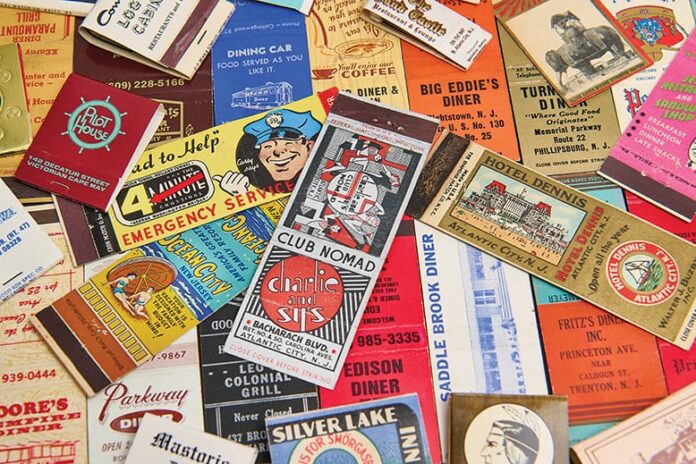

In an age dominated by digital ephemera and fleeting online trends, a small but devoted group of South Jersey collectors continues to safeguard a tangible slice of Americana that once fit neatly into every pocket. Matchbooks, those humble paper folders designed for a single purpose, have evolved into unlikely historical records, and nowhere is that transformation more evident than among the collectors who refuse to let the hobby fade quietly into ash.
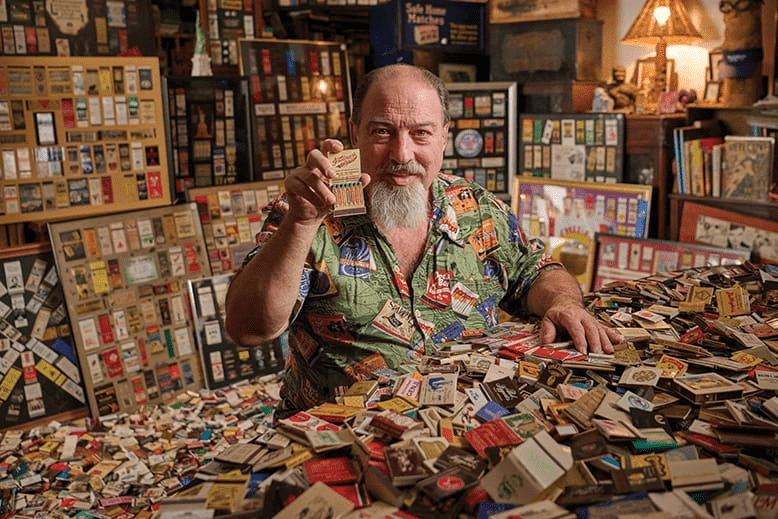
At the center of this world is Collingswood resident Richard L. Greene, a match-industry historian whose personal archive numbers roughly 750,000 matchbooks, making it one of the largest private collections in the country. On a recent summer afternoon, Greene returned from an estate pickup at the Jersey Shore with dozens of meticulously organized binders filled with match covers tied to Garden State businesses, landmarks, and long-gone attractions. These discoveries quickly made their way to a backyard gathering in Middlesex, where fellow collectors combined recent finds, compared notes, and traded stories with the enthusiasm of archivists uncovering lost chapters of local history.
Greene serves as vice president of the Liberty Bell Matchcover Club, a regional organization whose meetings rotate throughout South Jersey and neighboring areas. The club’s leadership spans the state, from Trenton to the Shore, and its members bring with them collections that document everything from seaside boardwalks and fire companies to nightclubs, diners, and amusement parks. In Greene’s binders alone, one can trace decades of New Jersey life, including vanished Shore resorts, defunct bars, and even obscure roadside curiosities that exist now only in memory and print.
What draws collectors to these paper artifacts is not nostalgia alone, but the realization that matchbooks once functioned as miniature billboards. When smoking was commonplace and every restaurant, hotel, and bowling alley handed out free matches, businesses relied on them as a primary advertising tool. Over time, those tiny designs captured typography trends, graphic art styles, and cultural shifts, making them valuable references for historians and designers alike. As Greene often notes, it is difficult to find another object that so thoroughly documents everyday commerce across generations.
That sense of cultural preservation resonates deeply in New Jersey, where diners, shore towns, and local enterprises have long defined the state’s identity. Fellow collector and club newsletter editor Marc Edelman has spent more than six decades building a collection that includes a framed display dedicated entirely to New Jersey diners, featuring matchbooks from Paterson, Trenton, Bound Brook, and beyond. For Edelman, the appeal lies in the way these items tell stories that official records often overlook.
Club gatherings are as much social events as they are sorting sessions. At a recent summer meeting hosted by Jim and Christy Benes, collectors spread out acquisitions poolside, comparing duplicates and setting aside pieces for newer members. The system is collaborative by design, with first access going to those present before extras are offered through auctions or convention tables. It is a model built on shared stewardship rather than competition, reinforcing the communal spirit that has sustained the hobby for decades.
Yet even with that dedication, collectors are candid about the challenges they face. Membership numbers have declined nationally, and many longtime enthusiasts are aging out of active participation. Liberty Bell itself counts hundreds of online followers but far fewer dues-paying members who attend meetings regularly. Despite this, New Jersey continues to punch above its weight in the matchbook world, with several of the most significant collections concentrated within a few counties.
A notable force reshaping the hobby’s future is Joe Danon of North Caldwell, founder of an independent match manufacturing company and a lifelong collector. By reintroducing custom and novelty match designs, Danon has tapped into a younger audience drawn to retro aesthetics and tactile branding. His work has helped push matchbooks back into circulation as promotional items for musicians, artists, and small businesses, many of whom discover them through social media. The resurgence has sparked a secondary market and introduced matchbooks to a new generation that views them less as smoking accessories and more as collectible design objects.
This evolution mirrors broader shifts in how people engage with hobbies tied to daily life and personal expression, themes often explored in Explore New Jersey’s lifestyle coverage. As interests cycle back toward analog experiences and locally rooted stories, matchbooks have found renewed relevance as both art and artifact.
For Greene, the passion is deeply personal. Growing up in Sewell, he was captivated by the visual language of matchbook graphics, a fascination that eventually led to extraordinary acquisitions, including covers signed by legendary astronauts. Each piece adds another layer to a collection that spans industries, eras, and imaginations.
Despite concerns about dwindling numbers, collectors remain optimistic. They see renewed energy in customization, online communities, and younger enthusiasts discovering the charm of these overlooked objects. As long as there are people willing to recognize the history contained in a folded piece of cardboard and a striker strip, the flame, however small, continues to burn.