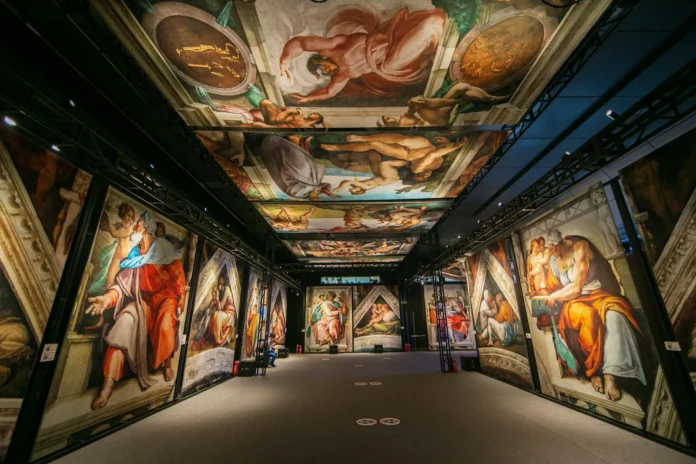

New Jersey’s cultural landscape continues to expand in bold and unexpected ways, and one of the most compelling examples of that evolution is now open to the public at Westfield Garden State Plaza. Sistine Chapel: The Exhibition offers a rare opportunity to experience one of the most revered artistic achievements in human history—not from a distance, but up close, at eye level, and with a level of access that fundamentally reshapes how audiences engage with Michelangelo’s work.
For generations, the Sistine Chapel ceiling has stood as a pinnacle of artistic accomplishment, drawing millions of visitors to Vatican City each year. Yet the very nature of that experience—viewing the frescoes from far below, often in crowded conditions—has limited the ability to fully absorb the detail, narrative complexity, and technical brilliance embedded within each panel. This exhibition, now installed in North Jersey, redefines that encounter entirely, transforming what has traditionally been a distant observation into an immersive, highly personal exploration.
At Westfield Garden State Plaza, visitors are invited to walk among life-sized reproductions of all 34 frescoes that comprise Michelangelo’s ceiling. These meticulously recreated panels are displayed at eye level, allowing for a clarity and intimacy that is virtually impossible to achieve in the original setting. The result is a viewing experience that feels both expansive and immediate, where each brushstroke, contour, and compositional decision can be examined with unprecedented precision.
This approach does more than enhance visibility—it fundamentally alters the relationship between viewer and artwork. Without the constraints of architectural distance or time-limited access, guests are free to move at their own pace, to revisit sections, and to engage with the imagery in a way that encourages deeper understanding. The exhibition becomes not just a presentation of art, but a space for reflection, where the scale and ambition of Michelangelo’s vision can be fully appreciated.
Central to the experience is the narrative dimension of the frescoes themselves. Each panel contributes to a larger story drawn from biblical themes, rendered with a level of dramatic intensity and anatomical mastery that has defined Western art for centuries. By presenting these works in a format that prioritizes accessibility and context, the exhibition allows visitors to trace these narratives with greater clarity, uncovering connections and details that might otherwise remain obscured.
The educational component of the exhibition further enhances its impact. Informational displays accompany the visual presentation, providing insight into the historical, cultural, and artistic significance of each fresco. These elements are carefully integrated to support, rather than distract from, the visual experience, offering visitors the tools to deepen their engagement without overwhelming the sensory impact of the artwork itself.
One of the defining characteristics of Sistine Chapel: The Exhibition is its camera-friendly environment, a deliberate departure from the restrictions typically associated with viewing the original works. This feature reflects a broader shift in how cultural experiences are designed, acknowledging the role of personal documentation in modern engagement while maintaining the integrity of the presentation. Visitors are encouraged to capture and share their experience, extending the reach of the exhibition beyond its physical location and into the broader cultural conversation.
The choice of Westfield Garden State Plaza as the exhibition’s host site is both strategic and symbolic. As one of the region’s most prominent destinations, the venue provides accessibility to a wide and diverse audience, bridging the gap between high art and everyday experience. This placement reinforces the idea that cultural engagement does not need to be confined to traditional museum spaces, but can instead be integrated into the rhythms of daily life, making it more approachable and inclusive.
This exhibition also reflects the broader trajectory of New Jersey’s art and culture scene, which continues to evolve through innovative programming and expanded access to world-class experiences. By hosting an exhibition of this caliber, North Jersey further establishes itself as a destination where global artistic achievements can be explored within a local context. It is a development that aligns with the state’s growing reputation for delivering cultural experiences that are both high-quality and widely accessible.
For those seeking to explore the full spectrum of artistic and cultural offerings across the region, Explore New Jersey’s art and culture coverage provides a comprehensive guide to exhibitions, installations, and events that define the state’s creative identity. From immersive experiences like this to traditional gallery presentations, the platform captures the diversity and depth of New Jersey’s cultural landscape.
Sistine Chapel: The Exhibition stands as more than a replication of a historic masterpiece—it is a reimagining of how that masterpiece can be experienced in the modern world. By bringing Michelangelo’s work into a format that emphasizes proximity, accessibility, and narrative clarity, the exhibition offers something genuinely rare: the chance to engage with one of history’s greatest artistic achievements on entirely new terms.
In doing so, it transforms a once-in-a-lifetime destination into an experience that is not only reachable, but deeply personal, reinforcing the idea that great art is not defined solely by where it resides, but by how it is experienced.