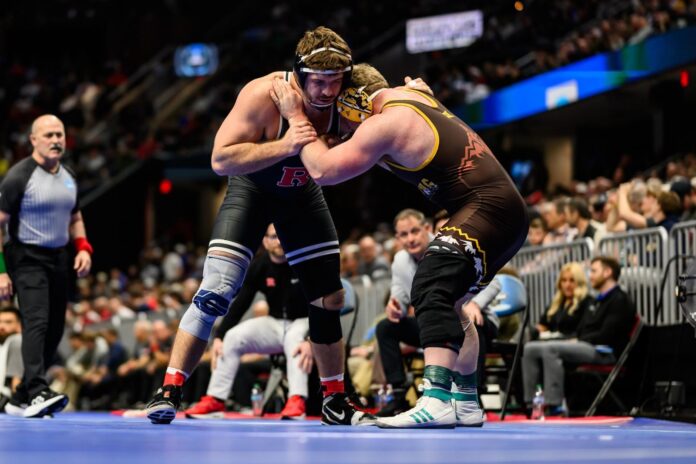

For a program that has spent the better part of the last decade building toward national relevance, the 2026 NCAA Wrestling Championships delivered a result that cuts deeper than a single tournament outcome. Rutgers wrestling, once synonymous with grit, breakthrough performances, and podium finishes, leaves this year’s championships without an All-American for the second consecutive season—a stark reality underscored by a troubling trend in the sport’s most unforgiving round.
The Scarlet Knights went 0–5 in the blood round across the last two NCAA Championships, a statistic that tells a far more revealing story than any single loss ever could. In wrestling, the blood round is where seasons are defined. It is the gateway to All-American status, the dividing line between national recognition and near-miss frustration. For Rutgers, it has become an obstacle that has proven just out of reach.
This year’s tournament followed a familiar script. Rutgers entered with a roster capable of competing, with athletes who had navigated the regular season and conference competition with enough consistency to earn their place on the national stage. Yet once again, the transition from contender to finisher proved elusive. Match after match, the Scarlet Knights found themselves within striking distance, only to fall short in the moments that mattered most.
The absence of an All-American is not simply a symbolic gap—it represents a measurable shift in the program’s competitive positioning. For years, Rutgers built its identity around producing wrestlers who could not only qualify for nationals but also place among the elite. That standard elevated the program within the Big Ten and nationally, creating expectations that extended beyond participation.
Now, those expectations are being challenged.
The 2026 NCAA Wrestling Championships showcased the depth and evolution of the sport at every weight class. The top eight finishers across all ten divisions reflected a field that is deeper, faster, and more technically refined than ever before. Programs across the country are investing heavily in development, analytics, and recruiting pipelines, raising the bar for what it takes to reach the podium. Within that environment, the margin between advancement and elimination has never been thinner.
For Rutgers, the issue is not a lack of talent. The roster continues to feature athletes capable of competing with the nation’s best. The challenge lies in converting opportunity into outcome—executing in high-pressure situations where a single takedown, escape, or ride can determine an entire season.
The blood round losses over the past two years highlight a pattern that extends beyond individual performances. They point to a program-wide hurdle in closing matches at the highest level. Whether it is late-match strategy, positional awareness, or simply the composure required in those final exchanges, Rutgers has repeatedly found itself on the wrong side of razor-thin margins.
This moment, however, is not without context. As covered across the Explore New Jersey Rutgers Scarlet Knights section, Rutgers athletics as a whole continues to evolve within one of the most competitive conferences in collegiate sports. The Big Ten remains the epicenter of wrestling excellence, where week-to-week competition mirrors the intensity of national tournaments. For Rutgers, this environment has been both a proving ground and a pressure point.
Competing in the Big Ten means facing ranked opponents consistently, preparing for styles and strategies that vary widely, and maintaining a level of performance that leaves little room for error. It also means that by the time wrestlers reach the NCAA Championships, they have already endured one of the most demanding schedules in the sport. The expectation, however, is that this preparation translates into postseason success.
At present, that translation is incomplete.
The implications of this stretch extend into recruiting, program perception, and long-term trajectory. High-level recruits are drawn to programs that consistently produce All-Americans and national contenders. While Rutgers still offers a strong platform—facilities, coaching, and conference exposure—the absence of podium finishes introduces new challenges in maintaining that competitive edge on the recruiting trail.
At the same time, this period presents an opportunity for recalibration. Programs often define themselves not only by their peaks but by how they respond to adversity. For Rutgers, the path forward will require a detailed evaluation of match management, training methodologies, and competitive mindset. It will demand a renewed emphasis on situational wrestling—the specific scenarios that define close matches at the national level.
There is also a psychological dimension that cannot be overlooked. The blood round is as much a mental battle as it is a physical one. Wrestlers must navigate the weight of expectation, the immediacy of elimination, and the knowledge that a single mistake can erase months of preparation. Building resilience in those moments is critical, and it is an area where incremental gains can yield significant results.
Despite the disappointment, the foundation of the program remains intact. Rutgers wrestling has established itself as a consistent presence on the national stage, and that baseline provides a platform for resurgence. The difference between a near miss and a breakthrough is often measured in adjustments—small, precise changes that accumulate over time.
As the offseason begins, the focus will shift to development, refinement, and preparation for the next cycle. The goal is clear: return to the podium, restore the program’s standing among the nation’s elite, and transform close losses into defining victories.
For the Scarlet Knights, the narrative is not finished. It is evolving.