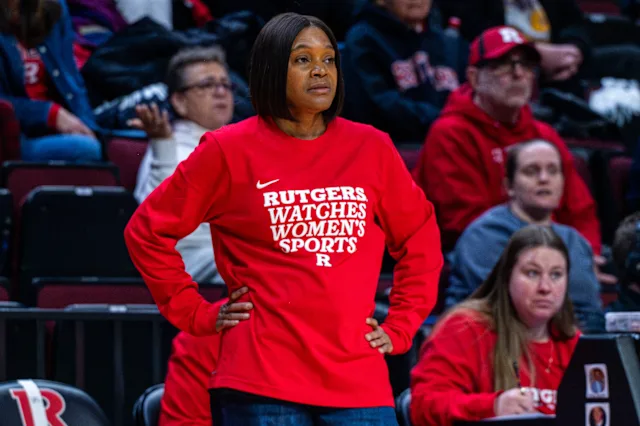

Change has officially arrived in Piscataway. On Monday, March 2, 2026, Rutgers University announced the dismissal of women’s basketball head coach Coquese Washington following a season that ended in 11 consecutive losses and a 9–20 overall record. The move signals a pivotal turning point for Rutgers Scarlet Knights women’s basketball and marks the first major coaching decision under Athletic Director Keli Zinn, who immediately launched a national search aimed at restoring the program to national prominence.
For a program with deep tradition and championship aspirations, this moment carries both weight and opportunity. Rutgers women’s basketball is not simply seeking a new coach. It is recalibrating its trajectory.
A Season That Forced a Reckoning
The 2025–26 campaign proved historically difficult. Rutgers finished last in the Big Ten with a 1–17 conference record—the worst league performance in program history. The season concluded with a decisive 93–52 loss to Nebraska Cornhuskers women’s basketball on February 28, punctuating an 11-game losing streak that underscored systemic challenges.
Over four seasons (2022–2026), Washington compiled a 42–84 overall record and an 11–61 mark in Big Ten play. In a conference widely regarded as one of the most competitive in women’s college basketball, sustained struggles in league competition ultimately proved untenable.
This decision does not erase Washington’s dedication or effort. However, the statistical realities reflect a program that has drifted from its historical standard. Rutgers women’s basketball has long defined itself by defensive identity, postseason consistency, and national respect. The gap between expectation and outcome became too wide to ignore.
A Program Defined by Legacy
To understand the magnitude of this transition, one must revisit the program’s foundation. Washington inherited the role directly from Hall of Fame coach C. Vivian Stringer, whose tenure transformed Rutgers into a perennial national contender. Under Stringer, the Scarlet Knights reached 17 NCAA Tournaments and became synonymous with resilience, defensive intensity, and player development.
Replacing a legend is inherently complex. Sustaining that legacy in an evolving collegiate landscape—marked by NIL dynamics, transfer portal fluidity, and escalating conference competitiveness—demands both tactical precision and cultural clarity.
The Financial Context
Washington had two years remaining on her contract, with a buyout estimated at just over $1.7 million. While significant, the financial component underscores Rutgers’ institutional commitment to competitive excellence. Investment in leadership is a signal of intent. The university’s willingness to absorb that cost reflects an understanding that women’s basketball remains a high-visibility pillar within Scarlet Knights athletics.
Leadership Reset Under Keli Zinn
As Athletic Director, Keli Zinn now steps into her first defining personnel decision. Public messaging emphasizes a commitment to returning Rutgers women’s basketball to “the nation’s elite.” That phrasing is deliberate. It does not suggest incremental improvement—it signals ambition.
A national search expands the candidate pool beyond regional familiarity, though Northeast recruiting connections remain strategically important. The next coach must balance immediate roster stabilization with long-term program architecture. In today’s NCAA environment, success requires more than X’s and O’s. It demands NIL strategy alignment, transfer portal management, recruiting adaptability, and cultural resonance within the university community.
Performance Metrics and Competitive Reality
The Big Ten has grown into a gauntlet. Elite programs consistently secure top-tier recruits, deep transfer additions, and national television exposure. Rutgers’ 11–61 conference record over four seasons reflects not merely isolated setbacks but sustained competitive disparity.
The statistical breakdown matters:
Overall record (2022–2026): 42–84
Big Ten record: 11–61
2025–26 conference finish: 1–17
These figures reveal the urgency behind the leadership shift. In an era where women’s basketball is experiencing unprecedented national momentum—driven by media growth, NIL visibility, and rising attendance—Rutgers must reposition itself to participate meaningfully in that surge.
Early Candidate Speculation
While the search remains in its initial phase, media outlets have begun circulating potential names. Among them:
Alisa Kresge, current head coach at Vermont and a New Jersey native, represents a candidate with regional roots and demonstrated program-building capability.
Ty Grace, head coach at Howard, brings Northeast ties and experience elevating competitive profiles within challenging environments.
Missy Traversi, formerly of Army, offers disciplined program structure and East Coast familiarity.
Speculative “Hail Mary” mentions include nationally elite figures such as Kim Mulkey (LSU) and Dawn Staley (South Carolina). While such hires would command attention, extracting coaches entrenched in championship-caliber programs remains highly improbable.
The most realistic path likely involves identifying a coach with demonstrated success in roster development, defensive identity construction, and recruiting momentum—traits historically aligned with Rutgers’ brand.
Recruiting and Roster Implications
Immediate priorities extend beyond naming a successor. Player retention and recruiting stability are critical. Coaching transitions often trigger transfer portal movement. Ensuring continuity—or at minimum, transparent communication—will shape the program’s near-term competitiveness.
New Jersey remains fertile recruiting territory. The state consistently produces Division I talent, and maintaining strong relationships with high school and AAU programs will be essential. A coach who understands the regional basketball ecosystem while possessing national recruiting reach would provide strategic balance.
Cultural Recalibration
Rutgers women’s basketball built its reputation on defensive grit, physicality, and relentless effort. That identity fueled national relevance. Restoring that ethos—while adapting to modern offensive trends and player development analytics—should anchor the next chapter.
The program’s infrastructure remains robust. Facilities, conference affiliation, alumni engagement, and institutional support create a foundation many programs would envy. The challenge is alignment—bringing leadership, roster composition, and competitive strategy into cohesion.
Why This Moment Matters
Women’s college basketball is experiencing transformative growth. Television ratings, sponsorship investments, and fan engagement have surged. The Big Ten, in particular, commands significant national visibility. Rutgers has an opportunity to re-enter that conversation at a time when the sport’s spotlight is brighter than ever.
For the Scarlet Knights, this is not merely about correcting a losing streak. It is about reclaiming competitive relevance within a rapidly ascending sport.
Explore New Jersey’s Commitment to Coverage
At Explore New Jersey, we continue to chronicle the evolving narrative of Rutgers athletics—from recruiting developments to coaching transitions and program milestones. The dismissal of Coquese Washington marks a pivotal inflection point in Scarlet Knights history.
The coming months will define whether Rutgers women’s basketball can reestablish itself as a Big Ten contender and national tournament presence. Leadership selection will determine cultural tone. Recruiting outcomes will shape immediate performance. Institutional commitment will drive long-term sustainability.
One truth is undeniable: Rutgers women’s basketball stands at a crossroads. The next decision will resonate for years to come.