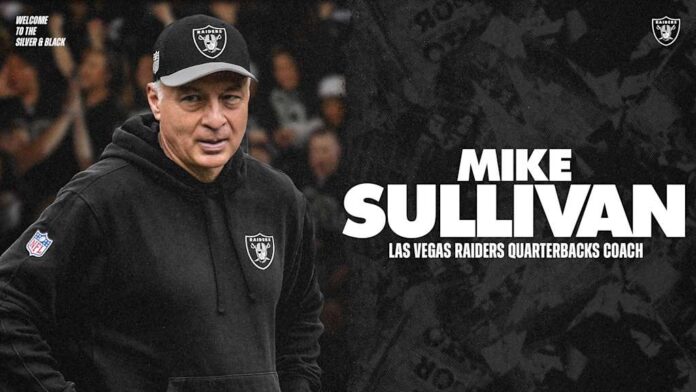

In a move that underscores the fluid, high-stakes nature of modern football coaching pipelines, veteran assistant Mike Sullivan has made a rapid transition from Rutgers University to the Las Vegas Raiders, accepting the role of quarterbacks coach in a decision that reverberates from Piscataway to the professional ranks. Announced on March 24, 2026, the hire comes just days after Sullivan had joined Rutgers as a senior offensive assistant, creating a sudden shift for one of New Jersey’s most closely watched college football programs while simultaneously strengthening an NFL staff preparing to build around a franchise quarterback.
The timing of the move is as notable as the hire itself. Sullivan had been brought into Rutgers on March 12 to contribute to head coach Greg Schiano’s offensive structure, stepping into a program that has been steadily reestablishing its identity within the Big Ten. His arrival was viewed as a calculated addition—an experienced offensive mind with deep NFL roots who could help elevate quarterback development and overall offensive efficiency. Yet less than two weeks later, the opportunity to return to the NFL proved decisive, illustrating both the demand for seasoned quarterback specialists and the increasingly blurred line between collegiate and professional coaching ecosystems.
For the Raiders, the hire addresses a critical gap. When the organization initially unveiled its 2026 coaching staff, the absence of a designated quarterbacks coach stood out, particularly given the team’s positioning at the top of the upcoming draft. By bringing in Sullivan, the Raiders are making a clear statement about their priorities—namely, the development of their anticipated No. 1 overall pick, Heisman-winning quarterback Fernando Mendoza. In a league where quarterback performance dictates franchise trajectory, the decision to secure a veteran voice with a proven track record reflects a strategic commitment to long-term success.
Sullivan’s relationship with new head coach Klint Kubiak adds another layer of continuity and trust to the move. The two previously worked together within the Denver Broncos organization, and that familiarity is expected to accelerate integration within the Raiders’ offensive system. In an environment where cohesion and communication are essential, particularly in the development of a young quarterback, this prior collaboration provides a valuable foundation.
From a New Jersey perspective, the ripple effects are immediate and significant. Rutgers, a cornerstone of the state’s football identity, now faces the challenge of recalibrating its offensive staff just as spring preparations intensify. The program is expected to elevate offensive assistant Jeff Carpenter into a larger role, a move that reflects both necessity and internal confidence. While transitions of this nature are not uncommon, the speed of Sullivan’s departure highlights the competitive pressures facing college programs as they contend with the constant pull of the NFL.
Sullivan’s résumé explains why that pull remains so strong. With more than two decades of NFL experience, he brings a depth of knowledge that spans multiple organizations and roles. His tenure includes two Super Bowl championships with the New York Giants, where he worked closely with Eli Manning during some of the franchise’s most successful seasons. He has also served as offensive coordinator for both the Tampa Bay Buccaneers and the Giants, as well as quarterbacks coach for teams including the Pittsburgh Steelers and Denver Broncos. This breadth of experience positions him as a stabilizing and influential presence within any offensive structure, particularly one centered on quarterback development.
The broader significance of this move extends beyond individual programs and organizations. It reflects a larger trend within football, where the exchange of coaching talent between college and professional levels is becoming increasingly dynamic. Programs like Rutgers are investing in NFL-caliber expertise to elevate their competitiveness, while NFL teams continue to seek out coaches with diverse backgrounds who can adapt to evolving offensive philosophies.
Within New Jersey’s football landscape, this moment reinforces the state’s ongoing connection to the highest levels of the sport. Coverage and engagement through platforms like Explore New Jersey football continue to highlight how local programs, from high school to collegiate levels, are intertwined with the broader national narrative. Moves like Sullivan’s serve as a reminder that New Jersey is not operating in isolation—it is part of a larger ecosystem that shapes and is shaped by the game’s evolution.
For Rutgers, the focus now shifts to continuity and adaptation. The program has made measurable strides under Schiano, emphasizing discipline, development, and a renewed commitment to competing within one of college football’s most demanding conferences. Maintaining that trajectory will require not only tactical adjustments but also a reaffirmation of the culture that has driven recent progress.
For the Raiders, the addition of Sullivan represents a calculated investment in the future. The development of a young quarterback is one of the most complex and consequential challenges in professional football, and the decision to entrust that process to an experienced coach signals a clear organizational vision. If executed effectively, it has the potential to define the franchise’s direction for years to come.
As the 2026 season approaches across both college and professional levels, this move stands as a compelling example of how quickly the landscape can shift. It is a story of opportunity, adaptation, and the constant pursuit of competitive advantage—elements that define football at every level.
In New Jersey, where the sport continues to inspire and connect communities, the impact of such decisions is felt not only within locker rooms and coaching offices but across a fan base that remains deeply invested in the game’s future.