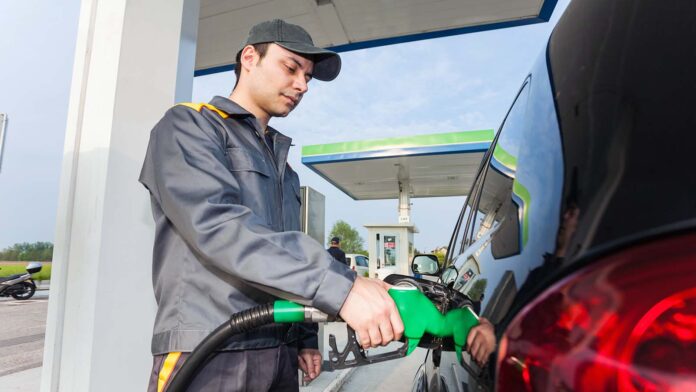

In a state defined by dense infrastructure, fast-moving commerce, and a population that rarely slows down, one of New Jersey’s most enduring—and often debated—laws continues to stand apart from the rest of the country: you still cannot pump your own gas. For residents and visitors alike, the experience feels uniquely “Jersey”—pulling up, staying in your car, and having an attendant handle the fill-up regardless of weather, time, or price. But behind that everyday convenience is a layered story that blends legislation, economic protectionism, cultural identity, and a modern-day debate that refuses to go away.
The law at the center of it all is the Retail Gasoline Dispensing Safety Act of 1949, a statute that has shaped daily life in New Jersey for more than seven decades. Officially, the reasoning remains rooted in safety. Lawmakers have long argued that gasoline is a volatile substance, and that trained attendants reduce the risk of fire hazards, spills, and unsafe behavior at the pump. The logic is straightforward: with a professional overseeing the process, there is less likelihood of accidents caused by distractions, improper handling, or environmental exposure. In a densely populated state where fuel stations often sit close to residential areas and commercial corridors, that argument has maintained its relevance in legislative circles.
Yet the origin story behind the law reveals a far more complex—and distinctly New Jersey—dynamic. In 1949, a gas station owner in Hackensack disrupted the market by introducing self-service fueling, allowing customers to pump their own gas at significantly lower prices. His model cut costs and undercut competitors, sparking what became known as a “gas war.” Unable to compete on price, rival station owners turned to political pressure, lobbying for legislation that would eliminate self-service entirely. The result was the statewide ban that remains in place today, effectively protecting the traditional full-service model and stabilizing pricing structures across the industry.
This dual narrative—safety on the surface, economic protection at its core—has defined the law’s longevity. While other states once maintained similar restrictions, New Jersey now stands alone as the only state in the country with a full prohibition on self-service gasoline. Oregon, which held out for decades, officially lifted its ban in 2023, leaving New Jersey as the last holdout and reinforcing its reputation for doing things differently.
What is perhaps most striking is that the law persists not because of neglect, but because of active public support. In a political environment where most regulations are constantly reassessed, this one has become what many insiders refer to as a “third rail” issue—something elected officials are reluctant to touch due to its popularity among voters. Recent polling indicates that a strong majority of residents still prefer full-service fueling, citing convenience as the primary reason. In a state where winters can be harsh and schedules are tight, the ability to remain in your vehicle while someone else handles the transaction is not just a luxury—it is a lifestyle expectation.
That lifestyle component cannot be overstated. New Jersey’s identity is built on a series of small but defining differences, and the gas station experience is one of them. It has become part of the state’s cultural fabric, reinforced through humor, tradition, and a sense of pride that residents carry with them. The phrase “Jersey doesn’t pump gas” is not just a statement—it is a shorthand for a broader way of life that values efficiency, service, and a certain refusal to conform to national norms.
At the same time, economic pressures in 2026 are bringing renewed scrutiny to the law. Gas prices across New Jersey have climbed above the $4 mark per gallon, aligning closely with neighboring states like Pennsylvania and New York. While some argue that allowing self-service could reduce costs by cutting labor expenses, the reality is more nuanced. Industry groups suggest potential savings of 10 to 15 cents per gallon under a hybrid model, but broader market forces—such as global oil supply disruptions, geopolitical tensions, and seasonal demand—continue to play a far larger role in pricing than local service structures.
Regional Gas Price Comparison (Regular Unleaded)
| State / Area [1, 2, 3, 4, 5, 6, 7, 8] | Average Price (Per Gallon) | Notable Details |
|---|---|---|
| New Jersey | $4.09 | Statewide average recently crossed the $4 mark. |
| Pennsylvania | $4.07 | Slightly lower than NJ’s average, though Philly remains higher. |
| New York | $4.07 | Matches PA’s average; NYC boroughs like Manhattan are much higher. |
| National Avg | $4.12 | Highest national average in nearly four years. |
These factors have fueled discussion around proposed legislation such as the Motorist Fueling Choice and Convenience Act, a bill that seeks to introduce a compromise rather than a full repeal. Under this framework, gas stations would be allowed to offer self-service alongside full-service, giving drivers the option to choose while maintaining the traditional model during peak hours. The proposal also includes provisions to ensure accessibility, requiring assistance for drivers with disabilities regardless of service type. Despite these efforts to modernize the system without dismantling it, the bill remains in committee, facing resistance from both political leadership and a public that remains largely satisfied with the status quo.
The broader context of New Jersey’s lifestyle landscape helps explain why change has been so difficult to implement. Across the state, there is a consistent emphasis on curated, experience-driven living—from dining and entertainment to travel and recreation. That same philosophy extends to everyday interactions, including something as routine as refueling a car. For many residents, the presence of an attendant is not seen as outdated, but as part of a service standard that enhances daily life.
This perspective aligns with the broader themes explored throughout the lifestyle section on Explore New Jersey, where the focus remains on how people live, move, and experience the state in ways that are both practical and distinctive. Whether it is the convenience of full-service fueling or the accessibility of local amenities, the throughline is clear: New Jersey prioritizes function, efficiency, and a certain level of built-in service that shapes how residents engage with their environment.
Of course, the debate is far from settled. As prices fluctuate and economic pressures evolve, the question continues to resurface: would allowing self-service actually make a meaningful difference? For some, the answer is yes—any potential savings, however small, are worth pursuing. For others, the trade-off is not compelling enough to disrupt a system that already works. The memory of occasional mishaps—like leaving a pump engaged and causing damage—only reinforces the argument that not every driver wants the responsibility.
What remains clear is that New Jersey’s approach to gasoline service is not simply a regulatory anomaly; it is a reflection of the state itself. It is practical, it is rooted in history, and it is shaped by the preferences of the people who live there. While the rest of the country has moved toward self-service as the default, New Jersey continues to define its own path, holding onto a system that blends convenience with tradition in a way that feels distinctly its own.
As 2026 unfolds, the law remains intact, the debate continues, and the experience at the pump stays unchanged. Pull in, roll down your window, and let someone else take care of it—because in New Jersey, that is not just how it’s done, it is part of what makes the state exactly what it is.