The Ottawa Senators take on the New Jersey Devils at the Prudential Center today. Here are the projected/expected lineups sourced from NHL.com staff writers, independent correspondents, and others.
1 p.m. ET; MSGSN, NHLN, TSN5, RDS
Senators projected lineup
Claude Giroux — Tim Stutzle — Adam Gaudette Brady Tkachuk — Josh Norris — Drake Batherson Nick Cousins — Shane Pinto — Ridly Greig Matthew Highmore — Zack Ostapchuk — Michael Amadio
Jake Sanderson — Artem Zub Thomas Chabot — Nick Jensen Tyler Kleven — Nikolas Matinpalo
Anton Forsberg Leevi Merilainen
Scratched: Donovan Sebrango
Injured: Linus Ullmark (back), Travis Hamonic (lower body), Jacob Bernard-Docker (high ankle sprain), David Perron (upper body), Noah Gregor (lower body), Cole Reinhardt (upper body)
Status report
Forsberg is expected to start after Merilainen made 23 saves in a 6-5 shootout win against the Boston Bruins on Saturday.
Latest for THW:
Devils projected lineup
Ondrej Palat — Jack Hughes — Jesper Bratt Timo Meier — Nico Hischier — Stefan Noesen Paul Cotter — Dawson Mercer — Brian Halonen Tomas Tatar — Curtis Lazar — Nathan Bastian
Brenden Dillon — Dougie Hamilton Jonas Siegenthaler — Jonathan Kovacevic Luke Hughes — Brett Pesce
Jacob Markstrom Jake Allen
Scratched: Kurtis MacDermid, Justin Dowling
Injured: Santeri Hatakka (shoulder), Erik Haula (ankle)
Status report
Devils coach Sheldon Keefe said Saturday there is an illness going around the team, which could result in some game-time decisions. … Markstrom will start after Allen made 15 saves in a 3-1 loss to the Philadelphia Flyers on Saturday.
Governor Phil Murphy today declared that New Jersey will enter a State of Emergency effective at 8:00 a.m. on Sunday, January 19 in anticipation of significant winter weather, causing hazardous weather conditions including heavy snow and dangerously low temperatures. Snow accumulations are expected to be as high as 8 to 12 inches in parts of the state, followed by extreme cold, with high temperatures in the teens and single digits and wind chills below zero. Executive Order No. 378 declares a State of Emergency across all 21 counties in New Jersey.
“Beginning tomorrow morning, we are expecting a winter storm to bring heavy snow, followed by dangerously low temperatures expected on Monday and continuing through Wednesday,” said Governor Murphy. “As always, I urge all New Jerseyans to use caution, follow all safety protocols, and remain off the roads unless absolutely necessary.”
The Governor encourages New Jerseyans to visit ready.nj.gov for important weather updates and safety information. Residents should also monitor local forecasts, warnings, and watches.
For those living in Northern New Jersey and the New York Metro area, visit the U.S. National Weather Service New York, N.Y. at http://www.weather.gov/okx/
For those living in Central and Southern New Jersey, visit the U.S. National Weather Service Philadelphia/Mount Holly at https://www.weather.gov/phi/
For a copy of Executive Order No. 378, please click here.
Bipartisan Effort Aims to Reduce Flooding and Restore Water Flow
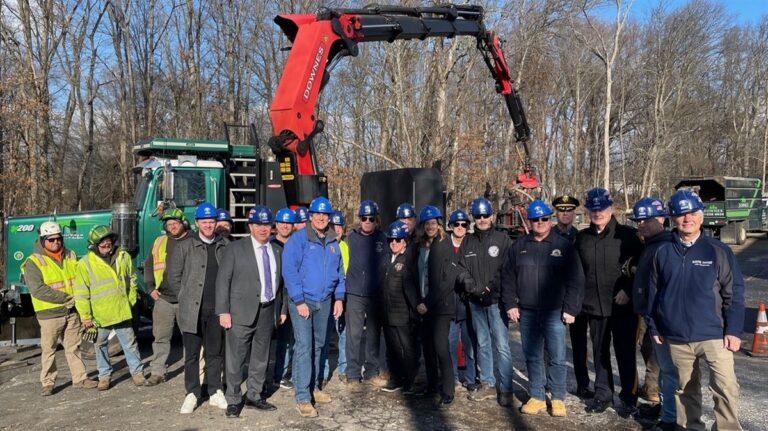
Morris County Commissioner Deputy Director Stephen Shaw and Sheriff James Gannon joined U.S. Rep. Mikie Sherrill, Hanover Mayor Thomas “Ace” Gallagher, Assemblyman Brian Bergen and other local officials in East Hanover Township today to witness the progress being made to “de-snag” sections of the Whippany River, launching debris cleanup efforts to address flooding that has long plagued riverside communities.
The initiative, called the Whippany River Improvement Project, is being led by the Whippany-Passaic River Flood Remediation Task Force, which was formed by the mayors of towns along the river. They include Mayor Gallagher, East Hanover Mayor Joseph Pannullo, Florham Park Mayor Mark Taylor, Morris Plains Mayor Jason Karr, Morristown Mayor Timothy Dougherty and Parsippany-Troy Hills Mayor James Barberio.
Congresswomen Sherrill secured a federal Community Project grant of more than $2 million to fund the work, which is being done in phases. By removing debris from waterways, rivers flow more easily and capacity is enhanced, which helps to prevent erosion and flooding.
“This initiative, three years in the making, demonstrates the power of partnerships. From local municipalities to federal support, we are working together to alleviate persistent flooding issues that impact so many residents and businesses,” said Deputy Director Shaw, the county commissioners’ liaison to the Morris County Flood Mitigation Program.
“I especially want to thank Mayor Gallagher and Congresswoman Sherrill for their leadership. This is about more than cleaning a river; it’s about reducing flooding and improving the quality of life for Morris County residents,” Shaw added.
According to Mayor Gallagher, Phase 1 of the project has already cleared nearly 275 cubic yards of debris, including trees, railroad ties, shopping carts, and other long-accumulated materials obstructing the river in Hanover Township. Phase 2, currently underway behind the auto store at 30 Ridgedale Ave. in East Hanover, targets another 200 yards of obstructions. Completion of the initial phases will require 12 to 15 days of work by professional contractors.
###
Photo 1: (l-r) The Whippany-Passaic River Flood Remediation Task Force, workers from Downes Tree Service, Inc. and others at the site of the Whippany River tree and debris removal taking place in East Hanover.
Photo 2: Commissioner Deputy Stephen Shaw, standing beside Downes Tree Service’s grapple saw truck.
Photo 3: A view of the Whippany River facing west behind the auto store at 30 Ridgedale Ave, East Hanover, N.J.
It was anything but a typical Wednesday morning for Ed Durr as he hit the road to deliver furniture and mattresses. It was a MAGA day, the greatest of them all, and Durr was beaming into a video camera mounted on his dashboard.
He sang out at something like full volume to an audience of Facebook followers.
“Gooooooooooood morning America!…Congratulations to President Trump on an outstanding victory, proving once again: You can’t bankrupt him. You can’t imprison him. You can’t assassinate him. You can’t defeat him.”
Durr, a commercial truck driver from Gloucester County, made national headlines in 2021 when he won election to the state senate by upsetting incumbent Stephen Sweeney, one of New Jersey’s most powerful Democrats.
Even though he was defeated in his bid for reelection two years later, Durr is now running for governor, one of a handful of Republicans buoyed by Trump’s surprising strength in a deep-blue state that hasn’t voted for a GOP presidential candidate since 1988.
Photo: Shutterstock/Chip Somodevilla
For many Republicans like Durr, Trump’s victory is confirmation that New Jersey is turning red, and doing it quickly. Even though Kamala Harris won the state by 6 percentage points, Trump’s performance jumped dramatically compared to 2020, when he lost to Joe Biden here by 16 points.
Five New Jersey counties that voted for Biden in 2020 flipped to Trump, including traditional Democratic strongholds such as Passaic County. Even counties Harris carried saw droves of voters switching to Trump: Essex, Bergen, Hudson and Middlesex counties all saw double-digit swings to Republican.
Perhaps the scariest trend for Democrats: Huge swaths of New Jersey’s 2 million-strong Latino community voted for Trump, even as he campaigned on the mass deportation of illegal immigrants and their American-born children.
North Jersey towns with large Latino populations like North Bergen, Bayonne, West New York, Kearney and Secaucus saw large shifts to the GOP. Trump won the city of Passaic, which is more than two-thirds Latino, by 6 percentage points.
“There’s no question that the Democratic brand is not strong as it has been in the bluest areas of the country, and that includes New Jersey,’’ says Patrick Murray, the director of Monmouth University Polling Institute, which has charted public opinion in the state for the past 20 years.
“We’ve definitely seen some shifting from Democrat to Trump in areas that have significant Hispanic and African American populations,” Murray says. “But in New Jersey and in other states like New York, a lot of Democrats just sat on their hands and didn’t vote. So is that an endorsement of Donald Trump or a statement about Kamala Harris and the party in power?”
In the wake of Trump’s historic victory and the broadening of his support almost everywhere, New Jersey Monthly sought out a handful of mavens like Murray, as well as some leading political figures, to assess the new electoral landscape. Their insights suggest that, while Jersey Democrats and progressives are definitely in dangerous territory, the state is not turning as red as die-hard Trumpers like “Ed the Trucker” Durr would like.
For one thing, the experts point out, registered Democrats here have an edge of 900,000 over Republicans, as well as big structural advantages in heavily gerrymandered legislative districts. The state Legislature, as well as its congressional delegation, remains firmly in the hands of Democrats.
Photo: Shutterstock/Peter Serocki
Another fact diminishing the Trump boom: State data shows that voter turnout in New Jersey in November was the lowest ever recorded for a presidential election, with just 65 percent of the state’s 6.6 million registered voters casting ballots. The collapse in voter interest, especially among Democrats, suggests that Harris and her party were not offering what their base wanted to hear.
Micah Rasmussen, director of the Rebovich Institute for New Jersey Politics at Rider University, says Harris simply didn’t talk enough about issues truly important to voters. While she was busy campaigning on abortion rights and warning about Trump’s threat to democracy, Rasmussen says, Harris ceded the pocketbook issues to the GOP.
“Were people concerned about abortion and democracy issues? Of course,” Rasmussen adds. “But a lot more people were concerned about stuff they saw as more front and center: affordability, property taxes, the high cost of car insurance. Things that move the needle for families.”
“New Jersey is an expensive place to live,” he says. “People want their public officials to do something about it.”
The election, Rasmussen adds, proved to be a wake-up call for Democratic party machines in North Jersey that have reliably turned out voters for decades. Losing more African American and Latino voters would make it harder for Democrats to prevail in this year’s gubernatorial race, he says, which is suddenly looking much more interesting.
“Hudson County has been a lazy machine for years,’’ he says. “They should be working with old-school shoe leather, block by block, family by family by family, house by house. But, with some exceptions, they’re just not doing it.”
One of the exceptions is Brian Stack, the longtime Union City mayor and Democratic state senator, whose get-out-the-vote work has become legendary. Every year, Stack gives away some 30,000 turkeys to constituents as he and his crew work the streets, ward by ward. “That’s the old-school way, but we’re watching it disappear,” Rasmussen says. “If Democrats want to reverse the trend and keep the governor’s office, they’re going to have to get back to it.”
At a time when almost every Republican politician of relevance is paying fealty to Donald Trump, one GOP player in Jersey will have none of it. State Senator John Bramnick, a stalwart member of the opposition in Trenton for 20 years, says his party will lose next year if it appeals only to MAGA voters in the belief New Jersey is turning red.
Bramnick, an amateur comedian who was voted by bar colleagues as the funniest lawyer in New Jersey, sees no joke in Trump’s threat to the Jersey GOP. New Jersey and its diverse, well-educated population, he argues, remains decidedly moderate.
Bramnick, who is seeking his party’s nomination in the governor’s race, recited a list of Republicans who have broken the Democratic voter-registration edge to win statewide office: Thomas Kean, Christine Todd Whitman, Chris Christie.
“What do those names have in common?” Bramnick asks. “They were all moderate, middle-of-the-road conservatives who placed practical good sense over some ideology. Their success tells me that people in New Jersey won’t ever elect a Trumper for governor.”
Despite Trump’s showing in 2024, public opinion polls over the years consistently show that New Jerseyans embrace a broad range of progressive policies, from the preservation of abortion rights to sensible limitations on gun ownership to gay marriage and legal marijuana.
“But people here also want lower taxes and less spending, and the sensible Republican who makes that case will win next year,” Bramnick says. “If we talk just about crazy Trump resentment stuff, we’ll lose.”
In the days leading up to the election, the race for New Jersey’s 7th Congressional District drew serious national attention when Sue Altman, a former pro basketball player and progressive Democrat, appeared poised to unseat GOP scion Thomas Kean Jr., with the political control of the U.S. House in play.
Altman’s aptitude for taking on tough political fights, even with figures from her own party, like Camden County Democratic leader George Norcross, lifted her to prominence among reformers looking to shred New Jersey’s political-boss system.
In challenging Kean, Altman would have to win over voters across New Jersey’s Republican heartland, from Sussex County through Morris, Warren and Hunterdon. The district had also recently been redrawn, making it even more hostile to Democrats: Registered Republicans now held a 16,000-vote edge.
Altman ended up losing to Kean by some 5 percentage points. Today, she concedes the possibility that New Jersey may be undergoing a red shift. But she says the real puzzle is not why Trump did so well in Jersey, but how Democrats did so poorly.
“It wasn’t just that we lost some people who went from D to R,’’ she said in a phone interview about a month after the election. “It’s that the turnout for Democrats wasn’t the boon we expected in a presidential year. And I don’t know why that is.”
“I’ve learned there’s usually a rational reason people don’t exercise their right to vote, and it’s usually because they don’t feel they can make a difference,” Altman went on. “We have to find ways to make people feel like their votes matter.”
As her party retrenches in the wake of 2024’s Trump quake, Altman sees no easy way to reignite flagging Democratic voters. But the way forward, she says, will require a new spirit to fight and a willingness to take on conservative spin that tars too many progressives as dangerous socialists.
Democrats, Altman says, have grown too timid.
“If there’s any takeaway here, it’s that Dems have to develop an appetite for boldness and finally put on the shelf the kind of risk aversion that plagues us,’’ she says. “We have to run campaigns on our own terms, not on the terms of a narrative set by Fox News.”
While Democrats in New Jersey search for answers, emboldened Republicans will continue measuring the state for MAGA furniture and curtains. Many say Jersey is now a swing state and predict that the Trump-led GOP will take over Trenton in the next few years.
“No matter what way you look at this, Trump has changed the party forever,” says Mike Crispi, a South Jersey talk-show host and businessman who is considering a run for governor this year.
“There’s a brand-new coalition forming. You can see it in places like Passaic County. It’s Latinos, it’s working-class people, union members, it’s people who live in urban areas that have been blue forever. You draw 10 percent of new voters in Newark, Paterson, all over Hudson County, and you’ve got a new ball game.”
Jeff Pillets is a journalist based in Trenton who was a Pulitzer Prize finalist in 2008.
Philip Sellinger, the former U.S. Attorney for the District of New Jersey, will rejoin Greenberg Traurig LLP as co-chair of the firm’s global litigation practice, the firm announced Friday afternoon.
The move is effective Feb. 1.
Sellinger, who began serving as U.S. Attorney in 2021, formally resigned from the position on Jan. 8 – a standard and expected move before a new presidential administration.
Sellinger was the founding chair of Greenberg Traurig’s New Jersey office in 2002 and served as co-chair of the firm’s global litigation practice before taking the position.
Richard Rosenbaum, the firm’s executive chairman, was thrilled to make the announcement regarding his return.
“It is an honor and pleasure to welcome Philip home to Greenberg Traurig, where his leadership in our global litigation practice and New Jersey office over the years prior to his becoming U.S. Attorney was always profoundly appreciated,” he said.
“He is a distinguished attorney and a pillar in both the U.S. litigation bar and the New Jersey community, having always maintained the highest standards of quality and integrity. His experience, energy, collaborative nature, and servant style of leadership will once again be of significant value to his colleagues and the firm’s clients, particularly in our global litigation practice, and to the further strategic growth of our New Jersey office.”
Greenberg Traurig CEO Brian Duffy was equally enthused.
“Philip’s return to help lead our global litigation practice is a strong addition to our robust team of 800 litigators, of whom more than 60 are former federal and state prosecutors, including eight former U.S. Attorneys,” he said. “This team continues to grow from strength to strength, providing clients with representation at the highest level including real trial experience wherever and whenever needed worldwide.”
As U.S. Attorney for the District of New Jersey, Sellinger was the presidentially appointed and Senate-confirmed chief federal law enforcement officer in the state. He oversaw a wide range of important federal criminal prosecutions and civil litigation for the state and managed 165 prosecutors and 120 staff members.
Under Sellinger’s direction, the New Jersey U.S. Attorney’s Office achieved international prominence in fighting cybercrime; reached landmark corporate criminal and civil resolutions; and aggressively prosecuted securities fraud, insider trading and market manipulation, public corruption, money laundering, fraud against government and private health care plans, government contract and customs fraud, unlawful kickback schemes, violent crime, and civil rights violations. He created the first standalone Civil Rights Division at any U.S. Attorneys’ Office and created a Bank Integrity, Money Laundering, and Recovery Unit.
Sellinger also served as chair of the Department of Justice’s E-Litigation Advisory Council, vice chair of the Attorney General’s Advisory Committee’s Civil Rights Subcommittee, and a member of both the Attorney General’s Advisory Committee’s White Collar Crime Committee and Corporate Criminal Enforcement Working Group, which authored a voluntary self-disclosure policy that set a nationwide standard detailing the circumstances under which a company will receive credit for disclosing misconduct.
Sellinger said he is thrilled to return to the firm.
“Serving as the U.S. Attorney for the District of New Jersey has been the privilege of a lifetime,” he said. “I am now thrilled to return home to Greenberg Traurig, an exceptionally dynamic law firm that truly embodies my commitment to legal excellence and the highest level of client service. Certainly, the firm’s presence in most major financial centers across the globe and vast array of practice expertise provides a platform that will greatly benefit the clients I expect to serve.”
At Greenberg Traurig, Sellinger will focus on high stakes complex trials and litigation in a wide array of areas, including government and internal investigations, white collar, class action defense, financial services, and technology litigation.
Lori Cohen and Masoud Zabeti, co-chairs of the practice group, welcomed him back.
“We are thrilled to once again be able to benefit from Philip’s considerable knowledge and skill as both an extraordinary litigator and leader,” they said in a joint comment. “We look forward to working closely with him to continue to grow our award-winning global litigation practice around the world.”
Traditional Policing is described as the response to calls for service, the investigation of crimes, and arresting individuals during and after the process. This method alone does not reduce crime, address public safety issues, or deal with community problems.
No single policing agency can solve complex social problems by itself, so the need to build partnerships between the Police Department, community members and local government is imperative. Using this Community Relations strategy increases public safety through information and awareness programs resulting in a higher quality of life for our residents.
Keeping the Community Involved
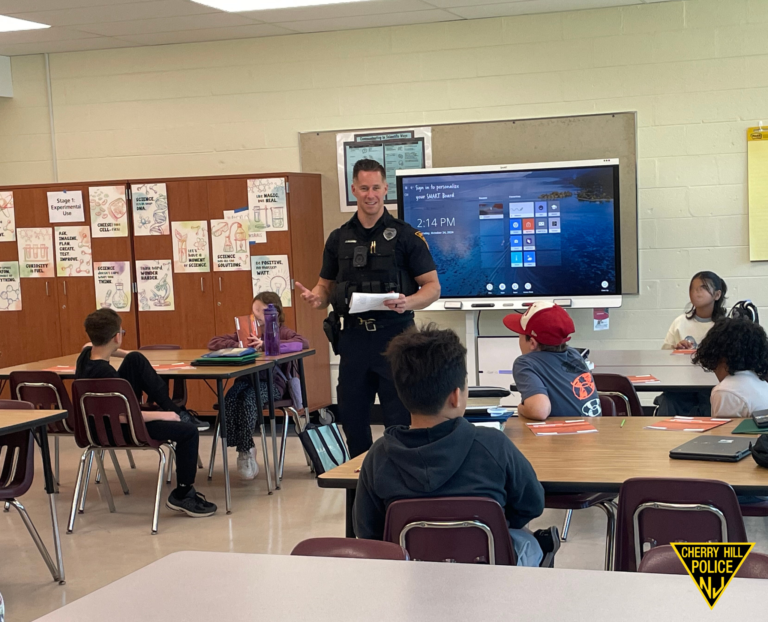
There is a shared responsibility between the police and community members in encouraging a problem solving partnership. Assigned to the Community Response Unit, our officers work closely with Township residents and business owners keeping them notified of crime trends, proactive police responses, and preventive measures to address crime in their neighborhoods.
The focus is on improving the 2-way communications between the police and the community to help the residents develop rapport and participate in the crime prevention process. The exchange of information between the community and the police is essential in the prevention of crime that traditional policing methods do not address.
This communication also helps redirect the many calls to the Police Department that should be handled more efficiently by other agencies for problem solving resolutions. This allows our patrol officers more time to focus on our residents and proactive crime deterring methods in all of our neighborhoods.
The Cherry Hill Township Police Department and the Camden County Prosecutors Office has a registry for individuals with Special Needs and disabilities in efforts to give police quick access in an emergency to critical information about a person who is registered. The registry can provide police with emergency contact information, detailed physical descriptions, known routines, favorite attractions, or the needs of an individual with Special Needs and other disabilities such as: Alzheimer’s, Dementia, Down Syndrome or any other endangered individuals.
This information can greatly assist police officers when time is essential in communicating and dealing with an emergency situation involving a person with Special Needs and disabilities. The online registration asks for valuable information that the police officer may need when helping individuals with Special Needs and disabilities. We ask that all questions be filled out completely and a current photograph be provided, which can be submitted online on Camden County Prosecutors Office Special Needs Registry here: https://camdencountypros.org/community-page/41
The information you provide is confidential and will only be used by our police officers. If any of the information on the registration changes you are encouraged to re-register as soon as possible.
If you have questions please contact our Community Relations Unit at copps@cherryhillpolice.com or call 856-488-7813.
Community Groups
Presently, several neighborhood and civic groups in our Township are in contact with the Community Response Unit. All receive monthly crime stats for their respective area. If you are interested in joining one of the existing groups or setting up your own group, please contact the Community Response Unit. Civic groups also can schedule a community meeting and request an officer to attend to discuss topics.
Kid Card ID
The Cherry Hill Police Department is proud to present this Child ID program to any child free of charge at township events. The Cherry Hill Kid Card is an identification card parents will have as a quick reference should your child be reported lost or missing. The card will include a photo and physical description of your child. Additionally, the information on the card meets the criteria needed for identifying and entering the child into the Amber Alert System.
Personal Safety
Officers will speak about how you can help avoid becoming the victim of a crime. We can provide information of crime prevention, personal safety, senior safety, Internet safety, and identity theft safety.
Crime Prevention for Business
Officers will speak about deterring crime within the business community conducting instruction on robbery, shoplifting, theft, and credit card fraud prevention.
School Safety
Officers will speak with students and parents about a variety of topics including Internet safety, bullying, and bike safety.
Bike Registration
Enter your bike information into our database via the Internet. This data will be stored and available to every Cherry Hill Police Officer. If your bike is stolen this information can be extremely helpful to the investigation.
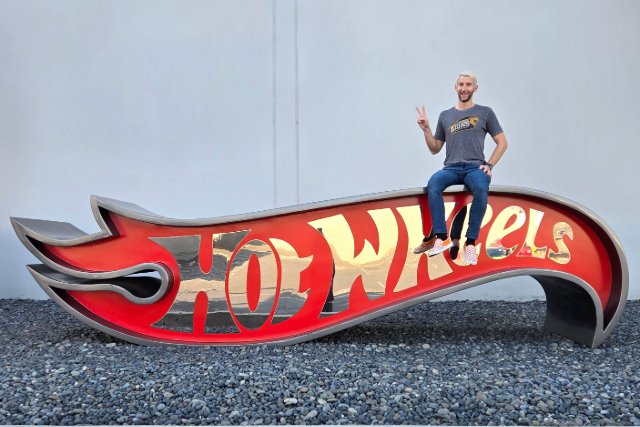
Matt Gabe at Hot Wheels. Photo credit: Alyson Hendrix
Speed over to your closest toy aisle and look for the Kei Swap — a new Hot Wheels car with ties to TCNJ.
Designed by Matt Gabe ’05, lead packaging designer at Hot Wheels, the car is a throwback to the ’90s and was created from nearly start to finish by Gabe.
A lifelong appreciator of cars, he’s had the Hot Wheels gig since 2009, designing the look of both large-scale playset packaging and individual die-cast car packages for the brand. Last fall, he was recognized as the guest of honor at the 38th Annual Hot Wheels Collectors Convention in Los Angeles.
Here, we get behind the wheel with Gabe as he talks about his toy car creation and his time as a graphic design major at the college.
Gabe displays his creation: The Kei Swap. Photo credit: Alyson Hendrix
Q: Start our engines, what is the Kei Swap all about?
A: I usually do the artwork for HW packages, but the design team knows that I’m a bit of a car guy. The team wanted to do a small ’90s Japanese van and asked if I would be interested creating an original Hot Wheel. I have a special place in my heart for small Japanese cars, so I said ‘yes’ before even knowing what goes into designing a car.
After a good amount of help from our design team, I worked with our in-house sculpting team to make the drawing into a 3D digital model. Then it was time to decorate. The car is part of a mini-collection called “Art Cars,” but the only direction I was given was to pick an art style and design my van around that. After a little brainstorming with the graphics team, we landed on ’90s pop art. I started with a red exterior and pulled some inspiration from Trapper Keeper binders and the intro from “Saved by the Bell” — SUPER ’90s. I also wanted to give the van a reason for having the graphics on it, so I decided to make it the shop van of a design shop. I lent my name to it and added “MattGabe! Designs” to the front doors.
The interior of the van is filled with extra details I wanted, too — an extra set of tires, a boombox (with my initials on it), and a BMX bike.
Q: Tell us about the process of going from a design on paper to casting an actual car.
A: The process was a lot of things. Exciting, stressful, but mostly very fun. After the team fully approves the design of all the individual pieces, we give the approval to “cut steel” and make the molds. After the molds are made, they produce a small run of cars to confirm that the finished product looks good.
The next steps are designing the package, coming up with a name, and writing copy for the package — all of which I offered to do. In fact, I did almost everything myself aside from going to the factory and running the machines. But I did offer to do that, too!
Q: We hear you were the guest of honor at the 38th annual Hot Wheels Collectors Convention. Tell us about that.
A: The HW Convention is an annual gathering of Hot Wheels superfans of all ages that takes place over five days in October. People come from all over the world to attend, and I’ve met so many fun and interesting people over the last few years. There are custom car contests, coloring and drawing contests, seminars about collecting, autograph and Q&A sessions with Hot Wheels designers, a charity auction, and a sneak peek at upcoming releases with the Hot Wheels team. The guest of honor is always a Hot Wheels team member who has had an impact in the world of HW. I was genuinely shocked when I was asked to be the guest of honor this year, as it is usually reserved for the car designers, not the packaging team.
Q: Take a lap around memory lane. What was your time at TCNJ like?
A: My professors, classmates, and Holman Hall were the glue that held it all together. Professors Chung Sum “Fanky” Chak and Anita Allyn instilled a strong foundation for my graphic design skills. I was also had an on-campus job as a graphic designer for the Art Gallery, creating booklets and mailers for art openings at the gallery. The hands-on experience of creating art and prepping it for actual production gave me a leg up in design work. Lots of late-night shenanigans with friends in the art studios and computer labs of Holman Hall were had while designing logos, magazines, and posters — and sometimes there were chair races in the hallway!
And quick shoutout to my high school graphic design teacher (and TSC alum) Lloyd Taylor who first got me interested in design and photography and opened the door to a career path I didn’t even know existed!
Newark-based law firm Gibbons P.C. has appointed John S. Mairo as chair of the Financial Restructuring & Creditors’ Rights (FRCR) Group. Mairo, whose practice focuses on commercial litigation, workouts, financial reorganizations, and creditors’ rights, was most recently with Porzio, Bromberg & Newman, P.C., serving as both chair of the Commercial Practice Group and co-chair of the Bankruptcy and Financial Restructuring Department.
At Gibbons, Mairo takes the baton from Robert K. Malone, now FRCR chair emeritus, who has led the group since 2019. In his new role, Mairo will apply his proven leadership skills to continuing the practice’s notable growth under Malone and building on the group’s proficient teamwork.
“Gibbons is a great and well-established firm, and I am excited and honored to receive this wonderful opportunity to join its legal team and take its Bankruptcy practice to even greater heights,” said Mairo. “I have worked with many Gibbons attorneys over the years and look forward to working more closely with them, particularly those in the firm’s Corporate, Real Property, and Litigation practices, which complement the FRCR Group.”
Mairo has represented an extensive slate of clients that comprises debtors, secured lenders, creditors’ committees, landlords, administrative agents for syndicates of lenders, foreign representatives, and more. Throughout his decades-long career, he has handled mid-size to multibillion-dollar bankruptcy matters on both national and international scales, securing favorable settlements, proposing beneficial recovery plans, and successfully litigating cases that have enabled his clients’ businesses to thrive and prosper. His significant experience has included complex restructuring cases and antitrust multidistrict litigation.
Mairo is an INSOL International Fellow and committee member of the INSOL Insolvency Practitioners Group and is one of only three bankruptcy attorneys in the Third Circuit selected for induction this March as a Fellow of the American College of Bankruptcy. He is listed in Chambers USA Guide to America’s Leading Lawyers for Business for Business/Bankruptcy/Restructuring; Thomson Reuters New Jersey Super Lawyers®; and The Best Lawyers in America® for Bankruptcy and Creditor Debtor Rights/Insolvency and Reorganization Law, Litigation – Bankruptcy, and Commercial Litigation. In 2020, Best Lawyers® featured him as “Lawyer of the Year” for Litigation/Bankruptcy in the Newark area.
“We are thrilled to welcome John on board, and I am very pleased to pass the baton to him,” remarked Malone. “I have known John for many years, and he is a tremendous addition to our firm. I look forward to working with John, and I am confident he will excel as the Group’s new leader in advancing the goals and objectives of the Bankruptcy practice for years to come.”
Added Peter J. Torcicollo, Gibbons’s managing director, “We are happy to welcome John to the Gibbons family. With his extensive experience and broad knowledge, he is highly qualified to steer the FRCR Group as it enters a new era of leadership.”
In addition to his previous roles with Porzio, Bromberg & Newman, Mairo’s background includes associateships at several private practices, as well as a clerkship with the Hon. Rosemary Gambardella, Bankruptcy Judge for the District of New Jersey. He is an appointed mediator for and a member of the Lawyers Advisory Committee of the Bankruptcy Court for the District of New Jersey, which has recognized him for his pro bono service. Additionally, Mairo is certified in business bankruptcy law by the American Board of Certification.
Mairo earned his J.D. from Seton Hall Law School, where he was managing editor of the Seton Hall Journal of Sport Law, and a B.A. with honors from Boston College. He is admitted to practice in the states of New Jersey and New York, as well as the United States Supreme Court and various New Jersey and New York district courts.
Over the next 20 years, the United States must spend $625 billion to fix, maintain, and improve water infrastructure. According to the US Environmental Protection Agency, New Jersey alone will need to spend at least $12,252,800,000 on drinking water infrastructure and $19,352,000,000 on clean water infrastructure over the next 20 years to make all necessary improvements and repairs. The predominant sources of water infrastructure funding and financing for all 50 states are the Clean Water State Revolving Fund (CWSRF – wastewater treatment and stormwater management) and the Drinking Water State Revolving Fund (DWSRF – safe and reliable water supply). These State Revolving Funds (SRFs) are financial assistance programs that provide low-interest loans to support critical water infrastructure projects essential for protecting public health and the environment.
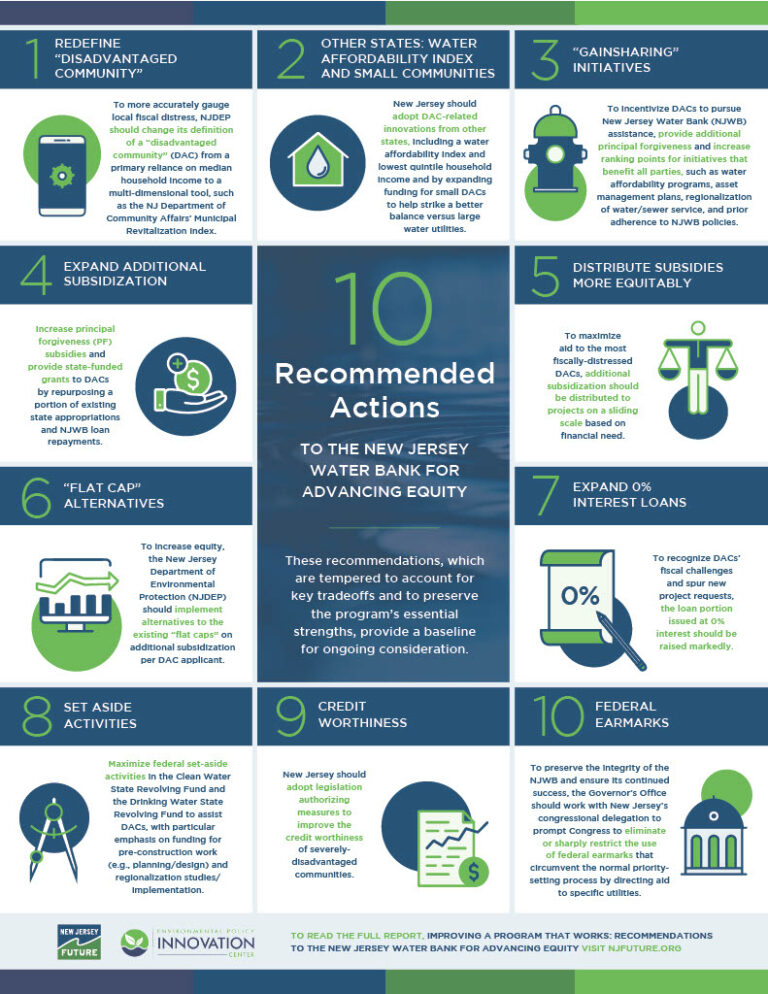
The New Jersey Water Bank (NJWB), a partnership of the New Jersey Department of Environmental Protection (NJDEP) and the New Jersey Infrastructure Bank (I-Bank), manages New Jersey’s State Revolving Funds. NJWB’s financial support to New Jersey wastewater and drinking water systems has generated significant savings through principal forgiveness (PF – grant-like funding) and low-interest loans. Disadvantaged communities (DACs) served by small and medium-sized systems face increased challenges in accessing SRF funding, particularly struggling to reach the initial application stage due to the high costs associated with planning and design. Larger water utilities tend to receive disproportionate awards, while smaller, fiscally distressed DACs lag behind, highlighting a significant equity concern. In Improving a Program that Works: Recommendations to the New Jersey Water Bank for Advancing Equity, released in November 2023, New Jersey Future (NJF) and the Environmental Policy Innovation Center (EPIC) primarily recommended policies to improve access to the SRFs for water systems serving DACs through a more robust method for identifying disadvantaged communities, maximizing pre-construction support, expanding principal forgiveness funds, and providing 0% interest loans.
Annually, the NJWB is required to develop Intended Use Plans (IUPs) for the DWSRF and CWSRF, laying out the policies, funding packages, and project priority ranking methodology for the corresponding state fiscal year. Over the last few years, NJF has reviewed New Jersey’s IUP policies and submitted comments concerning the amount of state and federal funding used to address the needs of water systems serving disadvantaged communities. NJDEP, which sets policy for the NJWB, has been open to feedback and working with stakeholders to improve the IUP policies.
Of the ten recommendations made in Improving a Program that Works, NJDEP has implemented the following:
NJWB has made progress in expanding set-aside activities for technical assistance and support for DACs, particularly for pre-construction needs. Project sponsors who meet the affordability criteria are eligible for the New Jersey Technical Assistance Program (NJTAP), a free technical assistance program for drinking water projects. Additional planning and design grants and principal forgiveness are also available.
Increased flat caps in all drinking water SRF categories that will result in more subsidies for small water systems, lead service line (LSL) projects, and DAC systems.
NJWB implemented a tiered funding structure to direct a greater share of financial assistance to DACs with the greatest financial need.
The most recent IUP clarified the I-Bank’s creditworthiness policy.
NJF is excited to see all the improvements that have been made and hopes to see the following changes made in the future:
As a key first step in refining its criteria for dispersing principal forgiveness, NJDEP implemented a two-tiered system based primarily on median household income (MHI).To maximize equity, NJDEP should adopt the model established by several other states (e.g., Wisconsin) that incorporates more tiers and indicators (e.g., family poverty, population trend). The combined effect directs a larger share of aid to the state’s neediest communities.
NJDEP should significantly expand the use of 0% interest loans to advance critical, high-priority projects in the most distressed DACs. NJDEP only increased these loans for investor-owned systems in the most recent IUP.
Significantly increase the ranking points awarded in the Project Priority List for “gainsharing” initiatives that benefit both the water utility and the state, such as water affordability programs (which support appropriate rate setting while protecting low-income customers), asset management plans, and regionalization of water assets.
NJDEP should repurpose a modest portion of loan repayments to increase principal forgiveness to DACs. NJDEP could use this approach to develop a funding source for galvanized water service lines within DACs, which may not be eligible for federal Bipartisan Infrastructure Law funding. Galvanized service lines are required to be removed in NJ by 2031 since they can be a source of lead in drinking water.
Legislation to improve creditworthiness for severely distressed DACs.
The report also identified the need to address congressionally directed spending, or earmarks. Congress has diverted SRF funding to earmarked projects, and the concern is that earmarked projects circumvent the normal priority-setting process where projects determined to be of the highest priority score the most points. In addition, communities with median household incomes (MHI) above the state average, including some of New Jersey’s wealthiest areas, have received nearly half of the earmarked funds. Meanwhile, less than a third of these funds have gone to disadvantaged communities (DACs). Discussions with New Jersey’s congressional delegation are ongoing, but no definitive changes have been made to prevent federal water infrastructure funding from being derailed by earmarks. Governor Murphy, according to NJDEP, sent a letter to the New Jersey Congressional Delegation expressing concern over this issue.
As last year’s report title states, NJDEP’s CWSRF and DWSRF programs are generally effective and have provided significant funding to improve water systems since their inception; however, as New Jersey faces the daunting challenge of aging water infrastructure and its extreme costs, ensuring equitable access to funding is critical. DACs served by small- to medium-sized water systems face the most barriers to accessing the financial resources needed to repair and upgrade water systems. Though progress has been made, significant disparities remain. NJWB should continue to refine its program to target funding to New Jersey’s most distressed communities, most of which lack the resources to provide safe, reliable water services for the future. Without a greater commitment to both equity and funding, the gap between resource-constrained DACs and other water utilities will continue to grow, undermining efforts to build resilient, sustainable infrastructure across New Jersey.











 The New Jersey Water Bank (NJWB), a partnership of the New Jersey Department of Environmental Protection (NJDEP) and the New Jersey Infrastructure Bank (I-Bank), manages New Jersey’s State Revolving Funds. NJWB’s financial support to New Jersey wastewater and drinking water systems has generated significant savings through principal forgiveness (PF – grant-like funding) and low-interest loans. Disadvantaged communities (DACs) served by small and medium-sized systems face increased challenges in accessing SRF funding, particularly struggling to reach the initial application stage due to the high costs associated with planning and design. Larger water utilities tend to receive disproportionate awards, while smaller, fiscally distressed DACs lag behind, highlighting a significant equity concern. In