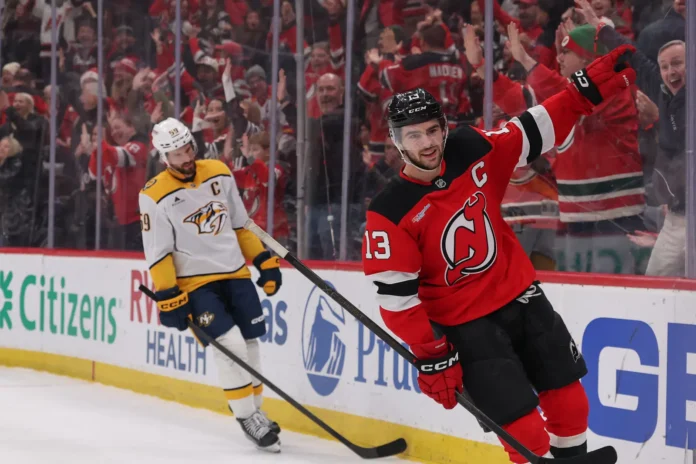

The New Jersey Devils needed more than two points Thursday night in Nashville. They needed proof that resilience still exists inside a season defined by narrow margins, inconsistent health, and relentless pressure in the Eastern Conference race. What they delivered was a composed, disciplined 3–2 overtime victory against the Predators that not only kept them firmly in the playoff hunt, but also underscored how sharply this roster is beginning to evolve—both on the ice and in the front office.
For a late-January matchup, the stakes felt unmistakably heavy. Every shift carried postseason implications. The Devils entered the game fully aware that the standings no longer allow for prolonged skids, moral victories, or learning experiences. Wins must be banked. Period.
What followed was one of the more complete road efforts the club has assembled in recent weeks.
The Devils controlled long stretches of play at five-on-five, defended the middle of the ice with urgency, and limited Nashville’s ability to generate sustained pressure below the hashmarks. Even when momentum swung, New Jersey did not unravel. That composure ultimately allowed the game to reach overtime, where execution finally broke through.
The 3-on-3 frame showcased exactly what separates competitive teams from fading ones—speed through the neutral zone, quick decision-making, and controlled puck support. New Jersey’s ability to stretch the ice and attack with pace created the opening that ended the game and delivered a critical two points that could loom large by the time the regular season closes.
The result was made more impressive by the growing cloud surrounding the team’s health.
Jack Hughes, the engine of New Jersey’s offensive identity, is currently undergoing evaluation for a lower-body injury. While the organization has yet to provide a firm timeline, any uncertainty involving Hughes immediately recalibrates expectations for the rest of the roster. His absence—or even limited availability—forces the Devils to win games differently. The Nashville performance offered an encouraging glimpse of what that adjustment might look like: tighter defensive layers, more responsible puck management, and scoring generated by committee rather than pure star power.
It was not flashy. It was necessary.
That mindset aligns closely with how the organization reshaped its roster just days earlier in one of the most quietly impactful transactions of the Devils’ season.
On a night dedicated to longtime team broadcaster “Doc” Emrick—an evening filled with nostalgia and celebration—general manager Tom Fitzgerald executed a move that finally closed the book on one of the most constraining contracts on the Devils’ ledger.
Ondrej Palat was held out of the lineup for roster-related reasons, a familiar signal across the league. Before the first intermission concluded, the deal was official. Palat, along with a third-round and a sixth-round draft pick, was sent to the New York Islanders in exchange for forward Maxim Tsyplakov.
For New Jersey, the headline was not the player swap itself.
The real victory was flexibility.
By acquiring Tsyplakov at a significantly lower cap hit, the Devils immediately created meaningful breathing room under the salary cap without retaining any portion of Palat’s contract. The move instantly frees roughly $3.75 million in space—an enormous amount for a club that has been navigating tight financial margins while trying to stay aggressive in a highly competitive conference.
For a team still chasing incremental upgrades and insurance options ahead of the trade deadline, that number matters.
It matters a lot.
Just as important, both players are signed through next season. No additional term was added. No future complications were layered onto the books. Instead, the Devils exchanged a rigid contract structure for one that offers multiple exit ramps and several strategic options.
Tsyplakov arrives in New Jersey as a player still searching for consistency after an uneven 2025–26 campaign. His first NHL season showed flashes of offensive confidence and physical engagement, but this year has been more turbulent. The Devils are not acquiring a finished product. They are acquiring a controlled experiment.
If the change of scenery unlocks his offensive rhythm and improves his puck decision-making, New Jersey gains a middle-six winger capable of providing much-needed depth scoring. If it does not, the organization is no longer trapped.
Unlike Palat’s deal, Tsyplakov carries no trade protection. That single detail quietly transforms the Devils’ leverage. Should management decide to pivot again—either before the deadline or during the offseason—Tsyplakov can be moved without navigating restrictive clauses that previously complicated similar discussions.
There is also a financial safety valve that did not meaningfully exist with Palat.
A potential buyout of Tsyplakov, if the situation ever demanded it, would be far less damaging and far shorter on the cap ledger than a Palat buyout would have been. That alone strengthens the Devils’ long-term roster planning.
But perhaps the most intriguing—and least discussed—layer of flexibility stems from Tsyplakov’s professional background.
Having developed primarily in the KHL before coming to North America, Tsyplakov maintains a realistic international alternative that allows for a mutual contract termination if both parties determine that his long-term opportunity is better overseas. While no organization builds its strategy around that outcome, it remains a legitimate contingency that further insulates New Jersey from dead money on future cap sheets.
In a league where immovable contracts routinely derail roster construction, every escape hatch matters.
Fitzgerald does not escape scrutiny for the original Palat signing. The investment failed to produce the impact envisioned at the time. But this transaction represents a meaningful course correction—one that restores optionality to a front office that now must navigate a playoff push while keeping one eye firmly on the coming summer.
That flexibility arrives precisely as the on-ice product demands reinforcement.
Despite the emotional lift of the overtime win in Nashville, the Devils remain a team walking a narrow line. The margin for error is thin. Health remains volatile. Scoring depth continues to fluctuate. And the reliance on core stars remains heavy—even more so if Hughes misses additional time.
Still, performances like Thursday’s suggest that the structure beneath the star talent is stabilizing.
Defensive zone exits were cleaner. Neutral-zone pressure forced turnovers. The Devils limited second-chance opportunities and kept Nashville from turning extended cycles into high-danger chaos. That is playoff-style hockey. Not dominant—but durable.
And durability is exactly what this group must prioritize over the next several weeks.
The ripple effects of the Palat-Tsyplakov trade now intersect directly with that reality. The Devils finally possess the cap maneuverability to respond to injuries, pursue deadline reinforcements, or simply maintain roster depth without financial gymnastics.
For supporters tracking every development around the organization, the full picture of how these moves shape the Devils’ stretch drive and playoff positioning continues to unfold through Explore New Jersey’s dedicated coverage of the New Jersey Devils, where roster decisions, health updates, and tactical shifts are examined through the lens of a franchise still very much in pursuit mode.
The question now is not whether the Devils improved their flexibility.
They clearly did.
The question is whether management will leverage that freedom aggressively—and whether the roster, newly restructured and increasingly tested, can convert both opportunity and momentum into a sustained run when it matters most.
Thursday’s overtime victory did not solve every problem. But paired with a decisive front-office adjustment, it sent a clear signal.
The Devils are not standing still.