
The New Jersey Devils are once again commanding attention across the Garden State—not because of where they sit in the standings, but because of how they are playing when expectations have largely faded. At 36-32-2, the Devils find themselves in a complicated position: a team showing flashes of elite offensive capability while simultaneously navigating the reality of a postseason outlook that remains all but out of reach. Yet within that tension lies one of the most compelling storylines in New Jersey sports right now—a late-season surge that raises as many questions as it answers.
Coming off an emphatic 6-4 road victory over the Dallas Stars, one of the league’s top teams, the Devils have injected life into what had previously been a frustrating and inconsistent campaign. That win did not exist in isolation; it is part of a broader stretch of improved play since the Olympic break that has seen the team rediscover offensive rhythm, confidence, and identity. As they continue their Central Division road swing with a stop in Nashville before heading to Carolina and then back home to the Prudential Center, the Devils are playing a brand of hockey that looks far closer to preseason expectations than anything seen during the midseason collapse.
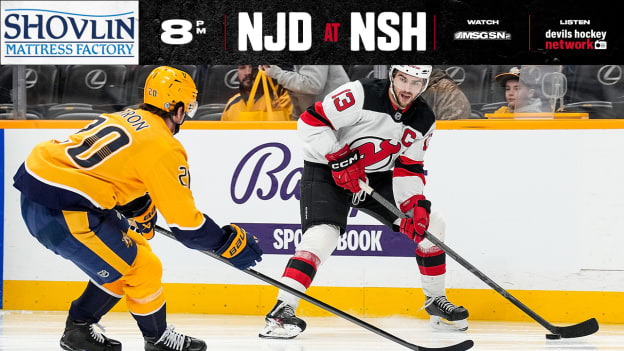
New Jersey Devils Continue Critical Road Stretch in Nashville as Late-Season Identity Takes Shape. The New Jersey Devils move deeper into a defining stretch of their season tonight as they take the ice against the Nashville Predators at Bridgestone Arena, a matchup that carries significance far beyond the standings. With the puck set to drop at 8:00 PM ET, this road contest represents another opportunity for a team that has rediscovered its offensive rhythm to continue building momentum, sharpen its identity, and establish a foundation that extends beyond the final weeks of the 2025–26 campaign.
This game arrives at a pivotal moment in the Devils’ schedule, positioned squarely within a road trip that has already delivered one of the team’s most compelling performances of the season. Their recent victory over Dallas was not just a win—it was a statement that, even in a year defined by inconsistency, the Devils possess the capability to compete with elite opponents when their core players are operating at full capacity. The challenge now is sustaining that level of play against a Nashville team known for its structured defensive approach and disciplined execution.
The Devils’ resurgence has been driven by a noticeable shift in offensive philosophy, one that has allowed the team’s skill players to operate with greater freedom and creativity. The transition game has become more aggressive, with an emphasis on generating opportunities off the rush rather than relying solely on set-zone play. This adjustment has unlocked production across the lineup, with the team’s top contributors once again leading the charge. The result has been a more dynamic and unpredictable offense, capable of producing scoring bursts that were largely absent during the midseason slump.
Central to this transformation is the continued impact of Jack Hughes, whose recent stretch of play has reestablished him as one of the most dangerous offensive forces in the league. His ability to dictate tempo, create space, and finish scoring chances has elevated the performance of those around him, turning individual brilliance into collective momentum. When Hughes is engaged at this level, the Devils’ entire system appears more fluid, more confident, and more capable of sustaining pressure against opposing defenses.
Support from key players such as Nico Hischier, Jesper Bratt, and Timo Meier has reinforced the idea that this is a team built around high-end offensive talent. Each brings a distinct element to the lineup—Hischier’s two-way reliability, Bratt’s playmaking vision, and Meier’s physical presence—creating a balance that, when functioning cohesively, gives the Devils the ability to control the pace of play. The recent uptick in scoring is not the result of isolated performances but a reflection of this group operating in sync.
Defensively, the Devils continue to navigate a more complex landscape. While recent games have shown improvement in limiting high-danger chances, consistency remains a concern. The goaltending tandem has delivered moments of stability but has yet to reach a level that can consistently compensate for defensive breakdowns. As the team faces Nashville, a club that thrives on capitalizing on mistakes, maintaining defensive discipline will be as critical as sustaining offensive pressure.
Injuries have also influenced the team’s structure, forcing adjustments that have tested depth and flexibility. The absence of key contributors has required players to step into expanded roles, creating both challenges and opportunities. How effectively the Devils manage these shifts will play a role in determining not only the outcome of this game but the trajectory of the remaining schedule.
Beyond the immediate matchup, tonight’s game is part of a broader evaluation period for the organization. With playoff positioning no longer a realistic objective, the focus shifts toward assessing systems, player development, and overall team cohesion. Each performance becomes a data point, informing decisions that will shape the offseason and, ultimately, the direction of the franchise moving forward.
This context adds a layer of importance to every shift, every possession, and every adjustment. The Devils are not simply playing out the schedule; they are defining what kind of team they intend to be. The recent stretch of improved play suggests a group that is capable of executing a more open, aggressive style, one that aligns with the strengths of its roster. The question is whether that approach will be embraced as a long-term identity or viewed as a situational adjustment.
For fans across New Jersey, this phase of the season offers a different kind of engagement. The stakes may not be tied to playoff qualification, but they are no less meaningful. Watching the team evolve, identifying emerging patterns, and anticipating how those elements will translate into the next season creates a narrative that extends beyond wins and losses.
The return home following this road trip will provide another opportunity for the Devils to connect with their fan base, bringing this evolving identity back to the Prudential Center. But before that, the focus remains on Nashville, where the team will look to build on its recent success and continue refining the elements that have fueled its resurgence.
For comprehensive coverage of the Devils’ season, including game analysis, roster developments, and ongoing updates, Explore New Jersey’s New Jersey Devils coverage remains the definitive resource for following every development surrounding the team.
As the Devils take the ice tonight, the objective is clear: sustain the momentum, reinforce the identity, and carry forward the lessons of a season that, while challenging, continues to reveal the potential of a team still very much in the process of becoming what it was built to be.
At the center of this resurgence is Jack Hughes, whose post-Olympic performance has elevated him from cornerstone player to undeniable engine of the team. Fresh off a gold medal performance on the international stage, Hughes has returned to NHL play with a level of urgency and creativity that has translated directly into production. With 12 points in his last six games and over 20 goals for the fifth consecutive season, he has not only driven the offense but redefined its pace and structure. His ability to generate chances off the rush has become a defining feature of the Devils’ recent success, and it is no coincidence that the team’s scoring output has surged alongside his return to form.
This offensive uptick is measurable and meaningful. Since the Olympic break, the Devils are averaging more than 3.5 goals per game, a dramatic improvement over their season-long struggles that had placed them near the bottom of the league in scoring. Contributions from key players such as Timo Meier, Nico Hischier, and Jesper Bratt have reinforced the idea that when the Devils’ top talent is engaged and producing, the team can compete with anyone. The chemistry among the top lines has improved, the transition game has opened up, and the overall pace has shifted toward a more aggressive, attack-oriented approach.
However, the broader context cannot be ignored. Despite this recent stretch, the Devils remain seventh in the Metropolitan Division with 74 points, sitting well outside the playoff picture with limited time remaining. The margin for error that once existed earlier in the season has long since disappeared, replaced by the reality that this late push is more about evaluation and momentum than postseason positioning.
Defensively, the picture is more nuanced. The Devils have allowed fewer than three goals per game in this recent stretch, suggesting improvement, but the goaltending remains inconsistent. Jacob Markstrom has carried the bulk of the workload, posting numbers that reflect marginal improvement but not the level of dominance required to elevate the team into contention. Jake Allen has shown flashes of reliability, but the overall stability in net has not been sufficient to offset the defensive lapses that have defined much of the season.
Injuries have also played a role in shaping the team’s trajectory. The absence of key contributors such as Brett Pesce and Stefan Noesen, along with uncertainty surrounding Arseny Gritsyuk, has forced adjustments that have at times disrupted continuity. While injuries are an unavoidable part of any NHL season, they do not fully explain the prolonged periods of underperformance that plagued the Devils through December and January. Even as players returned to the lineup, the inconsistencies persisted, pointing to deeper structural and strategic issues.
What makes the current moment particularly significant is the contrast between what the Devils are now and what they were just weeks ago. The team that struggled to generate offense, that endured extended scoring droughts, and that often appeared disconnected has been replaced—at least temporarily—by a group that is playing with confidence and purpose. This transformation raises an essential question for the organization: which version of the Devils is the real one?
The answer is likely somewhere in between, and that ambiguity is precisely what makes this stretch so critical. There is a risk that a strong finish to a lost season could create a false sense of resolution within the organization. Decision-makers—from ownership to the front office to the coaching staff—must determine whether the recent improvement reflects a sustainable identity or a temporary surge driven by reduced pressure and favorable circumstances.
This evaluation carries significant implications for the offseason. The Eastern Conference remains one of the most competitive environments in professional hockey, and standing still is not an option. The Devils’ roster construction, particularly within the top six forward group, continues to present questions that have yet to be fully addressed. The departure of key offensive contributors in recent seasons has left gaps that have not been adequately filled, and relying on internal improvement alone may not be sufficient to close that gap.
Coaching philosophy will also come under scrutiny. The shift toward a more open, aggressive system has clearly benefited the team in recent weeks, allowing players to leverage their speed and skill more effectively. The question moving forward is whether that approach will be sustained when games carry higher stakes, or whether a return to a more conservative structure will once again limit offensive potential. The timing of these adjustments—arriving deep into the season rather than earlier—adds another layer of complexity to the evaluation process.
For fans across New Jersey, the frustration lies in the inconsistency. The Devils have shown, repeatedly, that they are capable of playing at a high level, delivering performances that suggest a team on the verge of contention. Yet those moments have been offset by stretches of ineffectiveness that undermine that potential. It is this oscillation between promise and disappointment that defines the current state of the franchise.
Still, there is value in what is happening now. Winning games, even in a season where the playoffs are unlikely, matters. It builds confidence, reinforces habits, and provides a foundation upon which future success can be constructed. The Devils are not playing for draft positioning; they are playing for identity, for cohesion, and for a sense of direction that can carry into the next season.
As the team continues its schedule with matchups in Nashville, Carolina, and a return home to face Chicago, each game becomes part of a larger narrative about who the Devils are and who they intend to become. The results themselves may not alter the standings in a meaningful way, but the process—how they play, how they respond, how they evolve—will shape the decisions that define the offseason.
For those following every development surrounding the franchise, Explore New Jersey’s New Jersey Devils coverage remains the central destination for in-depth analysis, updates, and insight into one of the state’s most closely watched teams.
The Devils’ late-season surge is not about salvaging the present; it is about informing the future. It is a stretch that demands clarity, not complacency, and one that will ultimately determine whether this team is positioned to take the next step or destined to repeat the cycle that has defined its recent past.