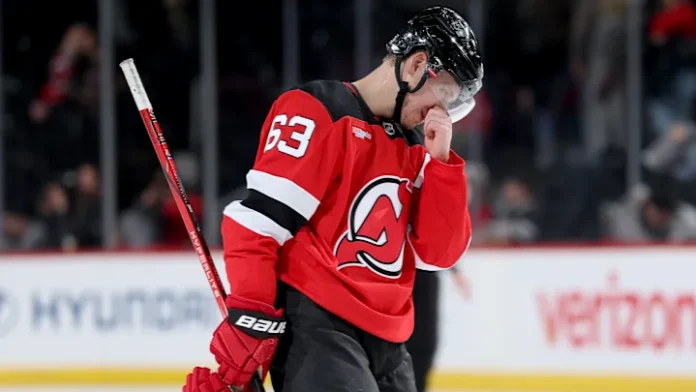

The New Jersey Devils find themselves in a critical stretch of the season, a moment where early expectations have collided head-on with a tough reality: a five-game losing streak, major injuries to cornerstone players, and a front office aggressively exploring ways to jolt the roster back to form. As the team works to stabilize, the conversations around potential blockbuster trades and internal accountability have intensified.
The recent downturn hit another low point over the weekend with a 4–1 loss to the Boston Bruins, a game that further exposed the team’s difficulty generating sustained offense without Jack Hughes in the lineup. That defeat followed back-to-back shutouts at the hands of the Vegas Golden Knights and Dallas Stars, a rare scoring drought for a roster built around speed and creativity.
Inside the front office, General Manager Tom Fitzgerald has ramped up efforts to find support, reportedly positioning himself as one of the most aggressive voices in current league-wide trade dialogue. Discussions around significant-impact players have surfaced in multiple markets, with names such as Steven Stamkos and Ryan O’Reilly emerging as targets capable of providing immediate leadership and stability down the middle. Fitzgerald has also kept tabs on scenarios involving Vancouver’s Quinn Hughes—though any possibility involving the league’s elite defensemen would require substantial assets and the right conditions.
Head coach Sheldon Keefe has not shied away from calling out the inconsistency that has plagued the Devils during this stretch. While the team has shown flashes of the transition dominance for which they’re known, depth scoring has struggled, defensive coverage has wavered, and special teams have been unable to shift momentum when opportunities arise. The frustrations have amplified with several regulars sidelined, further thinning a lineup already trying to rediscover its rhythm.
The injury report remains one of the defining storylines in New Jersey’s current battle. Jack Hughes remains out with a finger injury and is not expected back until early January. The blue line is missing Brett Pesce, a steadying defensive presence who is projected to return later this month, while Evgenii Dadonov and Johnathan Kovacevic remain unavailable as they work through their own recoveries. The absence of multiple regulars has forced the team to lean heavily on secondary players who haven’t consistently provided the needed impact.
With the Metropolitan Division tightening and several rivals gaining ground, the urgency around the Devils is unmistakable. Monday night’s matchup against the Ottawa Senators offers an opportunity to reset, but also carries the weight of a team in need of a spark—whether from within the room or through the bold moves being explored behind the scenes.
As trade chatter intensifies across the league, New Jersey sits squarely at the center of the conversation, eyeing opportunities that could reshape both the roster and the trajectory of the season. Fans watching closely can also explore the broader local arts and entertainment scene through resources such as the state’s vibrant theatre community, underscoring just how much the region has to offer beyond the rink.
The Devils remain determined to regain control of their season, and the coming weeks promise to be pivotal. Whether the answer arrives through healing, internal elevation, or a blockbuster deal, New Jersey’s response will define not just this stretch—but the identity they carry into the heart of the campaign.
New Jersey Devils Teeter as Depth Crumbles and Roster Concerns Mount
The New Jersey Devils have plunged from early-season promise into a December spiral that now defines the conversation around the franchise. Just weeks ago, New Jersey sat atop the Metropolitan Division and looked every bit like a club ready to build on its recent resurgence. Today, a five-game losing streak has dragged the team down the standings, and the tone around the organization has shifted from confidence to concern. The Devils suddenly sit outside the playoff picture, carrying more games played than several rivals and a points percentage that no longer reflects a postseason-caliber pace.
The downturn did not arrive out of nowhere. Jack Hughes’ injury, suffered off the ice, exposed just how thin the roster truly was—a flaw that was hinted at throughout November but dismissed as temporary turbulence. Instead, the cracks have widened, and the structure around the team has felt increasingly fragile as issues compound at every level: roster construction, coaching decisions, lineup deployment, and organizational depth that has failed to offer support when the injuries began to stack.
Even before this slump, the Devils were winning despite warning signs. At five-on-five, they ranked near the bottom of the league in high-danger chance share and allowed more expected goals than a contending team should stomach. The power play struggled to convert despite clean entries, and while the penalty kill started the year strong, it crashed hard as November wore on. What once felt like isolated trouble spots now appear foundational.
It is impossible to evaluate the coaching staff or broader systems without first confronting the most urgent truth: this roster has not held its weight. The scoring has dried up, the depth has faltered, and only a handful of players have maintained the level expected of them.
A Roster Built with Good Intentions but Unsteady Execution
General Manager Tom Fitzgerald has made bold, often successful moves during his tenure. But this recent stretch has magnified the miscalculations. The departures of Pavel Zacha and the later cap-dump departure of Erik Haula stand out more sharply now because the bottom six lacks anyone capable of carrying play with consistency. The organization wanted reliability, defensive responsibility, and seasoned veterans. What it has instead are redundant pieces struggling to fill roles they no longer fit.
Luke Glendening, signed for his faceoffs and penalty killing, has been unable to anchor a fourth line at the pace the modern NHL demands. His units have been outscored significantly, and even strong defensive wingers cannot elevate the line when the center cannot drive offense. The numbers paint the picture clearly across all combinations: nearly every winger performs noticeably better away from him.
Juho Lammikko was brought in to fill a similar role, but the result has been duplication instead of depth. He is defensively serviceable but cannot create plays or finish scoring chances. His best moments have come only in the rare instances he has been separated from Glendening. For a team desperate for secondary scoring, two defense-first centers with limited offensive instincts have created a structural hole that has gone unaddressed.
Further up the lineup, underperformance has also taken its toll. Ondrej Palat continues to play smart, precise hockey, but the finishing touch that once made him invaluable has diminished. Five points in 29 games from a $6 million winger leaves a scoring void that ripples through the lineup. Dawson Mercer, tasked with filling in as a center again, has seen his early-season spark fade. Connor Brown has lost the burst that made him so effective before his injury. And Paul Cotter, a player with clear raw ability, remains a puzzle the coaching staff hasn’t solved—his defensive issues remain, and his scoring touch has evaporated.
Without production from these players, more responsibility has shifted to the blue line. That too has been uneven. Dougie Hamilton’s return has not generated the offensive push the Devils needed, Luke Hughes has slowed compared to the surge he produced last spring, and Simon Nemec—despite strong moments—has hit a temporary lull. With the power play searching for answers and the five-on-five attack bogged down, the lack of goals has become the defining theme of the team’s slump.
Untangling the Core from the Periphery
When a season goes sideways, fans naturally begin calling for seismic changes. But dealing top-tier players—Nico Hischier, Timo Meier, Jesper Bratt, or any member of the franchise’s core—would address none of the team’s underlying issues. Hischier and Meier are the primary reasons the Devils haven’t completely collapsed during Hughes’ absence. Bratt, despite a cold finishing stretch, remains their most reliable transition playmaker. These are not the players dragging New Jersey down; they are the ones propping the team up.
What needs reevaluation are the expensive pieces failing to produce and the depth roles that have become sinkholes. Successful playoff teams rely on second and third lines that can tilt the ice, and right now, the Devils simply do not have that insulation. A fourth line that can at least stay afloat territorially would be a step forward. A third line that can apply sustained pressure would be transformational.
Fitzgerald faces a crucial moment in shaping this season—and perhaps the direction of the franchise’s next phase. Corrections may require difficult decisions, including waiving veterans, elevating younger players, or restructuring roles. The reality is that the system Sheldon Keefe wants to run needs personnel who can execute it with pace, confidence, and offensive instinct. The roster is not providing that balance.
This is just the beginning of the story. In the next installment, attention turns to the coaching staff—how the lines are being deployed, why certain tactical decisions have stalled the offense, and how defensive structure has repeatedly broken down. We will also take a closer look at the organizational depth chart, including how limited internal reinforcements have left the Devils short on solutions when injuries hit.
For those looking to explore more of New Jersey’s vibrant culture beyond the rink, the state’s thriving arts and entertainment landscape offers plenty to discover. Fans can dive into the region’s rich performing arts scene through its dynamic theatre community, a reminder that even during tough stretches in the sports world, there is always something exciting happening across the Garden State.
Part Two will examine the coaching and structural challenges that have intensified the Devils’ December slide, and what must change to put the season back within reach.
Here is the New Jersey Devils’ upcoming schedule (all times EST):
| Date | Opponent | Time | TV |
|---|---|---|---|
| Today Dec 8 | Ottawa Senators | 7:00 PM | MSG, TSN5, RDS, SUNSET |
| Wed, Dec 10 | New York Islanders | 7:00 PM | MSG, MSGSN, ESPN+, SUNSET |
| Fri, Dec 12 | Pittsburgh Penguins | 7:00 PM | ESPN, SUNSET |
| Sun, Dec 14 | at Buffalo Sabres | 6:00 PM | MSG, MSG-B, SUNSET |
| Tue, Dec 16 | at Detroit Red Wings | 7:00 PM | ESPN+, SUNSET |
| Thu, Dec 18 | Toronto Maple Leafs | 7:00 PM | MSG, TSN4, SUNSET |
| Sat, Dec 20 | at Montreal Canadiens | 7:00 PM | MSG, CBC, RDS, SUNSET |
You can catch all the action on the channels listed above. The Devils will be looking to get back on track in these games!