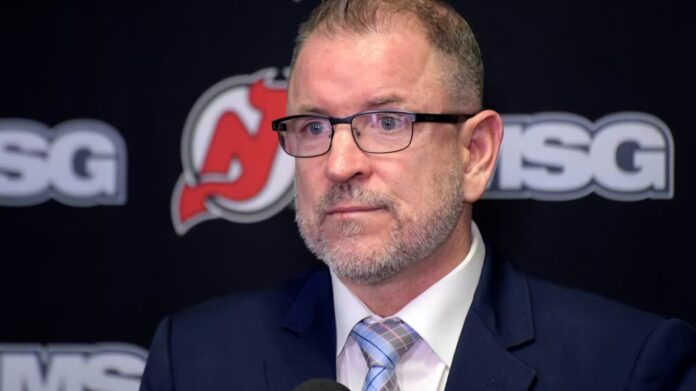

The New Jersey Devils have entered a defining period of transition following the announcement that General Manager Tom Fitzgerald has parted ways with the organization, a decision confirmed by Managing Partner David Blitzer. The move, executed with one year remaining on Fitzgerald’s contract, immediately reshapes the leadership structure of the franchise and signals a broader recalibration of direction at one of the most consequential moments in the team’s recent history. As developments continue to unfold, the implications extend well beyond a single front office change, placing the Devils squarely at the center of league-wide attention and reinforcing the importance of this moment within the evolving narrative covered across Explore New Jersey’s New Jersey Devils platform.
The timing of the decision is notable. While speculation around front office changes often builds gradually, this move arrives with a level of immediacy that reflects both internal urgency and external pressure. Across the league, multiple organizations are actively evaluating or restructuring leadership positions, creating a competitive environment for executive talent. By acting now, the Devils position themselves within that broader landscape rather than reacting after key candidates have already been secured elsewhere.
Fitzgerald’s tenure presents a complex and layered evaluation. When he assumed the role of general manager, the franchise was in a transitional phase, working to establish a sustainable competitive identity. Early results suggested forward momentum, highlighted by a franchise-record season in 2022–23 that positioned the Devils as one of the league’s most promising young teams. That period reflected a roster built around speed, offensive creativity, and a core of emerging talent capable of competing at a high level.
However, the seasons that followed introduced inconsistency and structural challenges that ultimately defined the latter part of Fitzgerald’s tenure. Strategic shifts in roster construction, particularly attempts to balance a high-tempo offensive core with contrasting stylistic elements, produced uneven results. The team’s identity, once clearly defined, became less consistent, leading to stretches of play that did not fully leverage the strengths of its top players.
Goaltending decisions also became a focal point of evaluation. The extension of Jacob Markstrom to a two-year, $12 million deal, executed well in advance of free agency, reflected a proactive approach but also introduced questions regarding timing, allocation of cap space, and long-term planning. Performance metrics throughout the season did not consistently align with expectations, placing additional scrutiny on front office decision-making.
Personnel management across the roster further contributed to the overall assessment. Fitzgerald demonstrated effectiveness in select areas, particularly within the trade market, where acquisitions such as Timo Meier, Jonas Siegenthaler, and Jake Allen added value to the lineup. At the same time, other transactions and roster decisions created challenges in both depth and flexibility, including the management of forward group composition and the long-term impact of certain contracts.
Drafting and development remain central to the evaluation of any general manager, and in this area, the Devils’ trajectory reflects both inherited strengths and ongoing questions. Core players such as Nico Hischier, Jack Hughes, and Jesper Bratt—integral to the team’s current identity—originated from prior organizational leadership, while Fitzgerald’s influence is more prominently reflected on the defensive side of the roster. The balance between developing internal talent and supplementing through external acquisition became a defining element of his tenure.
The decision to part ways now opens the door to a broader structural reassessment within the organization. One of the immediate considerations is whether the Devils will maintain a unified leadership model or separate the roles of General Manager and President of Hockey Operations. This distinction carries strategic significance, as it determines how decision-making authority is distributed and how accountability is structured moving forward.
Equally important is the evaluation of internal operations beyond the general manager position. Front office transitions often trigger a comprehensive review of scouting, analytics, player development, and organizational alignment. The effectiveness of these interconnected systems plays a critical role in sustaining long-term competitiveness, and the Devils now have an opportunity to reassess each component within a unified strategic framework.
From a roster perspective, the foundation remains intact. The Devils continue to possess a core of high-skill players capable of driving performance, and recent stretches of play—particularly following adjustments to a more aggressive, transition-focused offensive approach—have demonstrated the team’s potential when operating within its strengths. The challenge for new leadership will be to refine that identity, ensuring that roster construction, coaching strategy, and player development operate in alignment.
Within the broader context of New Jersey’s sports landscape, this moment carries significant weight. The Devils are not simply navigating a leadership change; they are redefining their trajectory at a time when expectations remain elevated. The organization’s ability to respond with clarity, decisiveness, and strategic vision will determine how quickly it can transition from uncertainty to stability.
As the search for new leadership begins, the Devils enter a competitive environment where multiple franchises are pursuing similar objectives. Identifying a candidate capable of integrating analytics, traditional scouting, and modern roster construction principles will be essential. Just as critical will be the ability to establish a clear organizational identity—one that aligns personnel decisions with on-ice performance and long-term sustainability.
For fans and observers across New Jersey, this development marks the beginning of a new chapter rather than the conclusion of the previous one. The departure of Tom Fitzgerald closes a period defined by both progress and inconsistency, while opening the door to a recalibrated vision for the franchise. The decisions made in the coming weeks will shape not only the immediate future of the Devils but also their position within the league for years to come, making this one of the most consequential transitions in the organization’s modern era.