
The New Jersey Devils are entering a critical phase of the 2025–26 NHL season, and the margin for error has effectively disappeared. Following a 4–1 loss to the New York Rangers on March 31, the Devils now sit at 38–34–2, positioned seventh in the Metropolitan Division and currently outside the Eastern Conference playoff picture. With fewer than ten games remaining, every shift, every decision, and every result is now amplified—not just for postseason hopes, but for the broader trajectory of the franchise.
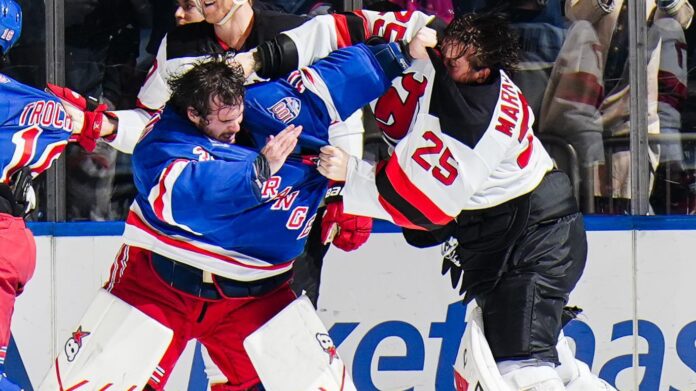
What unfolded at Madison Square Garden was more than just another loss in the standings. It was a game that encapsulated the emotional volatility, urgency, and unresolved identity of this Devils team. The rivalry between New Jersey and New York has always carried weight, but this latest chapter delivered one of the most unforgettable moments in modern NHL history: a full-fledged goalie fight between Jacob Markstrom and Igor Shesterkin. In an era where such altercations are virtually extinct, the clash marked the league’s first goaltender fight since 1995, instantly becoming a defining image of the Devils’ current state—intense, combustible, and searching for control.
The spark came after a controversial interference sequence involving Shesterkin, which escalated tensions to a breaking point. Markstrom’s decision to engage was not just about defending territory; it was emblematic of a team pushing back against adversity, frustration, and the weight of expectation. Yet beyond the spectacle, the scoreboard told the harsher truth. The Devils managed just one goal, a power-play finish from Connor Brown—his 16th of the season—while the Rangers executed with greater precision and composure.
That duality has defined New Jersey’s campaign. There are flashes of resilience, moments of high-end skill, and evidence of a roster capable of competing with anyone. But consistency has remained elusive, and in a division as unforgiving as the Metropolitan, inconsistency is the difference between contention and chasing.
The immediate path forward offers no relief. The Devils return home to Prudential Center for a trio of must-win matchups, beginning April 2 against the Washington Capitals, followed by April 4 against the Montreal Canadiens, and concluding April 12 against the Ottawa Senators. These are not just games—they are inflection points. Each opponent represents an opportunity to reclaim ground in the Wild Card race, where teams like Detroit, Philadelphia, and Washington have already established a narrow but significant cushion.
Within that context, the performance of key players becomes even more critical. Jack Hughes continues to be the offensive engine, posting 63 points in just 57 games. His recent stretch, highlighted by a surge in goal scoring throughout March, reinforces his role as one of the league’s most dynamic forwards. But the Devils’ success cannot rest on one player alone. Secondary scoring, defensive structure, and goaltending stability must align if New Jersey is to mount a credible late-season push.
Connor Brown’s contribution in the Rangers game underscores the importance of depth production. Acquired to provide veteran presence and scoring balance, Brown’s ability to convert on special teams adds a necessary layer to the Devils’ offensive identity. Meanwhile, Dawson Mercer continues to embody durability and reliability, recently setting a franchise “Iron Man” record with 402 consecutive games played—a testament to his consistency in a season defined by fluctuation.
Injuries, however, have complicated the equation. Brett Pesce’s uncertain status leaves a gap on the blue line, while Arseny Gritsyuk’s day-to-day designation offers cautious optimism but no guarantees. The confirmed absences of Stefan Noesen and Zack MacEwen further thin the roster, forcing adjustments that test both depth and adaptability. In a playoff race measured by inches, these variables carry significant weight.
Beyond the NHL roster, the organization’s development pipeline provides both encouragement and perspective. In Utica, goaltender Nico Daws has etched his name into franchise history, becoming the Comets’ all-time wins leader. His milestone, achieved through persistence and steady performance, reflects the long-term investment the Devils have made in their system. Daws’s journey—from early appearances to becoming a reliable option—illustrates the value of continuity, even as questions remain about his future with the club.
The Comets themselves mirror the Devils’ situation in many ways. Sitting just outside playoff contention in the AHL North Division, they are also navigating a late-season push that may ultimately fall short. Strong performances from prospects like Topias Vilen, Cam Squires, and Matyas Melovsky highlight the emerging talent within the system, but the timeline for impact at the NHL level remains a key consideration for management.
And it is at the management level where perhaps the most consequential questions are beginning to surface. Speculation surrounding a potential restructuring of the front office—specifically the possibility of separating the roles of President of Hockey Operations and General Manager—signals that ownership may be evaluating the organization’s direction with increasing scrutiny. Tom Fitzgerald’s tenure has delivered both promise and inconsistency, and the decision to potentially bring in additional leadership while retaining him as GM would reflect a measured, transitional approach rather than a full reset.
For fans and analysts following the team through Explore New Jersey Devils coverage, the narrative is becoming clearer. This is not simply a team fighting for a playoff spot—it is a franchise at a crossroads. The core is talented, the pipeline is active, and the market is energized. But translating those elements into sustained success remains the challenge.
The remaining games will determine more than postseason qualification. They will shape perception, influence decision-making, and define the tone heading into the offseason. A late surge could validate the current structure and reinforce belief in the roster. A continued slide, however, would intensify calls for change and accelerate discussions about the team’s long-term blueprint.
What is certain is that the Devils are no longer in a position to wait for things to click. The urgency is immediate, the stakes are tangible, and the spotlight is unrelenting. From the chaos of a historic goalie fight to the quiet consistency of a franchise Iron Man, from the rise of prospects in Utica to the uncertainty in the front office, every layer of the organization is now part of the same story.
And as the Devils take the ice in Newark for this defining stretch, the question is no longer whether they have the pieces. It is whether they can bring them together in time to matter.