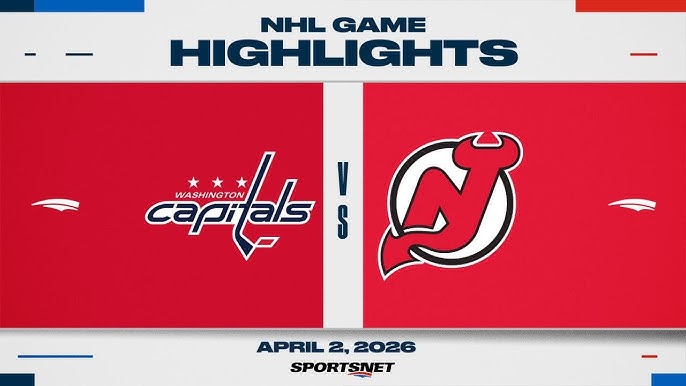

The New Jersey Devils may have entered Thursday night searching for a response, but what unfolded at Prudential Center on April 2, 2026, was something far more emphatic—a statement performance that reestablished their offensive identity, reignited belief inside the locker room, and injected real tension back into the Eastern Conference playoff race. In a commanding 7–3 victory over the Washington Capitals, the Devils didn’t just win—they overwhelmed, dictated, and reminded everyone exactly what this roster is capable of when it plays with pace, precision, and purpose.
At the center of the explosion was Jack Hughes, who delivered one of the most dominant individual performances of the NHL season. With two goals and three assists, Hughes orchestrated the Devils’ attack with elite-level control, turning every shift into a threat and every possession into opportunity. Jesper Bratt matched that production with a five-point night of his own, reinforcing the reality that when this duo is fully engaged, the Devils’ offensive ceiling rivals any team in the league. Dawson Mercer added two goals, capitalizing on the momentum created by the top line and reinforcing the kind of secondary scoring that becomes essential as the postseason approaches.
This was not simply a high-scoring game—it was a complete offensive takeover, executed with structure and confidence. The Devils attacked in waves, stretched the Capitals’ defensive coverage, and forced breakdowns that translated directly into goals. More importantly, they did so in a game that carried real implications. Washington entered the night firmly in the playoff mix, and the Devils’ victory didn’t just boost their own position—it directly disrupted a competitor’s path forward.
As of April 3, 2026, the Devils sit at 39-34-2 with 80 points, positioned seventh in the Metropolitan Division. On paper, that placement still leaves them outside the traditional playoff cutoff. In reality, however, the context tells a different story. A 7-3-0 record over their last ten games signals a team trending upward at precisely the right moment. The win over Washington is not an isolated result—it is part of a broader shift in performance that suggests the Devils are far from finished in this race.
Goaltender Jake Allen provided stability behind the offensive surge, stopping 29 shots and delivering the kind of composed performance that allows an aggressive team to play freely. His presence, alongside Jacob Markström, continues to fuel discussion about the organization’s long-term strategy in net. What is becoming increasingly clear is that the Devils have the foundation of a reliable tandem—something that has eluded them in previous seasons and often defined their inconsistency.
Yet even in the wake of a dominant win, the broader picture surrounding the Devils remains complex. The team is navigating a difficult injury landscape, with Arseny Gritsyuk, Stefan Noesen, and Zack MacEwen all sidelined for the remainder of the season, while Brett Pesce continues to deal with a lower-body issue. These are not minor absences—they are structural losses that impact depth, physicality, and lineup flexibility. That the Devils are producing at this level despite those setbacks only reinforces the underlying talent within the roster.
The front office has also been active in shaping the current iteration of the team. March acquisitions Maxim Tsyplakov and Nick Bjugstad were clear signals that management recognized the urgency of the moment and sought to reinforce the lineup for a late push. At the same time, speculation surrounding Dougie Hamilton’s future introduces another layer of uncertainty, with offseason trade conversations already beginning to circulate. This is a team in motion, balancing present ambition with long-term decision-making.
And that tension—between what the Devils are now and what they could be—sits at the core of the conversation surrounding this franchise. Because as impressive as Thursday’s performance was, it also raises a larger question: why has this level of urgency not been more consistent?
Across the NHL, few organizations embody urgency more aggressively than the Vegas Golden Knights. Their willingness to make immediate, sometimes ruthless decisions—whether it involves coaching changes, roster moves, or strategic pivots—has defined their identity since entering the league. It is a model built on a simple principle: if something is not working, it is changed without hesitation.
The Devils, by contrast, have often operated with a more measured approach, one that prioritizes patience and continuity but has at times drifted into stagnation. The difference between those philosophies is not theoretical—it is visible in the standings, in playoff appearances, and ultimately in championships. For a Devils team that has shown flashes of elite capability, the question is no longer whether the talent exists. It is whether the organization will consistently match that talent with the same level of urgency displayed by the league’s most aggressive contenders.
Thursday night offered a glimpse of what happens when everything aligns. The speed was there. The execution was there. The confidence was undeniable. It is the version of the Devils that fans have been waiting to see—not in isolated bursts, but as a sustained identity.
And the timing could not be more critical. The upcoming schedule presents both opportunity and pressure, with matchups against the Montreal Canadiens, Philadelphia Flyers, and Pittsburgh Penguins set to define the final stretch of the season. Each game carries weight, not just in terms of points but in shaping the narrative of whether this team can convert potential into results when it matters most.
For New Jersey, hockey is not just a sport—it is part of the state’s cultural fabric, woven into a broader landscape of live entertainment, community engagement, and shared experience. That same energy extends across the region’s theaters, arenas, and performance spaces, where audiences gather for moments that resonate beyond the event itself. Those looking to explore more of what the state has to offer, from live performances to major events, can find a wide range of experiences through Explore New Jersey’s theatre coverage, where the spirit of live entertainment continues to thrive.
What the Devils delivered against Washington was not just a win—it was a reminder. A reminder of their offensive firepower. A reminder of their ability to control a game from start to finish. And perhaps most importantly, a reminder that the difference between falling short and making a run often comes down to urgency, execution, and belief.
The pieces are in place. The window is still open. The question now is whether the Devils will continue to play like a team chasing something—or finally become one that expects to take it.