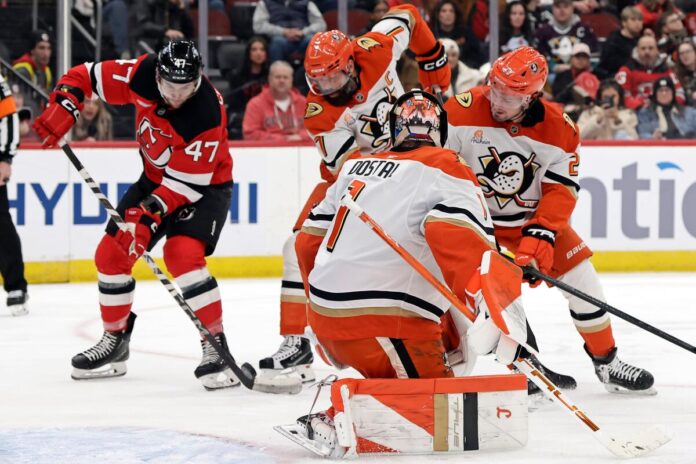

The New Jersey Devils arrived at Saturday’s afternoon matchup against the Anaheim Ducks facing a familiar obstacle this season: adversity. With a depleted lineup, mounting injuries, and lingering questions following recent uneven performances, expectations were cautious. What followed instead was one of the Devils’ most complete and disciplined efforts in weeks, a 4–1 victory that showcased structure, commitment, and a renewed sense of purpose at Prudential Center.
From the opening faceoff, New Jersey played with urgency and clarity. The Devils established their forecheck early, disrupted Anaheim’s breakout, and controlled the pace far more effectively than in recent outings. Despite missing several regular contributors, the lineup on the ice showed cohesion, with lines supporting each other through the neutral zone and defenders making quicker, cleaner decisions with the puck.
The first period set the tone. New Jersey generated sustained offensive pressure without sacrificing defensive responsibility, limiting Anaheim’s ability to counterattack. The Devils’ opening goal came as a reward for that persistence, created not by a highlight-reel rush but by winning battles along the boards and funneling pucks to high-danger areas. It was the type of goal that reflects buy-in rather than individual brilliance.
Perhaps most encouraging was how the Devils managed the middle of the ice. Anaheim entered the game with speed and skill capable of exploiting defensive gaps, but New Jersey consistently collapsed into shooting lanes and forced the Ducks to the perimeter. That structure carried through all three periods, preventing Anaheim from building momentum even when trailing.
Goaltending, an area that has drawn scrutiny throughout the season, was quietly effective. The Devils’ netminder delivered a calm, composed performance, making timely saves and handling rebounds efficiently. While Anaheim did manage to break through once, the response from New Jersey was immediate. There was no visible sag in confidence, no extended defensive-zone scramble. Instead, the Devils pushed back, reclaiming control and extending their lead shortly after.
Offensively, the Devils spread the production across the lineup. Secondary scoring played a key role, easing the burden on top-line forwards and underscoring the importance of depth, especially with regulars sidelined. The power play showed improved puck movement and patience, while at even strength, New Jersey capitalized on turnovers and transition opportunities without forcing plays that were not there.
The Ducks, to their credit, competed hard and attempted to push back in the third period. But New Jersey remained disciplined, closing gaps quickly and exiting the zone with purpose. The final goal of the afternoon served as a fitting punctuation mark, effectively sealing the outcome and drawing a strong response from the home crowd.
Beyond the scoreline, the most notable takeaway was the Devils’ collective approach. This was not a performance driven by one player taking over the game; it was a group effort rooted in accountability and execution. With so many injuries testing organizational depth, the response spoke to preparation and internal standards.
As the season continues, consistency remains the challenge. However, performances like this provide a template for success: structured defense, balanced scoring, and steady goaltending. For a team navigating constant lineup changes, that identity may be the most valuable asset moving forward.
Fans following the club’s progress can find expanded coverage, analysis, and updates throughout the season in Explore New Jersey’s dedicated New Jersey Devils section, where this performance stands out as a reminder of what the Devils are capable of when process meets effort.
Midday Reset today at the Rock when the Devils Look to Steady Themselves Against Anaheim. An early puck drop at Prudential Center offers the New Jersey Devils an immediate chance to stop the bleeding and reset the tone of their season. Sunday’s 12:30 p.m. matinee against the Anaheim Ducks arrives less than 48 hours after a night many around the fanbase would prefer to forget, and it presents a familiar crossroads for a team still searching for consistency.

New Jersey enters the matchup at 17-13-1, a record that reflects flashes of promise but also prolonged stretches of uneven play. Anaheim, meanwhile, comes to Newark at 19-11-1, carrying a stronger mark in the standings but also coming off a loss that exposed some vulnerabilities. As the Devils continue to navigate injuries, goaltending questions, and lineup instability, games like this take on added weight. Coverage of the team’s broader trajectory and season-long developments can be found in Explore New Jersey’s ongoing New Jersey Devils coverage.
The Devils are still trying to process what unfolded Thursday night against Tampa Bay, when defensive breakdowns and shaky goaltending combined to produce an 8-4 loss that got away almost immediately. New Jersey surrendered multiple goals in rapid succession early, forcing head coach Sheldon Keefe to make a rare and early goaltending change. Jacob Markstrom was pulled less than four minutes into the game after allowing three goals on seven shots, and while the switch to Jake Allen briefly stabilized things, the end result remained the same. The Devils never truly recovered their structure, and Tampa Bay continued to find open ice and high-danger chances throughout the night.
Offensively, there were moments that hinted at life. Luke Hughes found the back of the net early to inject some optimism, and Jesper Bratt finally snapped a lengthy scoring drought with a power-play goal. Paul Cotter, Stefan Noesen, Cody Glass, and Angus Crookshank also chipped in, with Crookshank recording his first goal of the season. Still, any positives were overshadowed by defensive lapses and special teams struggles, particularly a penalty kill that allowed multiple goals and erased the value of the Devils’ lone power-play conversion.
Anaheim’s most recent outing was far less chaotic but no less frustrating. The Ducks fell 5-2 to the Islanders after surrendering three goals in the opening period, two of which came on the power play. Anaheim managed to claw within one midway through the game, but New York pulled away late. That loss snapped a three-game winning streak and highlighted an issue the Ducks have dealt with intermittently this season: slow starts that force them to chase games.
One of the more intriguing storylines surrounding Anaheim is in goal. Ville Husso has quietly become a workhorse, starting eight consecutive games in an era when few teams rely so heavily on one netminder. His workload suggests confidence from the coaching staff, and if that trend continues, the Devils can expect to see him again in Newark. Husso has been steady, if not spectacular, and his ability to manage rebounds and control traffic will be tested by a New Jersey team that often generates volume but struggles with finishing.
Injuries remain a familiar obstacle for the Devils. Arseny Gritsyuk is the latest addition to the list and will miss both weekend games after attempting to play through an existing issue. The status of Timo Meier continues to loom large, though there is little indication he will return in the immediate term. Cody Glass and Stefan Noesen, who missed practice, are expected to be available, offering some stability to a forward group that has been frequently reshuffled.
Goaltending remains the most scrutinized area. Markstrom’s numbers have dipped to the bottom tier of the league, and his confidence appears shaken. Allen, while not immune to rough outings, has generally provided more reliable stretches this season and owns metrics that suggest league-average performance. The decision on who starts will carry significance, not only for Sunday’s result but for how the Devils manage the position moving forward.
Sunday’s matchup is less about the opponent and more about New Jersey’s response. The Ducks are a capable team with speed, depth, and improving structure, but they are also beatable if pressured early and forced into mistakes. For the Devils, the mandate is simple but far from easy: tighten defensive coverage, limit special teams damage, and translate puck possession into meaningful chances.
With a midday crowd, a home rink, and little time to dwell on the previous loss, the Devils have an opportunity to show resilience. Whether they seize it will say a great deal about where this season is heading as the calendar turns deeper into winter.