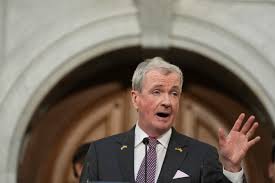

As Governor Phil Murphy approaches the close of his second and final term, New Jersey finds itself at a political inflection point defined by legacy, transition, and the early shape of contests still to come. After eight years in office, Murphy is preparing to step away having overseen wide-ranging policy shifts in public health, education funding, and economic development, even as Democratic leaders across the state begin consolidating support ahead of pivotal congressional races.
Murphy has often described the governorship as the opportunity of a lifetime, and his final months in office reflect an administration eager to frame its record in concrete outcomes rather than rhetoric. Among the most ambitious initiatives of his tenure has been the state’s push to dramatically curb HIV transmission. Launched in 2018 with a goal of effectively ending the epidemic by 2025, the effort expanded rapidly in its final phase. By the end of 2025, New Jersey had authorized more than 50 harm reduction centers statewide, collectively serving over 11,800 residents during the year alone—more than double the reach of the previous year. The strategy paired access to testing and treatment with a broader public health infrastructure designed to ensure early diagnosis and long-term viral suppression. In early 2025, Murphy reinforced that approach through executive action, creating a permanent council to coordinate HIV-related policy across public agencies, hospitals, and nonprofit partners.
Education has been another defining pillar of Murphy’s legacy. His final budget completed the long-promised full funding of the School Funding Reform Act, closing a seven-year phase-in and delivering nearly $12 billion in direct K–12 aid. That figure represents a multibillion-dollar increase since Murphy took office and has been central to his administration’s argument that New Jersey now stands as a national model for equitable school funding. Early childhood education also saw substantial expansion, with preschool funding rising by more than half a billion dollars during Murphy’s tenure and tens of thousands of new seats added across hundreds of districts. In early 2025, the state also eliminated a long-criticized basic skills test for aspiring teachers, a move aimed at easing staffing shortages while maintaining professional standards.
On the economic front, Murphy’s closing argument centers on wage growth and investment in future-facing industries. The statewide minimum wage climbed steadily during his two terms, reaching $15.49 per hour in 2025 after starting below $9 when he took office. At the same time, the administration launched major incentive programs targeting advanced manufacturing and STEM-driven employers, including a half-billion-dollar tax credit initiative designed to keep New Jersey competitive in a rapidly evolving economy. With voters having selected U.S. Representative Mikie Sherrill as the state’s next governor, Murphy has spent recent weeks quietly transitioning responsibilities ahead of her January 2026 inauguration, while allowing himself the rare luxury of planning time away from Trenton.
That transition at the top has already reshaped the political landscape down-ballot. In Morris County, Democratic leaders have moved quickly to rally behind a familiar figure as they prepare for a special congressional election. Former U.S. Representative Tom Malinowski, who previously served portions of Morris County while representing the Seventh Congressional District, emerged as the clear favorite of county Democrats seeking to fill Sherrill’s soon-to-be-vacant seat in the Eleventh District.
County committee members gathered this week to hear from a crowded field of a dozen candidates before casting ballots using a ranked-choice system. The outcome was decisive. Malinowski led every round of voting and finished with the backing of roughly 52 percent of participants, a commanding showing in such a large field. Brendan Gill followed with just under 30 percent support, while Analilia Mejia placed third at approximately 18 percent. For many observers, the vote confirmed what had already been widely assumed: that the contest is likely to narrow quickly into a two-candidate race.
The results were less encouraging for other Morris County contenders, including Morris Township Deputy Mayor Jeff Grayzel and Chatham Borough Councilman Justin Strickland, neither of whom gained meaningful traction. Questions about Malinowski’s current residency within the district appeared to have little impact on the outcome. Although he does not presently live in the Eleventh District, Malinowski has indicated he intends to relocate, and the issue failed to sway the 461 Democratic committee members who cast votes.
Storm Recovery Sparks Clash Between Trenton and Washington at the Jersey Shore. A new political dispute has emerged over the future of storm recovery along the Jersey Shore, with Congressman Jeff Van Drew accusing Governor Phil Murphy of allowing partisan considerations to interfere with urgently needed aid for coastal communities.
Van Drew, who represents New Jersey’s Second Congressional District, says Shore towns are still grappling with erosion, infrastructure damage, and lingering economic fallout from recent severe weather, yet state-level action has been slower than necessary. According to the congressman, funding and approvals that could accelerate recovery efforts are being delayed, leaving local governments and small businesses in limbo at the height of planning season for tourism-dependent communities.
The accusation places Governor Murphy squarely at the center of a debate that blends disaster response with broader political tensions. Van Drew argues that beach replenishment projects and coastal protection initiatives should be treated as nonpartisan necessities, particularly for regions where tourism revenue supports entire local economies. In his view, the Shore’s needs should transcend party lines, especially as municipalities prepare for another busy summer with infrastructure still compromised in some areas.
Murphy’s administration, however, has consistently framed its approach as fiscally responsible and methodical, emphasizing long-term resilience over short-term fixes. State officials have pointed to the complexity of coordinating federal, state, and local funding streams, as well as environmental permitting requirements that govern coastal projects. They maintain that decisions are being made based on planning and sustainability rather than political leverage.
The public exchange highlights a recurring fault line in New Jersey politics: how quickly aid should flow after storms, and who controls the narrative around recovery. Shore communities have long been caught between competing priorities—economic urgency on one side and regulatory oversight on the other. For mayors and county officials along the coast, the concern is less about who scores political points and more about whether beaches, boardwalks, and protective dunes will be ready in time to support local livelihoods.
Van Drew’s criticism also reflects his broader positioning as an advocate for South Jersey and coastal interests, frequently framing Trenton as distant from the day-to-day realities of Shore towns. By taking direct aim at the governor, he is tapping into frustrations among residents who feel the recovery process moves too slowly and lacks transparency.
At the same time, Murphy’s allies note that New Jersey has invested billions in coastal resilience over the past several years, arguing that sustained planning is the only way to reduce repeated storm damage. They caution that rushing projects without comprehensive review could leave communities vulnerable to future disasters, potentially compounding costs over time.
As hurricane seasons grow more unpredictable and climate concerns intensify, disputes like this one are likely to become more common. The question facing New Jersey is whether leaders can bridge partisan divides to deliver timely assistance while also preparing the Shore for long-term challenges. For readers following the evolving debate over disaster relief, governance, and accountability in the Garden State, ongoing coverage is available through Explore New Jersey’s politics section.
Together, these developments underscore a broader moment of recalibration for New Jersey Democrats. As Murphy exits the stage after reshaping state policy across multiple fronts, party leaders are simultaneously working to maintain continuity and leverage experience in federal races that will draw national attention. For ongoing coverage of statewide races, policy debates, and leadership transitions, readers can follow Explore New Jersey’s dedicated section on state and national politics.