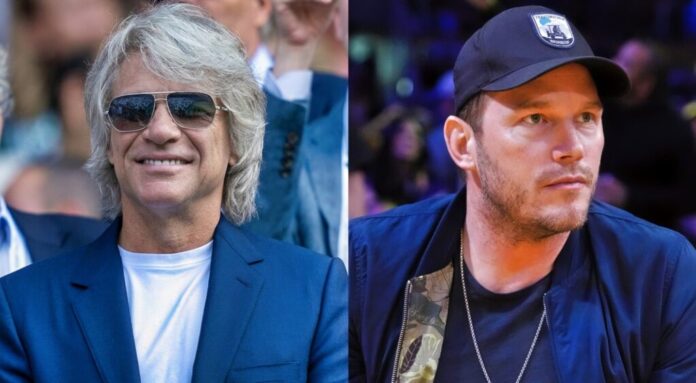

For a brief, electric moment before kickoff at Super Bowl LX on Sunday night, the spotlight wasn’t on a quarterback, a coach, or a Hall of Fame broadcaster. It belonged to a New Jersey icon.
As the New England Patriots gathered at the mouth of the tunnel and the stadium settled into a roar that only the Super Bowl can generate, Jon Bon Jovi stepped forward and introduced the team to the world—live, in real time, and on the largest television stage in American sports. On February 8, 2026, one of New Jersey’s most recognizable cultural figures quite literally gave the Patriots their voice.
The moment landed with immediate weight. Bon Jovi’s announcement marked the franchise’s entrance into Super Bowl LX and formally signaled how dramatically the NFL’s presentation of its biggest event has evolved. Once defined by legendary broadcast calls and network polish, the league’s modern team introductions now center on celebrity superfans—high-profile cultural ambassadors whose personal ties to franchises add emotional credibility to the spectacle.
For New England, the choice was not symbolic. It was personal.
Bon Jovi’s relationship with the Patriots is not a casual celebrity fandom. It is a long-running, deeply rooted bond shaped by years of access, friendship, and shared history inside the organization. His connection to owner Robert Kraft has quietly placed him inside the inner circle for decades, while his rapport with former head coach Bill Belichick has made him a familiar presence in spaces most fans never see.
Tonight’s introduction wasn’t a cameo. It was the culmination of a relationship that has grown alongside the Patriots’ modern dynasty.
From the opening syllables of his announcement, the moment carried a layer of irony that only New Jersey sports fans could fully appreciate. Bon Jovi is, and always will be, a Jersey original. His music, philanthropy, and public identity are inseparable from the state that shaped him. Yet on football’s biggest night, his voice represented Foxborough, not the Meadowlands.
In many ways, this has been a long time coming.
Within Patriots circles, Bon Jovi’s presence has become so familiar that it barely registers anymore. He has been a regular on the sidelines and at training camp practices for years, often staying long enough to be mistaken for part of the football operation itself. Team insiders have quietly noted that his access has extended well beyond casual meet-and-greets. He has been seen watching film with staff, spending time inside coaches’ offices, and holding long, low-key conversations with Belichick during the height of New England’s championship run.
That unusually close relationship became something of folklore among fans and beat reporters alike.
It is not uncommon, even now, for spectators at Gillette Stadium to glance up at the owner’s box and notice a familiar figure standing next to Kraft—hoodie pulled tight, sunglasses on, blending into the background with almost intentional anonymity. Longtime Patriots fans joke that if you spot someone quietly leaning on the rail beside the owner, there is an overwhelming chance it’s Bon Jovi.
His integration into the franchise’s culture reached its most visible point during the 2017 season, when his song “This House Is Not for Sale” became an unofficial soundtrack for the team. The message of resilience and defiance resonated inside the building during a defining stretch of the Patriots’ post-dynasty transition, and Bon Jovi later appeared at the Super Bowl LI ring ceremony, reinforcing just how embedded he had become in the organization’s identity.
That history is what gave tonight’s introduction its emotional credibility.
This was not a celebrity lending star power to a football broadcast. It was a longtime insider stepping forward to represent a franchise he has quietly supported through multiple eras of leadership, locker room turnover, and postseason runs.
The NFL, however, has been moving steadily in this direction.
Once upon a time, team introductions at the Super Bowl were the domain of broadcast legends. Patriots fans still remember when Pat Summerall delivered the franchise’s first full-team introduction during their early championship rise in 2002, lending his unmistakable voice to a moment that helped define the dynasty’s public identity.
In the modern Super Bowl era, the league has intentionally shifted that responsibility to recognizable cultural figures whose loyalty to teams extends beyond marketing.
Bon Jovi’s appearance tonight is part of a wider, deliberate trend.
Earlier this evening, actor Chris Pratt took on the same role for the Seattle Seahawks, introducing the NFC champions moments before their own tunnel entrance. The pairing—Bon Jovi for New England and Pratt for Seattle—underscored how the league now frames its biggest pregame moments around narrative and personality as much as tradition.
That approach follows directly from last season’s championship game, when Bradley Cooper and Jon Hamm introduced their respective teams in a move that signaled the NFL’s full embrace of celebrity superfans as ceremonial anchors for Super Bowl broadcasts.
The league has discovered that fans respond to authenticity. A recognizable voice means more when it belongs to someone who genuinely lives within the orbit of the franchise.
For Bon Jovi, the irony remains unavoidable.
Despite growing up in New Jersey and spending his life championing the communities and causes of his home state, his football allegiance quietly shifted years ago. The Giants and Jets, geographically closer and historically tied to the state’s fan base, never truly became his professional home. Instead, Bon Jovi found his football family north of the border in Foxborough, where relationships—not geography—cemented his loyalty.
For New Jersey sports culture, the moment lands as both a point of pride and a reminder of how intertwined regional identity and professional fandom have become. The Garden State may not have its own NFL franchise, but its influence continues to echo through the league’s most visible personalities, players, and cultural figures. That ongoing connection to the sport is explored regularly through coverage of New Jersey’s evolving football landscape, including features and reporting found throughout Explore New Jersey’s dedicated football coverage.
Beyond the introductions, Super Bowl LX has leaned fully into the modern fusion of entertainment and professional football.
The halftime show tonight features Bad Bunny as the headlining act, making history as the first solo Spanish-language artist to lead the Super Bowl’s marquee performance. The selection reflects the league’s continued push to expand its cultural footprint and global relevance, especially among younger and international audiences.
The pregame ceremony set the tone long before Bon Jovi stepped to the microphone. Green Day opened the festivities with a high-energy medley of their signature hits, bringing arena-level intensity to the opening moments of the broadcast. Charlie Puth followed with a performance of the national anthem, delivering a stripped-down, vocal-forward rendition of “The Star-Spangled Banner” in front of a worldwide audience. Brandi Carlile took the stage for “America the Beautiful,” while Coco Jones performed “Lift Every Voice and Sing,” rounding out one of the most stylistically diverse pregame lineups in Super Bowl history.
The halftime production itself is being presented by Roc Nation in partnership with Apple Music and is scheduled to begin roughly between 8:00 and 8:30 p.m. Eastern Time, depending on the length and flow of the first half.
Yet for New England fans—and for New Jersey viewers watching one of their own command the stage—the emotional center of the night arrived before a single snap was taken.
When Bon Jovi introduced the Patriots just moments ago, he did more than announce a roster. He bridged two worlds that rarely overlap so cleanly: the cultural legacy of a Jersey-born rock star and the competitive mythology of one of the NFL’s most influential franchises.
In a league increasingly driven by storylines, visibility, and personality, his voice carried something deeper than celebrity recognition. It carried history, familiarity, and genuine connection.
For a few charged seconds, the roar of the crowd, the glare of the cameras, and the weight of Super Bowl tradition all passed through a microphone held by a New Jersey legend—standing at the edge of a Patriots tunnel, welcoming his adopted football family to the biggest night of their season.